Wednesday, 10 April 2013

Poland mourns Smolensk presidential plane crash victims


Warsaw is remembering the victims of the air tragedy that killed 96 passengers, including the president, first lady and most of the country's political elite. Memorial ceremonies marking the third anniversary of the crash are held in Poland.

Thousands of people gather near the Presidential Palace in central Warsaw to commemorate the victims of the plane crash, among which were President Lech Kaczynski and other members of a high-profile Polish delegation.

The late Polish president's twin brother Jaroslaw Kaczynski attends the memorial event at the military cemetery in Povonzkah, where a monument to the victims of the tragedy has been erected.

Prime Minister Donald Tusk lays flowers at the memorial in the military cemetery.

“I believe the day when this sad, tragic anniversary of the Smolensk plane crash won’t separate Polish people will come and we’ll be able to pray and think without negative emotions,” Tusk says.

At 8:41am local time, the moment when the delegation’s plane crashed, the ceremony begins.

Jaroslaw Kaczynski also joined the ceremony to lay flowers on the memorial installed outside the Palace.

Last year a Polish delegation of the crash victims' relatives and officials took part in the commemoration service at the site of the tragedy, near Smolensk. A minute of silence was held at 8:41 am local time, marking the moment of the crash.

On April 10, 2010, a high-profile Polish delegation was flying to western Russia to pay tribute to the victims of the 1940 Katyn forest massacre in which thousands of Polish officers were murdered and executed by Stalin's secret police around 14 kilometers west of the city of Smolensk.

The plane never reached its destination. The tragedy soured already strained relations between Russia and Poland.

Separate investigations were carried out by the two countries. Bad weather and dubious decisions by the crew were blamed by both expert commissions. It turned out that the personnel were warned of heavy fog and low visibility and asked to reroute to a different airport, but decided to land regardless of the poor weather conditions.

Warsaw’s official position has coincided with that of Moscow. Thorough investigation has confirmed that the crew committed a number of appreciable errors performing the landing in Smolensk.

On top of this, it’s believed psychological pressure was exerted on the pilots by some of the high-ranking officials on board also contributed to the crew's fatal decision to land.

Transcripts from the plane’s "black box" revealed that the pilots were in a hurry to land, on the insistence of an unknown person on-board who said he would “go crazy” if they chose not to.

The recording also showed that a certain influential official had entered the cockpit numerous times throughout the flight, while Poland’s Chief of the Air Force was present in the cockpit at the time of the crash.

The investigation was set back due to the suicide of a key witness just before testimony.

In October, flight engineer Remigiusz Muś, 42, set to deliver critical testimony in the Polish parliamentary investigation into the plane crash, as one of two key witnesses in the case, was found dead in his house in Warsaw after committing suicide.

His testimony contradicted the official version, which said that the traffic controller only allowed the airplane to descend to 100 meters. The engineer claimed he overheard a Russian air traffic control officer allowing descent to a ‘landing decision’ height of 50 meters.

His suicide became the second incident connected to the investigation of the plane crash as earlier a Polish prosecutor involved in the investigation shot himself during a media briefing in January 2012.

Last year, in March, Poland’s Supreme Chamber of Control released its final report on the accident, according to which Kaczynski's plane was not even authorized to carry out the flight.

Smolensk airport was not listed as an active facility for the presidential flight. The head of the chamber Yatsek Yazersky pointed out that landing there should have been done only after a test flight, which never took place.

While hundreds of thousands of Poles were deeply shaken by the tragedy, some tried to use it to advance their political ambitions.

Despite the hard evidence and eyewitness accounts supporting the investigation, some political forces in Poland have pointed the finger at Russia.

Polish right-wing parties made an attempt to use the Smolensk crash to score points in their presidential and parliamentary campaigns. Their failure to win votes with anti-Russian rhetoric later proved their line had nonetheless failed to reflect the general mood of the Polish people.

Meanwhile, Nationalist Law and Justice party leader Jaroslaw Kaczynski has repeatedly claimed that the tragic death of his brother might not have been an accident, accusing Moscow of killing his brother.

“If there were explosions [on-board the plane], if this catastrophe looks increasingly like an assassination, then this means there is a new quality to international politics,” Kaczynski was quoted as saying.

On the eve of the second anniversary of the presidential plane crash, Jaroslaw Kaczynski’s supporters rallied in front of the Russian Embassy in Warsaw and set fire to an effigy of Vladimir Putin, also claiming the tragedy was an assassination.

On Wednesday, in Smolensk memorial services are to start at 9:00am to commemorate the death of the Polish President and a swath of the Polish military and political elite.

Several Polish officials, including the head of the Prime Minister’s office, Interior Minister and Defense Minister, are expected to visit the memorial ceremony at the site of the crash in Smolensk.

The two countries have long been discussing the details of construction of the monument in Smolensk. Russia had provided Poland the topographic and geological information about the crash site and its surroundings needed for a monument to be designed.

This week Poland has announced that the Smolensk memorial area will occupy 1,219 square meters. According to the Polish Ministry of Culture and National Heritage plan, the monument will be in a form of a 115-meter-long and 2.2-meter-high red granite wall with the names of the victims on it.

“We hope our cooperation will intensify, and allow us to do everything possible to build a memorial to mark the site of this terrible tragedy, that could become a symbol of solidarity between our two nations,” Russia’s foreign minister Sergey Lavrov said last year. “This is our common goal.”

Wednesday 10 April 2013

http://rt.com/news/poland-mourns-smolensk-tragedy-585/

continue reading

Pakistan: 10 people dead as coach collides with truck


Ten people were killed and 30 were injured when a Larkana-bound coach collided with a long truck on Indus Highway near Khanote Town, Jamshoro district, on Tuesday.

The deceased were identified as Shamshad Soomro, Zubeda Khawar, and Khursheed Bhatti, Ali Muhammad Chandio, Muhammad Saleem Thalho, Arif Ali Brohi, Gulzar Waryam Phulpoto, Amir Abbass, Sahib Khan Abbassi and Waryam Bhatti. The injured, including drivers of both the vehicles, were shifted to Liaquat University Hospital, Jamshoro. At least a dozen were undergoing medical treatment, five of whom are reportedly in critical condition.

Sarang Soomro, one of the injured persons, said that the driver had already lost control of the coach due to over-speeding, when it was hit by the truck.

According to the Khanote police station SHO, Ibrahim Shah, the coach tipped over several times before landing in a deep ditch.

Yar Muhammad, who lives in Sachal Goth in Karachi, was sitting on the front row seat. He said that the accident happened when the driver swerved the coach to avoid hitting carcass of a donkey which was placed on the road. “As the driver lost control, the truck coming from the opposite direction hit the rear part of the bus making it rotate before overturning on the ground.”

Many passengers, he added, were trampled by the coach as they fell outside from the windows before the coach hit the ground.

According to retired DSP Shafique Mohammad Soomro, the coach’s suspension or engine had some fault. “When we were crossing the toll plaza on the Super Highway – the highway between Karachi and Hyderabad – the coach developed some problem. Later, the driver stopped it at a workshop in Jamshoro for a brief examination.” The accident, he said, happened half an hour after they left the workshop.

Majid Ali, a passerby who stopped to help the injured, said that they found three women and six men who were dead by the time their bodies were taken out from under the coach. The accident’s impact was so severe that the coach split into two pieces and its roof detached from the body, carrying it with itself the luggage placed over it.

No FIR was registered till the filing of this report.

Wednesday 10 April 2013

http://tribune.com.pk/story/533348/fatal-accident-10-people-dead-as-coach-collides-with-truck/

continue reading

Tuesday, 9 April 2013

Survivor who lost 8 members of his family still hunting for father


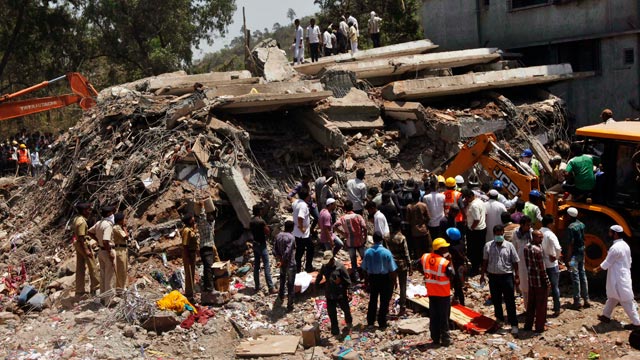
Nine bodies, which include the corpses of five minor girls, have been lying unclaimed in the morgues of Thane Civil Hospital and Chhattrapati Shivaji Maharaj Hospital (CSM) since they were brought out of the debris of the building collapse in Mumbra.

The identity of the victims is still to be revealed, as nobody has identified them as their relatives. However, Relatives, who are hunting for their kin, have said seven people are still missing. One such relative is Aamir Shaikh, who has been searching for his 64-year-old father.

Shaikh lost eight of his family members when the building collapsed. “I managed to find the bodies of my wife, seven-month-old son, nephews, niece and my mother-in-law, but my father has not been traced,” he said.

Shaikh owned a flat and a shop in the ill-fated building. “I was in my shop on the ground floor when my niece pointed a crack on the wall. I realised something was wrong and pushed my niece and a customer out, but was trapped under the debris. I was rescued and brought out after nine hours. During this period, I called my brother several times. He then informed the fire brigade that I was alive and they came looking for me. When I was pulled out, Irealised I had lost nine members of my family,” he said.

Like Shaikh, many others are still looking for their family members - some of which could be lying at the hospitals. Hospital sources say that the unclaimed bodies could be of those who may have lost all their family members.

The sources add that the bodies are beyond any recognition, making them difficult to identify.

There are six unclaimed bodies at Thane Civil Hospital and three at CSM Hospital in Kalwa. The corpses of two men, two women and two girls have been lying at Thane, while three girls lie unidentified at the Kalwa Hospital. Several people have come to identify these bodies, but none of them have been claimed.

Aunt from Karnataka to adopt ‘miracle’ baby

The eight-month-old, who lost her parents and had no one who could recognise her, in the Mumbra building collapse, will be adopted by her aunt, who lives in Karnataka.

Sources at CSM Hospital Kalwa said a social activist, who came to know that parents were looking to adopt the baby, met officials on Monday. He said the baby’s name is Zoya and her aunt, who lived in Karnataka, would be arriving in the city soon to take her back.

The official has asked the hospital sources not to hand over the baby to any children’s institutions or social activists, as she had a family where she could go.

Zoya was rescued from debris around five hours after the collapse, but she was safe while her mother in whose lap she was found had died. She was termed the ‘miracle baby’ by the media.

Tuesday 8 April 2013

http://www.mumbaimirror.com/article/2/2013040920130409085230765cc0b13e7/Survivor-who-lost-8-members-of-his-family-still-hunting-for-father.html

continue reading

Quake near Iran nuclear plant kills at least 20


A powerful earthquake has struck near Iran's Gulf port city of Bushehr, killing at least 20 people and injuring 650 but leaving Iran's only nuclear power plant intact, officials say.

Shocks from the quake were felt across the Gulf in Bahrain, Kuwait, Qatar and the United Arab Emirates, provoking panic and the brief evacuation of some office towers, residents and media said.

At least 20 bodies had been taken to the morgue in the city of Khormoj, an unnamed hospital official told Iranian state news agency IRNA.

Khormoj, east of provincial capital Bushehr, is about 35km from Kaki.

Bushehr provincial Governor Fereydoon Hasanvand said at least 650 people needed medical help.

There were no immediate details on where the casualties occurred, but the head of Iran's Red Crescent rescue corps, Mahmoud Mozafar, said it appeared at least one village near Khormoj had been razed.

Media reports said search and rescue teams had been sent to the area, where telephones and electricity had been cut.

Meanwhile, Hasanvand told state television "no damage at all has been caused" to the nuclear plant.

The facility's chief engineer, Mahmoud Jafari, told Arabic-language Al-Alam television "no operational or security protocols were breached".

The 6.1 magnitude quake hit at 4.22pm (2152 AEST) with a depth of 12 kilometres, in the area of Kaki, nearly 90km southeast of Bushehr, the Iran Seismological Centre said.

The agency has so far reported more than a dozen after shocks, the strongest at 5.3 magnitude.

The US Geological Survey ranked the quake at a more powerful 6.3 magnitude.

In Dubai, hundreds of kilometres down the Gulf from Bushehr and home to the world's tallest building, Burj Khalifa, local media reported that several high-rise buildings were briefly evacuated.

"Chandeliers were shaking," tweeted one resident.

Iran sits astride several major fault lines and is prone to frequent earthquakes.

A double earthquake struck northwest Iran last August, killing more than 300 people.

In December 2010, a big quake struck the southern city of Bam, killing 31,000.

Tuesday 9 April 2013

http://www.theaustralian.com.au/news/breaking-news/quake-near-iran-nuclear-plant-kills-20/story-fn3dxix6-1226616901309

continue reading

Aroor: Poor disaster management delays rescue


The site where the St. Augustine’s Church collapsed at Aroor on Monday could not have been more chaotic, a testimony to how ill-equipped Ernakulam and Alappuzha districts were in dealing with such a disaster.

According to standard disaster management protocol, an accident of this magnitude warranted a specialised Collapsed Structure Search and Rescue (CSSR) team, comprising personnel proficient in entering disaster sites and carrying out rescue operations. But no such team was part of the rescue operations on Monday.

A building collapse called for the same disaster management measures followed in the case of an earthquake.

At Aroor, no measures were put in place to manage crowds, with people milling around the site of the collapsed structures, hampering search and rescue operations. Continuous requests by the church authorities, through public announcement system, asking people to leave the site fell on deaf ears. More people kept coming after learning of the accident through television channels.

Police had a tough time making way for ambulances and fire tenders to the accident site. Though the police closed the church gates, a large number of people had already entered the premises. People also kept clicking images of the disaster on their mobile phones.

Local volunteers stepped in to keep the crowd away by cordoning off the area with ropes.

Even warnings about the threat of another collapse during the rescue operations did not drive the people away.

The disaster also drew attention to the absence of hand-held specialised equipment to break into concrete structures. One of the victims could be seen trapped under a fallen structure but could not be pulled out for want of proper equipment. The medical team was unable to administer first aid to him.

Lacunae

The use of excavators, as witnessed at the site, posed a real danger of bringing down the existing structures as well. The accident once again highlighted the lacunae in structural safety, said S. Suresh, a structural consultant in the city. The existing building rules and norms did not insist on the presence or approval of a structural engineer while the building was under construction.

It had to be scientifically examined whether the temporary structure erected for the concrete work would support the construction load, including weight of wet cement, equipment used and the number of workers in action, Mr. Suresh said.

The Kerala Municipal Building Rules put the onus of ensuring safety of the structure on the owner and consultant.

The municipal body’s role ended with the approval of the building plan, he said, adding that the rules had to be changed. The Department of Fire and Rescue Services is also ill-equipped to meet an emergency of this scale.

The Ernakulam, Alappuzha and Kottayam divisions, which were involved in the rescue operations, face severe staff shortage.

Ill-equipped

The personnel also lacked knowledge about the rescue procedure to be adopted during a building collapse.

Department sources pointed out that such operations could not be carried out without cranes to remove the rubble. The force also lacked life detector sensors that could pick up signals from possible survivors.

They suggested that state-of-the-art equipment fitted with thermal cameras should be inserted into the wreckage after making holes to locate survivors and extricate them with gas cutters.

Tuesday 9 April 2013

http://www.thehindu.com/news/cities/Kochi/poor-disaster-management-delays-rescue/article4595673.ece

continue reading

Pakistan among top ten natural-disaster-hit countries


Senate Standing Committee on Climate Change on Monday apprised that Pakistan is ranked among top ten countries worst hit by impacts of climate change in shape of severe floods, torrential rains, rise in temperature and cyclones. The Committee highlighted vulnerability of the country due to increased frequency and intensity of natural disasters in the country, which are being caused due to changing and unpredictable weather patterns.

The committee met here under the chair of Senator Dr Saeeda Iqbal who emphasised to work together with civil society organisations to mitigate these impacts and help vulnerable communities, to better adapt to changing weather patterns. While briefing, Director Resource Centre Akhtar Hameed Khan said Pakistan is among the most vulnerable countries facing climate risks and mechanisms need to be devised for greener, more resilient options for growth and sustainable development.

"Pakistan's contribution to global warming is negligible but it is one of the top ten most affected countries", he said. Chairperson Senator Dr Saeeda Iqbal said "We must pursue sustainable economic growth by appropriately addressing the challenges of climate change and integrate climate change policy with other interlaced national policies".

While briefing about the activities of Pakistan Poverty Alleviation Fund (PPAF) Senior Group Head (PPAF) Zafar Pervez Sabri said " We strengthen the institutional capacity of civil society organisations, and support the creation of organisations of the poor, that can work together to alleviate poverty". PPAF ensures that public services for poor communities are available and adhere to identified quality standards, he said.

"We focus on pro-poor gender sensitive adaptation while also promoting mitigation to the extent possible in a cost effective manner to ensure water, food and energy security of the country in the face of challenge posed by climate change", he told committee. Speakers of the committee emphasised that facilitating an effective use of the opportunities, particularly financial, available both nationally and internationally, is critical for fostering the development of appropriate economic incentives to encourage public and private sector investment in adaptation measures and promoting conservation of natural resources.

An editorial in the Dawn on Tuesday said that away from the din of politics and the immediacy of militant strife, a disaster of enormous proportions is silently evolving in the Hindu Kush-Himalayan mountains up north, one that could in time impact the length and breadth of Pakistan.

"The peaks are home to some 15,000 glaciers which, as a result of rising temperatures, are retreating at an alarming rate of almost 40 to 60 metres a decade, leaving behind glacial lakes in their wake," it said.

The daily warned that 52 such lakes, an inherently unstable phenomenon that can trigger devastating flash floods, have been classified as dangerous to human settlements.

Parts of Gilgit-Baltistan and Chitral have already suffered floods on this count in 2010.

"The melting of the glaciers will also ultimately lead to a rise in sea levels, threatening coastal areas and cities such as Karachi," it said, while referring to a meeting to review the progress of a four-year project between the government and international organisations to deal with the fallout of climate change in Pakistan.

It stressed that by most estimates, "Pakistan will be one of the countries hardest hit by climate change".

"It is therefore encouraging that the government is taking steps such as setting up meteorological observatories at sites vulnerable to glacial lake outburst floods and the planned establishment of automated weather stations in the area which should lead to improved data collection, an essential requirement for a well-calibrated response."

Tuesday 9 April 2013

http://www.brecorder.com/general-news/172/1172969/

http://timesofindia.indiatimes.com/home/environment/global-warming/Pakistan-to-be-hardest-hit-by-climate-change-Dawn/articleshow/19455281.cms

continue reading

Nigeria: Mass burial for victims of Benin accident


Arrangements have been concluded to bury en masse victims of last Friday’s fatal auto accident that occurred at about 1.30 pm at Igbogui village, located on the Benin-Ore-Lagos expressway.

Authorities of the University of Benin Teaching Hospital (UBTH), disclosed this on Monday.

While sympathising with relatives of the accident victims, a brief statement signed by the Hospital’s Public Relations Officer, Mrs. Kehinde Ibitoye, said “the management is left with no option, because the bodies were burnt beyond recognition.

The statement noted that it was “not in the best interest of the Hospital and its immediate environs to continue to keep such bodies.”

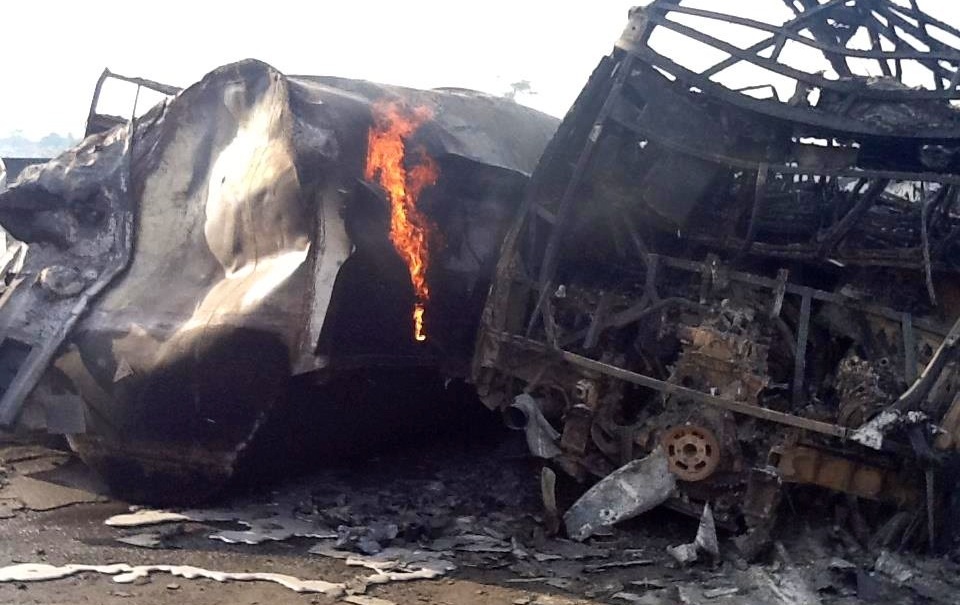
Over 60 persons were burnt beyond recognition when an articulated truck belonging to a cement company, fully loaded with cement (with registration number GA 71 XA),collided with an a tanker fully laden with petrol, which in turn, ran into a luxury bus marked “The Young Shall Grow,” said to be fully loaded with passengers.

Tongues of fire from the oil tanker consumed the luxury bus before spreading to other vehicles parked along the road and nearby buildings.

Two brothers who were said to be sleeping inside one of the burnt buildings when the accident occurred, also died.

Tuesday 9 April 2013

http://pmnewsnigeria.com/2013/04/08/nigeria-mass-burial-for-victims-of-weekend-tragic-accident/

continue reading

Nigeria bus crash kills 20


A speeding and overloaded bus crashed into a truck parked by a road in northern Nigeria on Monday, killing 20 passengers, an official and a hospital source told AFP.

The bus had set off from Nigeria's second city of Kano and was headed to Potiskum, the commercial capital of Yobe state.

Potiskum has been attacked repeatedly by Boko Haram Islamists, and the insurgency has forced state officials to impose a dusk-to-dawn curfew in several areas.

The bus was reportedly speeding towards the city in order to beat the curfew when it crashed at roughly 5:00 pm (1600 GMT).

"A commercial bus carrying 22 passengers ran into a stationary truck" just outside Potiskum, said Sani Umar, an official with the state drivers union, noting that the vehicle was intended to carry just 17 people.

"The truck somersaulted several times on impact. ...We evacuated 20 dead bodies from the bus, with two seriously injured," he added.

He described speeding as the "likely cause," as drivers typically increase their speed as the curfew approaches to avoid being barred from entering the city when the military shuts off access at 6:00 pm.

A doctor at the Potiskum General Hospital, who was not authorised to speak to journalists, told AFP that 20 dead bodies had been brought in from the accident site.

Osuman Masari of the Federal Road Safety Commission in Yobe state said he had "received information about a ghastly motor accident outside Potiskum this evening involving a commuter bus."

"We don't have details at the moment because we don't have people on the ground," he added.

Road safety officials were forced to withdraw from the area following a spate of attacks blamed on Boko Haram, he said.

The Islamists have killed hundreds of people across northern Nigeria since 2009.

Parts of several states targeted by the insurgents have been placed under curfew.

Nigeria's roads are among the most dangerous in the world.

Badly maintained vehicles, poor roads and widespread reckless driving conspire to kill thousands in motor accidents across Africa's most populous country each year.

Tuesday 9 April 2013

http://www.globalpost.com/dispatch/news/afp/130408/nigeria-bus-crash-kills-20

continue reading

Monday, 8 April 2013

‘Pablo’ makes Philippines most disaster-affected nation


Massive death and destruction caused by Typhoon "Pablo" (international name: Bopha) last December has made the Philippines as the most disaster-affected country in the world in 2012, a group said on Monday.

Based on data from government agencies and news articles, the Citizens’ Disaster Response Center (CDRC) said 2,360 Filipinos died due to natural disasters (1,067 from Pablo alone) while China came in second with 771 fatalities.

Twelve million Filipinos were also affected by typhoons, flood, earthquakes, armed conflict, fire, and landslides, which caused over P39.9 billion in damages. On top of these incidents was the havoc brought by Pablo in Southern Mindanao, a region that is rarely visited by tropical storms.

"The government definitely needs a lot more to improve in terms of disaster preparation especially in areas like Mindanao which never used to experience strong typhoons before," CDRC deputy executive director Carlos Padolina told Sun.Star.

Padolina said natural and human-induced disasters that occurred in the country grew by nine percent to 471 last year as majority of these disasters were caused by flood (143 incidents) that affected 7.8 million people.

To recall, a large part of Luzon including Metro Manila was inundated last August because of the southwest monsoon.

The CDRC official also noticed the increasing trend in the number of affected people in the last five years. He said the strong tropical storms that the Philippines experienced in recent years have contributed a lot to this trend.

Monday 8 April 2013

http://www.sunstar.com.ph/breaking-news/2013/04/08/pablo-makes-philippines-most-disaster-affected-nation-276550

continue reading

China: Natural disaster death toll up


Natural disasters across China claimed 141 lives and left another 83 people missing from January to March, the Ministry of Civil Affairs (MCA) announced on Monday.

Affecting a total of 52.76 million people, disasters forced the evacuation of 253,000 people and toppled some 34,000 houses, according to a statement jointly released by the MCA, the National Commission for Disaster Reduction and other 10 central government agencies and organizations.

The disasters caused direct economic losses of 23.1 billion yuan ($3.72 billion) and affected more than 5 million hectares of farmland, destroying crops on 350,100 hectares of farmland.

During the period, 11 heavy fogs shrouded 20 municipalities, provinces and autonomous regions. The number of days with heavy fog was the most ever since 1961.

Monday 8 April 2013

http://www.globaltimes.cn/content/773520.shtml#.UWMvMZP9aCA

continue reading

The scars of genocide in Bosnia: ‘I didn’t know that human hearts and souls could be so evil’


It was a moment of Kafkaesque absurdity witnessed through the eyes of a seven-year-old. When the Bosnian town of Kozarac fell to the Serb forces in the first months of war, one by one Bosniak families were hurled into the barbed confines of Trnopolje, a concentration camp that would evoke the worst memories of the Holocaust.

Seven-year-old Elmina Kulasic was transferred out of Trnopolje with half her family after a month of horrors, but her father and two elder sisters were missing. On the train to the city of Zagreb, Elmina recalls an uncanny encounter with a Croat. He was the same age as her father, watching quietly as her mother sobbed. “He told us that the Chetniks [Serb nationalists] had probably killed my elder, disabled sister, and raped my other one. He said that it was only a matter of time before my father was dead. I remember the words, but I did not understand them. There was no sympathy.”

In a region once hailed as the jewel of Yugoslavia, the melting pot of Orthodox Serbs, Catholic Croats and Bosniak Muslims, former neighbours and colleagues turned into enemies. Not a corner was left untouched by the war. On July 11th 1995, Serb atrocities culminated into the worst scene of carnage in Europe since the Second World War. The UN declared ‘safe haven’ turned into a graveyard of bodies as 8,000 Bosniak men were separated from their women and murdered in the pitch black night in the forests.

Today the ghastly scars of the war have been covered with cement and cardboard shutters. But there are still some buildings pockmarked with shell-holes, some cratered streets. In Kozarac, as in other Bosnian towns of Tuzla, Omarska, Mostar, and alas, Srebrenica, there are wounds still open. They are now entrenched as territorial imprints of ethnically cleansed villages, and partition lines dividing the country into Serb and non-Serb entities. Twenty-one years since the war and Bosnia remains just as divided. With genocide denial and nationalist rhetoric of politicians permeating everyday life, ‘closure’ and ‘reconciliation’ have become mere buzz words.

For the many survivors and refugees the war has altered their sense of ‘home.’ In spite of this, they return to their villages — or the site of crime — from time to time to pay respect to their dead, or recover their remains from the mass exhumations that still carry on to this day. Twenty-seven-year-old Elmina Kulasic, whose family was miraculously reunited in Zagreb and finally sought asylum in Chicago, describes her emotions upon return. “My sense of home in Bosnia was destroyed during the war. Since 1992, it has been my dream to return without feeling discriminated or ethnically cleansed. The situation in Bosnia is not welcoming. But I returned home because I want to be able to choose where I can live, and not be dictated by someone else’s choice.”

Now at the Cinema for Peace Foundation (CPF) in Sarajevo, Elmina Kulasic works as the program development coordinator for “The Genocide Film Library.” As the first oral history project of the war, it aims to record 10,000 life stories of the Srebrenica genocide. Since January 2011, it has collected over 1,175 narratives.

“This was the missing element in the overall process of reconciliation and social transition to a democracy,” says Elmina. “To tell the story is to be a witness; a witness that innocent people were killed for no reason other than their different identity. It also takes a lot of courage to tell and takes the war to a personal level. One cannot hear a personal narrative and look away.”

Reclaiming History

Sixty-four-year old Fatima Alijic lived with her husband and three sons in Srebrenica until her hometown fell to the Serb forces in May 1995. As she gives her testimony to the CPF, her face framed by a bronze headscarf is pained and exhausted. “I lost my husband and my children and never saw them again,’” she says. A moment later, she takes a deep breath and continues, “Well, I say I never saw them… But I did see them when I was in the truck… going to Kravica. They were all lined up, like they sometimes show on television, holding their hands behind their necks. I saw my youngest son lying near the ditch as if facing the ditch, but he was headless… I started vomiting… I didn’t know that human hearts and souls could be so evil.”

Fatima Alijic was among the approximately 40,000 Bosniak refugees who arrived at the town of Tuzla after their men were left behind. “One of the Chetniks came to me and started interrogating my surname, over and over again,” recalls the 64-year-old. Perhaps her testimony, by breaking the silence on the genocide, will give her some consolation, but Alijic is certain that her wounds will never heal. “People who still have someone left, maybe they have some comfort to ease the pain. I have no one.”

Another survivor of Srebrenica, 35-year-old Eldiha Selimovic is cautiously hopeful that some semblance of coexistence and normality could return to Bosnia. But much depends on the portrayal of the war’s true narrative, of destruction and human pain, so that it can reach across inter-ethnic divides. “Everyone here writes their own history,” she says, “And by history, I don’t mean this history, but those that go back. Of vengeance against the Turks … or the [Catholic] Austro-Hungarians.”

If there is a retrospective glance on the past in Bosnia today, it is tinctured with myths and politically manipulated narratives of vengeance and victimhood unleashed during the war. The conflict in the former Yugoslavia was as much literary as it was political. Libraries and museums were systematically targeted in an attempt to wipe out the multi-ethnic identity of the region. Serb paramilitaries marching into Muslim villages quoted verses from The Mountain Wreath, an infamous play by Petar Njegos depicting the mythical extermination of the Islamized Serbs for their betrayal and collaboration with the Turks. Labeled as “race traitors,” Bosniaks were caught between the contesting claims of Serb and Croat nationalists. When former colleagues and acquaintances became voluntary perpetrators of atrocities, they hid behind masks, transporting themselves back in time. They were no longer acquaintances, but Serb heroes fighting their traitors in blood and in religion.

But in the midst of skewed narratives, the Genocide Film Library seeks to do justice to history by giving voice to the survivors silenced by politics. Although few survivors testified at The Hague during the trials of war criminals, Radovan Karadzic and Ratko Mladic, there has been no large-scale reckoning with the truth in Bosnia, as was the case in South Africa. The archived testimonies will now be provided to schools and universities, to researchers and policy makers – an important move in Bosnia’s awfully politicised education sector.

Crucial for Bosnia and the survivors are the lessons learned. “Many survivors who have shared their stories have never spoken before. This is the first time they are recounting their past and are breaking the silence,” says Elmina. “They know what is at stake if they don’t speak up.”

As the sixty-four year old survivor, Fatima Alijic puts it: “Genocides still go on in the world. Srebrenica didn’t teach anyone a lesson.”

For more information about the Genocide Film Library click here

Monday 8 April 2013

http://blogs.independent.co.uk/2013/04/08/the-scars-of-genocide-in-bosnia-i-didn%E2%80%99t-know-that-human-hearts-and-souls-could-be-so-evil/

continue reading

Nyaruguru District commemorates the 1994 genocide at the very place where the first Tutsi was murdered in the District


Over 500 residents (plus some neighbours and friends) of Ruramba village in Ruramba cell of Ruramba sector in Nyaruguru district, Southern Rwanda, on Sunday gathered in Ruramba village as the whole of Rwanda launched the 19th commemorate the 1994 Genocide against. People laid flowers on mass graves at Ruramba Genocide memorial site where 321 dead bodies have been decently buried.

It’s in Ruramba sector where the first Tutsi across Nyaruguru district was killed on April 7, 1994.

The mourners − in their grey-colored scarves, among other grey-colored clothes – keenly listened to soft songs, poems and speeches – the core message of all of which was rotating around the brutality with which Tutsis were killed during the Genocide and how Genocide survivors have so far managed to carry on moving forward with hope.

And for the first time, grey has replaced purple as the national color as a symbol of remembering the Genocide, with grey alluding to the traditional way of mourning the dead using ashes.

“Within the first days [of the Genocide], Tutsis including my father [late Gasimba] offered their cows to the killers in exchange for their lives”, recalls Valens Ngendahayo, one of the Genocide survivors in Ruramba sector.

“After eating them [cows] up, they [killers] could come back and finish you off. That’s how people including my father got killed”, Ngendahayo, by then a second-year primary school student, added, his voice tone changing with sadness as if he were about to sob.

“But today I have hope to carry on living. And that’s how I have managed to complete my primary and secondary education and I am now an employee at Sacco [a savings and credit cooperative] Ruramba. And I even plan to go to university someday”, said Ndendahayo, closing his testimony.

Bertin Muhizi, head of IBUKA (an umbrella organisation of Genocide survivors) in Nyaruguru district, also did hint at Ngendahayo’s hope message.

“Let’s keep collaborating, having hope and building for a bright future”, said Muhizi, who also thanked the then RPA (Rwandese Patriotic Army), now the Rwanda Defense Forces (RDF), for halting the Genocide.

Over 200 extra remains of those killed during the Genocide have so far been recovered throughout Nyaruguru district, said Muhizi, calling the district officials to arrange for their “decent burial”.

To this, Nyaruguru district Mayor, François Habitegeko, responded that a sum of Rwf 100,000 (about $160) has been earmarked for that particular purpose plus revamping the existing Genocide memorial sites across Nyaruguru, and construction activities, the Mayor said, are set to begin before the end of this year.

Sunday’s ceremony in Ruramba village to mark the week-long Genocide commemoration also took place in Rwanda’s 14, 873 villages, including Ruramba village itself. And the commemoration theme for this year’s 19th anniversary of the 1994 Genocide against the Tutsi is: “Let’s commemorate the Genocide against Tutsi by striving self-reliance”.

And Rwanda’s President Paul Kagame hinted on that “self-reliance” while at Gisozi National Memorial Site on Sunday.

The Head of State said the commemoration period is an opportunity for Rwandans to look back to their Genocide history and see how far Rwandans have gone in rebuilding their country. He also said there is need for Rwandans themselves to write their history so that those who were still young and those who were born after the Genocide can grasp the repercussions of “bad politics” that led to the Genocide.

For a week, the national flag will be flying at half-mast and different commemoration activities like talks on how the 1994 Genocide was masterminded and on Genocide prevention will be held all across the country.

Such activities, including decent burials of recovered remains of those killed during the Genocide, are expected to carry on for a hundred days just in the memory of slightly over three months – from April to July 1994 – that the Genocide claimed over a million lives according to Rwanda’s official statistics or over 800,000 people according to the UN records.

Monday 8 April 2013

http://www.newsofrwanda.com/ibikorwa/17806/nyaruguru-district-commemorates-the-1994-genocide-at-the-very-place-where-the-first-tutsi-was-murdered-in-the-district/

continue reading

French priest documents Shoah mass graves


As we come upon another Holocaust Remembrance Day, we often look to the camps – Auschwitz, Treblinka, Dachau – as the main centers of killing. But across Eastern Europe, more than a million Jews lost their lives to so-called death squads – often shot to death, their bodies unceremoniously piled in mass graves.

Many of those graves stood unmentioned and untouched for many decades, and likely would have remained so, if not for the efforts of a French priest, Father Patrick Desbois.

Many of the witnesses haven’t uttered a word about the slaughter of their neighbors in more than half a century. In this documentary film, a woman explains no one was pushed into the pit of corpses.

"They killed them," she says, "and the Jews fell in."

Elie Wiesel Institute says more than 100 Jews – men, women, children, and elderly people – buried at newly discovered site in forest area near Popricani

Over the past decade, Father Desbois and his colleagues have discovered hundreds of mass graves and interviewed over 3,000 people across Eastern Europe. It’s an attempt to piece together what Desbois calls "the Holocaust by bullets."

Desbois’ organization, Yahad (In Unum), employs 22 people. Fifteen times a year, nine-person teams go from village to village, asking if anyone remembers what happened to the Jews. Desbois says 99% of the time, witnesses are willing to speak and be interviewed on camera.

The stories are chilling, yet Father Desbois wants to make sure the world knows of this under-told chapter of the Holocaust. As a clergyman, he says his role is not to judge.

Desbois knows the clock is ticking. As the number of witnesses tapers, he acknowledges there may be parts of the story that remain untold.

Desbois’ organization has begun researching Roma mass grave sites as well, further illustrating the atrocities of the World War II. Later this year, they hope to unveil an online interactive map, showing the world the final resting place of millions

Monday 8 April 2013

http://www.ynetnews.com/articles/0,7340,L-4364207,00.html

continue reading

5 Nepalis among Mumbai building collapse victims


Five Nepalis were among the victims of the Thursday building collapse in Mumbai of India, Indian media reported on Monday.

According to the online version of The Times of India, the bodies of five Nepali nationals were recovered after 40 hours of the rescue operation.

They have been identified as Mujaeed Raza, wife Miladun (28), daughters Jalekha (8) and Rataya (6) and brother-in-law Akbar Ali (26). However, the report has not mentioned where from Nepal they hailed.

Raza (32) reportedly had taken his kith and kin to Mumbai six months ago.

At least 72 people were killed when a seven-storey building being constructed illegally on forest land in a suburb of India's financial Capital cave in on Thursday.

Monday 8 April 2013

http://www.thehimalayantimes.com/fullNews.php?headline=5+Nepalis+among+Mumbai+building+collapse+victims&NewsID=372072

continue reading

Perenco helicopter crashes in Peru, 13 dead


A helicopter chartered by French oil company Perenco has crashed in a remote northern part of Peru, killing all 13 Peruvians aboard, including one Perenco employee and representatives of three contractors, a company source told Reuters.

Perenco confirmed the accident, adding "at this stage, no survivors have been found." A Peruvian official usually has to confirm a death toll in an accident before a company can publicly confirm the casualties.

The helicopter went down in the sparsely populated region of Loreto, Peru, near the border with Ecuador. It had left the jungle city of Iquitos to fly to the company's Block 67, the company said.

"The [Peruvian] armed forces are in the area of the events, and two additional helicopters are taking part in the search and rescue operation. So far, no survivors have been found," said a statement released in Lima from the Anglo-French firm.

There were nine passengers and four crew members on board, it added.

Block 67 is a 630-square-mile (1,020-square-kilometer) block of more than 300 million barrels.

The Russian-made MI-8 plummeted to ground near the Curaray and Arabela Rivers in Loreto, local media reported.

Media reports initially put the death toll at nine.

This is the second accident of the year involving a helicopter used by energy companies that work in the remote, oil-rich Peruvian jungle.

Monday 8 April 2013

http://uk.reuters.com/article/2013/04/07/uk-peru-crash-idUKBRE9360CR20130407

continue reading

Sunday, 7 April 2013

Alicante's missing children - in search of the truth


The search for truth continues in the Alicante region for up to eighty families who are still embroiled in the case of ‘the stolen children.’

Originating from the 30 year period between the fifties and the eighties there are still about 80 families in the province seeking clarification on suspected stolen babies, children that are alleged to have died at, or within 24 hours of, their birth, which many relatives now suspect were the subject of illegal adoption.

One case that is currently making the headlines is that of the ilicitana María José Picó who has been immersed in a quest to find her twin sister for about two years. “It is a commitment that will never end” she says "despite the many obstacles put in front of her, until she has the answers that she needs.”

The story of this search goes back to March 28, 1962, when the mother of Maria Jose, Francisca Robles, went into labour. She was taken to Alicante General Hospital, says Maria Jose.

"A nurse told my father and grandmother that two girls had been born and everything had gone very well, however neither was allowed to see the children.”

The mother was transferred to a room where she was left alone for three days, apart from visiting hours. The children were brought in from time to time but for the most part they were kept in another room. Sometime later a nurse came into the room and told the mother that one of the children was ill. “At about 4 am on the following morning the nurse came back again and told my mother that my sister had died,” said Maria Jose.

The next day, the hospital priest went to visit the mother of Maria Jose to ask about the girls, and was furious when he was told that one had died. "He was asked to baptize her before burial, but my sister did not even have a name," laments Maria.

From then on everything was rushed. Hospital staff told the father to go buy a small coffin to bury the dead twin and bring it back to the hospital. The hospital then sealed the coffin and sent the father to the Alicante cemetery where they said that staff were urgently waiting to bury the child.

The family, who all lived in Elche, did not understand why the girl had to be buried in Alicante, but were told that it was mandatory that the body went to the cemetery closest to the hospital. The father, who is now 82 years old, still remembers the area where he deposited the coffin, and is still wondering why he was not allowed to open it to confirm that it held the body of his daughter.

Interestingly, the death certificate does not include the name of the doctor who confirmed the child’s passing. As such the family has always had it’s doubts. María followed a myriad of bureaucratic red tape as she took the case to la Fiscalía de Menores (the Juvenile Prosecutor). This eventually culminated with the burial plot being formally identified and the exhumation on the remains of a baby girl taking place.

But just last week, fourteen months after the exhumation, María was hit with the bombshell that the DNA of her parents does not match that of the remains found in the grave and as such she is now carefully considering her next step.

She said that she is now trying to find out if her sister is alive and living under another name and with another family. Currently, la Fiscalía de Menores is responsible for investigating fourteen cases of missing children in the province, although more are expected to arrive in the coming weeks. The , prosecutors currently awaits DNA results from the National Toxicology Institute in seven of the cases.

As a result of the investigations the Association of Victims of stolen children and illegal adoptions in Alicante (AVA) was formed. The organization provides support to those families who find themselves in a similar situation.

They provide information and assistance to those like Maria who have started a crusade to find out if their relatives are still alive. They do this through the courts, through burial records and even through social networks. They also provide advice on how to initiate a complaint or request an exhumation. Currently there are about 80 families in the province seeking clarification on suspected stolen babies.

But the AVA also warns that the circumstances surrounding burials and exhumations varied enormously during the period in question, particularly where a child was buried in a coffin within a public grave.

Here the task of identifying the remains becomes much more complicated, since there could well be the existence of several babies within the same small plot, many of whom will have been buried in biodegradable coffins which could now prevent the recognition of specific DNA traces.

Between 1950 and 1980 estimates put the total number of children that are thought to have been illegally adopted at around 300,000. This was done through a network of Catholic Church-run children's homes and private hospitals would take newborn infants, typically from young, impoverished single mothers, who were told that their baby had died.

The women were usually known to have supported the Republican cause during the Spanish Civil war. It was seen at the time as an effective way of inflicting a lasting punishment on those who had backed the wrong side. The children were then placed in the care of families who had supported the new regime, at the same time preventing the appearance of a new generation of "reds."

Sunday 7 April 2013

http://www.theleader.info/article/38476/spain/national/alicantes-missing-children-in-search-of-the-truth/

continue reading

Angola: Rains claim nine lives in Luanda, 4 missing


At least nine dead and four people missing is the provisional assessment of the consequences of rain that fell Saturday morning on the city of Luanda and surroundings.

ANGOP learned today, Sunday, from the deputy governor for technical area of the Provincial Government of Luanda, António Resende, in the urban district of Ingombota, that among the victims are adults and children, following collapsing of houses.

The deaths and missing were registered in the urban districts of Samba and Kilamba Kiaxi, Luanda district. It is known that teams specializing in shipwrecks of the National Civil Protection and Fire (SNPCB) are continuing their search today in order to locate the bodies of the missing.

However, during its reporting round ANGOP found the collapse of homes of Boavista mountain (Ingombota) and the flood of other beachfront house, near the port of Luanda.

Sunday 7 April 2013

http://www.portalangop.co.ao/motix/en_us/noticias/sociedade/2013/3/14/Rains-claim-nine-lives-Luanda,e9f05a8e-b295-4706-8539-182b253f9ffe.html

continue reading

Mass burial likely for Benin accident victims


Victims of the accident that occurred at Ugbogui along Benin-Lagos road on Friday might be given a mass burial if their identities can not be ascertained. Many of them were burnt to ashes.

The luxurious bus they were travelling in was engulfed in fire after a tanker that was hit by a trailer carrying cement exploded and only three passengers managed to escape with severe burns. Witnesses said the luxurious bus was filled with passengers.

The remains of the victims have been deposited at the University of Benin Teaching Hospital mortuary while it was gathered that the police authorities were waiting for directives from Abuja on what to do with corpses.

State Police Commissioner, Folusho Adebanjo said relatives have started showing up to collect corpses of their love ones.

He said time would be given for relatives to identify corpses and added that the manifest showed that 36 persons died in the fire.

An official of the FRSC said they would soon remove the vehicles from the highway to ease traffic movement.

Owners of the shops, vehicles and motor-cycles affected by the fire have demanded for compensation from owners of the tanker that caused the fire.

A mechanic said three Toyota Camry cars kept at his workshop were consumed in the fire.

Florence Olufemi said she lost 50 kegs of palm oil to the inferno while One Mrs. Dupe Abiola, a restaurateur, said everything in her shop were burnt.

Sunday 7 April 2013

http://thenationonlineng.net/new/news-update/mass-burial-likely-for-benin-accident-victims/

continue reading

Nigeria: How poisoned cows sparked killings, arson on uphill villages


Like a little bush fire turned into a ravaging inferno, the discovery of two dead Fulani cows,allegedly poisoned in Zankan, an uphill village in Fadan Atakad Chiefdom, Kaura Local Government Area of Kaduna State, ignited a bloodbath in Atakad villages in Kaduna and Plateau States in the past three weeks.

Alhaji Ibrahim S Abdullahi, Kaduna State Chairman of Miyeti Allah Kautal Hori Socio-Cultural Association – Fulani umbrella body – told Sunday Vanguard that the Fulani considers the cow as the equivalent of cash deposit in bank, and would do anything to take vengeance anytime his cow is hurt.

The national body of Miyeti Allah Kautal Hori Socio-Cultural Association was headed by the deposed Sultan of Sokoto, Alhaji Ibrahim Dasuki.

Members of the House of Representatives from Southern Kaduna wore forlorn looks last Wednesday when they visited one of the refugee camps holding some 10,000 Atakad refugees displaced from the violence and assured them of help and justice, while asking for calm.

The Atakad people live on lush plains and fertile valleys served by perennial stream high up the Atakar hills, that form part of the Kagoro mountains linking the Jos plateau.Unlike most southern Kaduna people, the Atakad are known to take dry season farming seriously, thus making them relatively prosperous among other tribal groupings of the area.

Also rich in fodder for grazing, Fulani nomads find the Atakad hills very attractive, and there had been cordial symbiotic relationship between the two groups as long as some of the oldest Atakad elders could recall to Sunday Vanguard, until the last three weeks.

On Monday, the Chairman of Kaura LGA, Mr Kumai L J Badung spoke to Sunday Vanguard at the refugee camp of Fadan Atakad on how the incident started. Said Badung:”There was a young man, Aboi Stephen (21), in Mafan, who had been complaining that some cattle had been grazing on his dry season farm. I was told that the cattle destroyed a good portion of the farm, and that there was no end in sight to the destruction.

”About two weeks ago, two Fulani cows were found dead, allegedly of poisoning. The owner of the cows was said to have publicly warned Aboi of the grave consequences of his action. I don’t know if it was Aboi that poisoned the cows, or even if they died of poisoning. ”Then one day, Aboi was found missing. A search by the villages found his corpse.

He had deep machete cuts all over his body, and his throat was slit.”Upon that discovery, women and children mobilised to the palace of the chief of Atakar, Tobias Nkom-Wada, and accused him of inviting the Fulani into Atakar land in the first place. They vandalised the palace.

The chief is now living in his personal house in Tachire, around here. ”On seeing what the women and children did, the Fulani started moving out en masse to their kins in Kanawuri areas of Plateau State, which also has some number of Atakar speaking villages.”On their way, they shot a young man that same day in Kanawuri area.

That pitched them against the Atakar in Plateau State and they fought for days. The fighting led to the burning of some Atakar villages. The affected ones had to move to this local government, where we opened the first refugee camp for them at Mifi. But we have closed it and merged it with the other two because it was vulnerable.

”When the army moved in last week, the Fulanis left Kanawuri in Plateau State back to this place with their arms.”Last Saturday, by 3pm they attacked Mafan, Zalang, Taliki and Zangkan villages up those hills, while able bodied men had gone to the farms or the market.

They went on unchallenged till Sunday morning. When the army arrived the scene on Sunday morning, the officer in charge told me that they counted 19 bodies. All the houses in the villages had been burnt.”They made no arrest, because the attackers had left before the came.”Right now, soldiers have escorted some men back to the villages to bury the dead.”We have not less than 5,000 refugees now, and that is a huge challenge to us.

The governor of Kaduna State, Alh. Muktar Ramalan, has done very much and is still doing more to help”.But events later revealed that the casualty was higher than the one given by the Council Chairman, when the House of Reps members came to find out what transpired.

The chief of Atakad chiefdom, Chief Tobais Nkom_Wada, while receiving the lawmakers, led by Hon Godfrey Gaya (Jaba/Zangon Kataf Federal Constituency), corroborated the story of Badung, but added that the death toll had shot to 28, the four villages left in ruins with the Fulani fully occupying them as their captured territory.”We gave 28 bodies mass burial, with the victims being mostly women and children.

The Fulani have fully taken over the villages. No one can enter,” he said. ”Now, the rains have started. Some have lost family members and are living as refugees. Yet they cannot go back and farm, after their entire food crops have been burnt. Next year will be terrible.”I am pleading with government to send securitymen so that we can go back and start our lives all over again.”As Christians, I call on my people to forgive, and keep living in peace with the Fulani like we have ever done ever since”.

The National President, Atakad Community Development Association, Mr. Ishaya Kudien told the visitors that the refugee figure had increased.”We heard the refugee was given as 5,000. That is far below the truth. As at yesterday, we have about 100, 000 refugees from the violence. Many are living with relations, some are staying with family friends, and some have relocated, more have joined the camps,” he said.

”There may be outbreak of epidemic, because everyday we take dozens of children for emergency treatment because of poor hygiene and feeding here.”We need relief materials and we want to go back home. We will always forgive, but we want government to help us get back our villages from the Fulani”.

Other members of the House of Reps from southern Kaduna were: Hon. Gideon L. Gwani (Kaura Federal Constituency), Hon. Adams Jagaba Adams (Kachia/Kagarko Constituency), Hon. Simon Arabo (Kauru Federal Constituency) and Hon. Shehu N. Garba ( Jema’a/Sanga Constituency).Meanwhile, Kaduna State Chairman of Miyeti Allah Kautal Hori Socio-Cultura Association, Abdullahi, spoke to Sunday Vanguard on behalf of the Fulani.”I was told that the corpse of a mentally deranged man was found in a bush in one of the Atakad villages. The Atakad youth attack the Fulani, and burnt their huts.

They even burnt the palace of their chief, who is peace loving man.”I am told that 20 Fulani were killed, and that the Fulani cannot go to the hills to bury their dead.”Let me tell you something that many people don’t know about us the Fulani. We don’t have bank accounts.

The cattle you see the Fulani with, represent his bank account. Therefore, if you hurt any of his cows, he can go to the end of the world and hide the remaining cows, then he will surely come back for vengeance.”But, we don’t want such crisis.

The Atakad and the Fulani have lived for decades and have even inter-married. It is sad that this is happening. I am still making more findings, and I will let you know next time”.

Sunday 7 April 2013

http://www.vanguardngr.com/2013/04/fulani-atakar-war-how-poisoned-cows-sparked-killings-arson-on-uphill-villages/

continue reading

Sri Lanka to probe mass grave with more than 150 dead


Sri Lanka is setting up a presidential commission to investigate a mass grave with the remains of more than 150 people, an official spokesman said on Sunday.

Two reports submitted to a court last week said that the human remains, in the town of Matale 142 km (88 miles) north of the capital, dated back to the period 1986-1989 when Sri Lanka faced a Marxist insurrection.

"The president has decided to appoint a presidential commission to inquire into the mass grave. This will be apart from the ongoing police inquiry," Mohan Samaranayake, President Mahinda Rajapaksa's spokesman, told Reuters.

The decision to set up commission comes five months after the mass grave was found at a building site near a hospital.

Ajith Jayasena, the judicial medical officer at the hospital, said the excavation was still going on and there may be more remains in the grave.

Marxist rebels of the Janatha Vimukthi Peremuna (JVP), or People's Liberation Front, launched the second phase of an insurrection in the late 1980s after the first one in 1971.

The security forces responded ruthlessly and many rebels were killed or disappeared. The JVP later transformed itself from a rebel group into a political party.

Sunday 7 April 2013

http://news.yahoo.com/sri-lanka-probe-mass-grave-more-150-dead-145207026.html

continue reading