Wednesday, 3 October 2012

Six dead after missing vintage plane is found at 'high-impact' crash site in Queensland

Six people found dead in the wreckage of a vintage aircraft are believed to have been killed instantly when the plane plunged into rugged bushland on Queensland's Sunshine Coast.

Almost 48 hours after it vanished on Monday, rescue helicopters today spotted a glimpse of red and then saw the wreckage of the 1934 DH84 De Havilland Dragon in dense forest near the Borumba Dam, south of Gympie.

After landing nearby and walking 200 metres to the crash site, 14km northwest of the dam wall, a team of paramedics and doctors established there were no survivors.

Australian Maritime Safety Authority spokesman Mike Barton said it was “a high impact” crash site.

“The plane is not in a condition that you would recognise,” he told reporters.

Mr Barton said it was apparent the plane was travelling fast when it crashed on Monday and hit the ground hard. He said it was too early to tell what caused the crash.

“They have hit the ground exceedingly hard and the aircraft is fundamentally destroyed.”

Formal identification may take up to two days, but police yesterday identified those on board as veteran pilot Des Porter, 68, his wife Kath Porter, 61, and their friends John and Carol Dawson, both 63, and Les and Janice D'Evlin, aged 74 and 61 respectively.

Their next of kin have been notified.

The discovery of the wreckage ended an intensive search which by early this afternoon involved up to 16 helicopters and which extended nearly 600 square nautical miles west from Gympie and south to Maleny.

Inspectors from the Australian Transport Safety Bureau are heading to the scene to determine the cause of the accident.

The recovery effort is expected to take some time, given the crash site is in a remote and heavily wooded area.

The crash is Australia's worst since 15 people died in the Lockhart River air disaster on Cape York Peninsula in May 2005.

The biplane disappeared while flying from Monto to Caboolture, in south-east Queensland, on Monday afternoon.

Mr Porter had called for help and activated a distress beacon.

Before contact was lost, he told air traffic controllers he had flown into clouds, didn't know his location and needed help.

Mr Barton said he personally knew Mr Barton and the discovery was a blow for everyone who knew the veteran pilot and his five passengers.

“It was always our hope today that we'd find this site, and we'd find survivors, but that is not the case.”

Mr Barton said the antique plane community would miss Mr Porter deeply, and he felt deeply for the family and friends of all six people who perished.

Mr Porter survived a 1954 crash involving the same model aircraft. The Brisbane Telegraph at the time reported he was flying with his father James and his elder brother Keith, in a plane owned and flown by James.

The plane crashed in Doboy Creek in Brisbane's south. James and Keith died but Mr Porter, who was 11 at the time, was saved from the sinking aircraft by rescuers, who cut a hole in the fuselage and dragged him out.

Wednesday 3 October 2012

http://www.theaustralian.com.au/news/nation/searchers-find-missing-aircraft-near-south-queensland-dam/story-e6frg6nf-1226487392979

continue reading

Retreating Italian Glacier Reveals Dead From World War I

Two soldiers' bodies from World War I have been discovered on an Italian mountain, the Telegraph reports.

Workers on the Presena glacier in the Trentino-Alto Adige region of the Dolomites in Italy found the bodies at an altitude of 9,850 feet. The glacier has been receding because of an unusually hot summer and the workers were covering it with a giant tarpaulin to keep it from thawing further.

The area was the scene of high-altitude fighting between Austrian and Italian forces towards the end of the war.

Historians believe the men may have died on 3 September 1918, during what was called "the great battle".

The soldiers are believed to have been from an artillery unit of the Austro-Hungarian army and were killed in 1918. The skeletons were identified by remnants of uniform and insignia. No word yet on whether they can be named.

During World War I, Italy fought against Austro-Hungarian and German forces in the bitter cold of the mountaintops. One favorite tactic was to fire artillery shells above enemy positions to cause avalanches to bury them. In other cases soldiers died from wounds or exposure and were lost. Many of these bodies have been found in later years.

The Presena glacier isn't the only one melting. The entire Alps is seeing less ice cover, reducing the number of ski slopes and increasing the risk of avalanches for trekkers.

The preserved bodies were spotted and retrieved by Maurizio Vincenzi. Map of Peio, Italy

Not only is he an amateur historian, but he is also a member of the local mountain rescue team, and the director of the military history museum at the small town of Peio.

The museum announced the discovery on Sunday, after Mr Vincenzi and his colleagues recovered the bodies on Friday.

Mr Vincenzi, 46, said: "Using binoculars, I saw what looked like a stain on the Forni glacier and went to look."

"When I got close, I discovered they were the bodies of soldiers frozen in the glacier. Nothing like this has ever happened in my lifetime. Bodies haven't been found in the ice around here for decades," he said.

The bodies were preserved by the ice. He said the bodies were found upside down, encased in ice.

Their uniforms included leather belts, a gas mask and a cap with a star on it - all in good condition.

It is thought the men may have died in a grenade attack.

The battle, 86 years ago, was won by the Austrians, but they lost 11 men in the process.

"This is an important discovery from a historical point of view, and exciting for the communities on both sides of the border," said Mr Vicenzi.

A funeral for the men is planned for Tuesday afternoon, after which they will be laid to rest in the local military cemetery.

The Presena glacier isn't the only one melting. The entire Alps is seeing less ice cover, reducing the number of ski slopes and increasing the risk of avalanches for trekkers.

Wednesday 3 October 2012

http://www.gadling.com/2012/10/02/retreating-italian-glacier-reveals-world-war-one-dead/

continue reading

Eight still missing in Ilam landslide

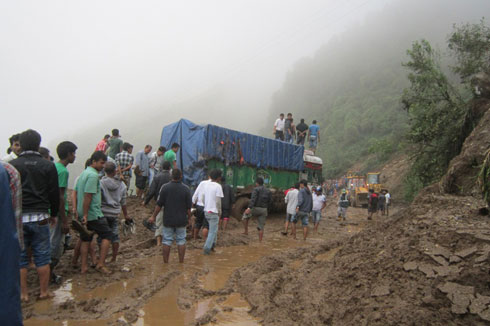
Eight of the 14 people swept away by a landslide along the Mechi Highway on Sunday night were still missing till Tuesday night.

Although a joint team of Nepal Police, Armed Police Force (APF) and Nepal Army (NA) personnel, accompanied by local villagers, searched for the missing people from Tuesday morning, no bodies were found. "We found only some dismembered parts," said DSP Bishnu KC, Chief of District Police Office (DPO) of Ilam. On Monday, six dead bodies were recovered from the debris.

Five vehicles -- a truck, two pick up vans and two cars -- were swept away by the landslide in Kolbung VDC of Ilam district on Sunday night.

Three of the six people killed in a landslide that hit the Mechi Highway at Harkate, Kolbung-1 in Ilam district on Sunday night, have been identified. Fourteen people had gone missing in the disaster.

Those identified are 42-year-old Saran Pradhan and Rabi Gupta of Fikkal-6, Ilam district and 15-year-old Tshering Kesang Kesang Sherpa of Sukepokhari, Darjeeling, India, the District Police Office, Ilam stated.

Pradhan´s body was found some 500 metres from the landslide site while the bodies of Gupta and Sherpa were found in the Biring stream flowing through Ghailadubba-9 Jhapa district

Sand excavation banned

A day after a massive landslide in the Harkate-Hanspokhari section of the Mechi Highway, an emergency meeting of the District Natural Disaster Rescue Committee of Ilam on Tuesday banned sand excavation along the highway. According to Assistant Chief District Officer of Ilam Purushottom Ghimire sand excavation will not be allowed along the Ilam section of the Mechi Highway. "The ban will be effective in the areas between Sunmai and Ranke," Neupane said. He said that the ban was necessary to avoid landslides along the highway.

"I survived by clinging to the truck"

Roshan Tamang, a landslide survivor

I was driving a pick-up van ahead of a truck along the Mechi Highway on Sunday night. I saw some stones and boulders coming down from the roadside hill. I stopped the van. So did the truck. Ravi Gupta, of Fikkal bazaar, and my assistant Kumar Tamang were in the van. Shortly, more stones and boulders started falling on the road. Ravi panicked and jumped out of the van. Our van was buried under the debris of the landslide in no time. I and Kumar somehow managed to get hold of the truck. We clung to the truck until stones and boulders stopped falling over us and we just fled the landslide site. Soon, the truck was also swept away by the landslide. Had we not escaped the site on time, we might have also been buried in the landslide

Wednesday 3 October 2012

http://www.myrepublica.com/portal/index.php?action=news_details&news_id=42861

continue reading

Bus plunges into ravine in Peru, killing 22 Read more: Bus plunges into ravine in Peru, killing 22

A bus riding along a foggy road in Peru plunged into a ravine, killing 22 people and leaving 16 injured, a news agency reported Tuesday.

Two foreigners were among the dead: a Spanish engineer working in Peru and a Venezuelan tourist, the Andina agency said.

The accident happened Monday near the city of Huarmaca, about 850 kilometers (530 miles) north of Lima.

The agency said the fog was apparently the cause of the tragedy.

Peru’s roads are among the most dangerous in Latin America, with 2,900 people killed in accidents in 2010 and 2,583 in 2011, according to government figures.

Perilous mountain roads and the shoddy condition of Peruvians’ cars and trucks are the cause of most of the accidents.

Last month 14 people died in an accident on a secondary road in the southeast Cuzco region.

Wednesday 3 October 2012

Read more: Bus plunges into ravine in Peru, killing 22 - Latest - New Straits Times http://www.nst.com.my/latest/bus-plunges-into-ravine-in-peru-killing-22-1.151926##ixzz28DzfgEHb

continue reading

Tuesday, 2 October 2012

For two mothers, the charred remains might have been their boy

Amid the nauseating stench of death inside the Edhi morgue in Sohrab Goth, two elderly women were at each other’s throats. The bone of contention was a body. One claimed it was her son “Honey”. The other insisted it was her boy “Zeeshan”.

There are 39 bodies of the Baldia factory fire victims at the morgue, burnt beyond recognition. The body of Honey or Zeeshan or perhaps somebody else is one of them.

Weeks after the devastating blaze that killed more than 250 people, the families of the victims are still looking for the remains of their loved ones.

“So far we have handed over 164 bodies to the families. But 39 of them are still with us,” said Edhi spokesperson Anwar Kazmi.

In many cases, the bodies that were eventually handed over to the families after identification turned out to be someone else’s, but taking them back is a daunting task for the officials.

“Both women have their sons’ company cards without their picture making it quite difficult to sort out the issue,” said Salman Asghar Ali, an operator at the ill-fated factory who survived the fire and also the two women’s neighbour. “But even if they have pictures, that won’t make a difference as the body is completely charred.”

Ali said Edhi officials were eventually asked to keep the body with them till the families came up with the identification papers.

Unbearable losses

Most of them next door neighbours to each other in Sector 3 of Baldia Town, the families know what happened to whom. With financial prospects nearly zilch, they help each other arrange food for the children and the elderly.

Babar Abdul Saeed, a factory worker and a survivor, lost eight members of his family. His wife Nasreen, four nieces, brother-in-law, a nephew and an aunt were among the victims.

He had found their bodies through a rescue worker’s help.

He did not recognise his wife at first, as her face and torso was completely burnt. But as soon as he recognised her dress, he fainted.

“A small piece of her floral printed shirt was stuck to her knee. It was the dress she wore to work that day.”

Saeed’s elder sister, Rehana, lost five of her children who worked at the factory. A diabetic, the grieving mother said if she got even one of them back, it would make her really happy.

“Most people at least have a body to fight over. I have no clue what happened to my children.”

Her children, 23-year-old Zoya, 16-year-old Rubab, 15-year-old Sony, 14-year-old Sehbo and 12-year-old Aijaz, had asked her to let them work.

“They worked in a 10-hour shift every day and didn’t take a day off. They asked me to rest at home. I want nothing else, but my children. They deserve a decent burial.”

Having lost almost all that she had, Rehana’s relatives have found a job for her in Hyderabad, so that she “stays busy and does not die from starvation”.

‘I see dead people’

Saiqa, Saeed’s younger sister who lives just a mile away from the factory, said she does not even look at the place where so many people she knew had met a tragic end.

She has been to almost all the hospitals and morgues in the city to look for her nieces and nephew, whom she now believes have perished in the fire. “Now, I see dead people all around me.”

One of the first people to know that a fire had broken out “at the back of the factory”, Saiqa, along with a few of her co-workers, was among the first ones to walk out of it.

“I just shouted ‘fire’ for all of them to listen. Some had started praying. I dragged them out.”

There was a reason behind the slackness. A similar tragedy had been averted “three months back”.

“But that didn’t turn into a disaster. The doors were not locked. This time, as soon most of us came out, the doors were locked and many were stuck inside.”

Many victims of the deadly inferno were children, working at the factory at the age of 13 or 14 years.

“During a tour by a foreign delegation, the children were given a day off, whereas we were ordered to say that we get a handsome salary of Rs10,000. We were actually given Rs6,000 without a day off.”

The hated Mansoor

Almost all the workers share a hatred for a man named Mansoor. Nobody knew his last name and when asked, they referred to the aliases - Bhai or Lala - by which he was called.

Saiqa recalled that Mansoor was the first one to flee the factory, when the fire could not be controlled. “He pretended that he had a heart attack and said he was feeling claustrophobic. He was taken away in the first ambulance that arrived. Nobody saw him after that.”

The workers said he had a home and family in New Karachi. But after the fire, nobody knew their whereabouts.

“A general manager and contractor for the Ali Enterprises, Mansoor was known to iron out petty problems for the owner,” Ali said. “That included dealing with the goons in the area and dodging extortion demands.”

Ali demanded that Mansoor should be remanded and questioned about what had exactly happened as he “surely knew a lot”.

Many of the workers did not deny the reports about the factory owner receiving “extortion threats”, and insisted that the probability “must be investigated.”

Tuesday 2 October 2012

http://www.thenews.com.pk/Todays-News-4-134806-For-two-mothers-the-charred-remains-might-have-been-their-boy

continue reading

Bus crash in China kills five Germans

A BUS carrying many German tourists has hit the back of a truck and burst into flames on an expressway in northern China, killing five Germans and a Chinese citizen, state media report.

The accident happened on Monday near Tianjin on an expressway that links that port city with the capital Beijing, the official Xinhua News Agency says.

The bus was engulfed in flames and black smoke, and was a charred skeleton of metal by the time the fire was out.

Xinhua quoted police as saying the bus rear-ended a container truck and caught fire. The driver was one of the dead.

It said 12 Germans and two Chinese were hurt, suffering from burns, fractures and bruises.

They were first taken to a local hospital but Xinhua said the three most serious cases, all German, were transferred to Tianjin Municipal People's Hospital and to the city's First Hospital for treatment.

The cause of the accident is being investigated, Xinhua said. It said the German ambassador to China, Michael Schaefer, went to Tianjin to visit the injured.

Road safety is a serious problem in China. According to government statistics, poorly maintained roads and bad driving habits result in about 70,000 deaths and 300,000 injuries a year.

Tuesday 2 October 2012

Read more: http://www.news.com.au/breaking-news/world/five-germans-die-in-china-bus-crash/story-e6frfkui-1226485967317#ixzz288IOQBWC

continue reading

Relatives of missing ferry passengers gather at Kwai Chung mortuary

Dozens of people gathered at Kwai Chung Public Mortuary by 10am on Tuesday morning, looking for relatives who went missing in the Lamma ferry disaster.

The mood was sombre and subdued as the relatives gathered in the building’s hall, some talking to mortuary officials.

Others wept openly while some speculated aloud about the ferry collision on Monday evening.

One man at the mortuary, who gave his surname as Leung, said he was looking for his father-in-law, who had boarded the ferry to watch the fireworks with his daughter and a granddaughter. His father-in-law was not a strong swimmer, Leung added.

A woman who identified herself as Mrs Shum said she and her family were searching for a cousin of her husband’s, and a niece of the cousin, who was seven or eight years old.

“No one thought it would turn out like this,” Shum said. But she was relieved that two other relatives had survived the disaster and been discharged from hospital.

The Lamma IV ferry was taking employees of Hongkong Electric, and their family members, to watch a National Day fireworks display on Monday evening, when the disaster happened shortly after 8.20pm.

Members of Hong Kong's Disaster Victims Identification Unit (DVIU) arrive at Kwai Chung Public Mortuary on Tuesday.

Earlier on Tuesday morning, specialists on the police disaster victim identification team were seen offloading items from the wreck at the Marine Police Aberdeen Base.

One man, who identified himself as Mr Li, arrived at the mortuary searching for his older sister after looking for her in vain elsewhere.

“I went to piers and three hospitals to look for her but there was nothing,” he said. “So I came to the mortuary to see whether there might be information here.”

His sister, a social worker with grown children, boarded the ferry on Monday night with three friends who were employees of Hongkong Electric.

Tuesday 2 October 2012

http://www.scmp.com/news/hong-kong/article/1052242/relatives-missing-ferry-passengers-gather-mortuary

continue reading

Ferry, tug collide off Hong Kong, killing 25 passengers

A ferry and a tugboat collided off Hong Kong on Monday night, killing 25 people and sending dozens of passengers into the water, according to government and medical authorities.

The crash necessitated what local police called a "major rescue" operation, China's state-run media Xinhua said.

The tug struck the middle of the ferry, Xinhua said. It happened around 8:20 p.m. local time, just off the coast of Lamma Island, southwest of Hong Kong, according to the government statement. The Hong Kong Hospital Authority said as of 4 a.m. Tuesday, about 100 people and the bodies of the dead had been taken to five public hospitals.

Rescuers initially retrieved dozens of approximately 120 ferry passengers from the water, and brought them to six on-shore locations, the city government statement said. The rescue effort was still going on as dawn approached Tuesday, the hospital authority said.

A local power supply company, HK Electric, had rented the boat for a staff outing, a company official told Xinhua.

The party was watching National Day celebrations, the South China Morning Post reported.

Monday 1 October 2012

http://edition.cnn.com/2012/10/01/world/asia/china-ferry-crash/index.html

continue reading

Monday, 1 October 2012

New DNA Technique Could Provide Hope of Identifying Remains of More 9/11 Victims

For the 1,120 families of 9/11 victims whose remains have yet to be identified, there's a new glimmer of hope for closure.

City forensic scientists plan to soon add another tool to their laboratory -- a cutting-edge technique that will allow the city Medical Examiner's Office to use DNA taken from bone fragments to determine a person's eye and skin color.

"It'll give us some physical descriptions of some individuals whose remains were recovered," said Mark Desire, assistant director of the medical examiner's Department of Forensic Biology. "We can narrow down the search."

As it stands now, an unidentified DNA sample without a match can only tell scientists whether the deceased was a man or a woman.

With 8,655 partial remains from the World Trade Center still unidentified, that isn't very useful.

But by determining if a DNA sample belongs to someone with light or dark skin or brown or blue eyes, scientists could get several steps closer to linking those remains to actual victims. Scientists believe that using such new data, coupled with yet-to-be-made advancements -- DNA markers for hair color, for example -- could eventually lead to positive identifications.

John Cartier, who lost his brother James on 9/11, hopes one day he will be able to claim James' remains.

"This is a step in the right direction," Cartier said. "I see it as them continuing to find ways to help."

The new technique has been unfolding for more than three years in the lab of Elisa Wurmbach, a scientist with the ME's Department of Forensic Biology. She studied ways to identify markers in DNA samples by conducting tests on more than 700 volunteers.

Wurmbach was able to determine eye color within a 3 percent margin of error and skin color within a 1 percent margin.

Those margins are "very low," she said.

Now she's working on perfecting a testing method in which identifying the DNA markers won't fail.

Before the city can use the technique, its scientists must validate it.

"It has to go through very rigorous evaluations," said Zoran Budimlija, a city researcher. "It's not going to be used in the WTC case -- not yet."

The new technique could be applied broadly, and even be used to solve some of the 60,000 missing persons cases that crop up in the U.S. every year.

In the aftermath of 9/11, Only 1,633 of the 2,753 victims have been identified. As DNA testing is exhausted, the number of new identifications has dwindled in the last six years. Only one new identification has been made so far this year.

The continuing effort to ID victims has cost more than $50 million. The examiner's forensics lab, which is the largest government lab of its kind in the nation, receives funding from the city, state and federal governments.

Matching up

21,817 Remains recovered

13,162 Remains matched to the dead

2,753 Victims killed at Ground Zero

1,633 Number of those victims identified from remains

Monday 1 October 2012

http://www.ufanyc.org/cms/contents/view/14130

continue reading

Kathmandu, without DNA testing, victims of plane crash unrecognizable

Kathmandu - The Nepalese government refuses to hand over the bodies of the 19 victims of the air disaster that occurred on September 28. According to police, the bodies are unrecognizable and a DNA test is needed to identify them. Unfortunately, Nepal does not have the technology to carry out the test and has asked India and other countries to use their equipment. To date, the estimated time for recognition is over a month. The news has sparked the ire of victims' families, mostly foreign who are not willing to wait for such a long period.

Wosti Harihar, head of the forensic department of the Tribhuwan University Hospital in Kathmandu, states that "the autopsies on the bodies have already been completed, but it is impossible to determine the identity without DNA testing." The doctor adds that the only option is to seek the assistance of foreign hospitals. "The bodies - he explains - are in terrible condition and if India agrees to help take us it will take more than a month to analyze all of the remains." Meanwhile, local media is railing against the authorities accused of failing to cooperate with the research institute, to avoid taking responsibility. Today Laxmi Prasad Dhakal, a spokesman for the Interior Ministry, confessed that he knew nothing about the case. Bal Krishna Ghimire, spokesperson for the Ministry of Tourism and Civil Aviation, on the other hand silenced the criticism, saying that for the moment there are no updates.

The plane, owned by Sita Air, crashed minutes after taking off from Tribhuvan International Airport in Kathmandu. According to the reconstruction, the aircraft collided with a large bird - perhaps a hawk - which damaged one of the engines triggering a fire on board. The pilot had attempted to land near the river Manahara, but without success. 19 people died in the disaster, seven Britons, five Chinese and seven Nepalese, including three crew. United Kingdom authorities have sent a team of experts on site to speed up the investigation.

Airplanes and helicopters are the main means of transport for the people of Nepal. Nepal has a limited network of roads and many communities in the mountains and hills are accessible only on foot or by air. The explosion of trekking tourism across the Himalayas has increased the risk of aircraft accidents. In a few years the travel agencies that offer tours on to the rooftop of the world have more than doubled. In order to collect more money, the authorities have lowered safety standards allowing flights during the monsoon season, characterized by fog and heavy rains. In December 2010, a plane carrying three crew members, 22 people in all, crashed into a mountain shortly after taking off from a small airstrip 140 kilometers east of Kathmandu. The passengers were mostly Bhutanese citizens on a pilgrimage who had chartered a plane to visit a Buddhist holy site in the area.

Monday 1 October 2012

http://www.asianews.it/news-en/Kathmandu,-without-DNA-testing,-victims-of-plane-crash-unrecognizable-25966.html

continue reading

Pipeline fire in southeast Nigeria kills 20

ABUJA, Nigeria (AP) — A government spokesman says 20 people in southeast Nigeria died when a broken gasoline pipeline caught fire, burning alive those gathering the fuel.

The fire happened in a remote village in Abia state, near Nigeria's oil-rich southern delta. Abia state government spokesman Ugochukwu Emezue said Monday that the fire happened Sept. 23, but it took days for the information to reach officials.

Pipeline ruptures remain common in Nigeria, an oil-rich nation where militants and criminals routinely tap into lines to steal crude oil and refined gasoline. Fires can easily and accidentlally be sparked by those attempting to gather the fuel.

In September, Nigeria's state-run oil company said suspected thieves shot dead three of its workers in southeast Ogun state after rupturing a gasoline pipeline to steal fuel.

Monday 1 October 2012

http://news.yahoo.com/pipeline-fire-southeast-nigeria-kills-20-111318939.html

continue reading

Sunday, 30 September 2012

DNA tests a must

KATHMANDU: With the bodies of the Sita Air Dornier crash victims charred beyond recognition in the fire that engulfed the plane after yesterday’s disaster, forensic experts are finding it tough to conduct post-mortems and identify the victims.

All of the 19 — seven Nepalis, seven Britons and five Chinese nationals — on board the plane died in the second air crash in the country within five months. Dr Harihar Osti, forensic expert at the Tribhuvan University Teaching Hospital, said post-mortems were expected to complete by tonight.

“Officials are collecting data on the crash victims and their belongings. We are preparing to recommend the government to conduct DNA tests to establish the deceased’s identities,” he informed.

Although officials from British and Chinese embassies and kin of the deceased have been demanding they be allowed to take stock of the bodies, the hospital said the bodies would not be handed over to the families until DNA tests are conducted.

Experts are facing a tough time identifying the victims’ body parts. They said only DNA tests can determine which parts belong to whom.

Sunday 30 September 2012

http://www.thehimalayantimes.com/fullNews.php?headline=DNA+tests+a+must&NewsID=349136

continue reading

Bodies of French climbers killed in Nepal reached Paris

The bodies of four French climbers who were killed in an avalanche on Manaslu peak in Nepal nearly a week ago reached in Paris on Saturday, sources at Charles de Gaulle airport said.

The four — two guides and two clients — were among eight people killed after an avalanche swept through their camp on the side of the 8,156-metre (26,759-foot) Himalayan mountain early last Sunday, just hours before the alpinists were to make an attempt to reach the peak’s summit.

The other dead included a Spaniard, a German, an Italian and a Nepali guide. Three climbers, two Frenchmen and a Canadian, remain missing and presumed dead following the deadly slide.

A memorial ceremony for the dead is due to be held on Tuesday in Chamonix, the French Alpine village that is considered the birthplace of European alpinism and the home of most of the French climbers killed

Sunday 30 September 2012

http://www.nepalmountainnews.com/cms/2012/09/30/bodies-of-french-climbers-killed-in-nepal-arrive-in-paris/

continue reading

Gyari operation: two more bodies found

The dead bodies of two of the soldiers who were buried under an avalanche in the Gyari Sector on April 7 have been recovered on the 176th day of the operation.

A total of 140 people—soldiers and civilian—were buried under the ice on April 7, 2012 and since then an operation is under way to rescue the victims. The rescuers found the 83 bodies till now and there are hopes that more bodies will be found in future.

The bodies have been shifted to Goma Hospital; however, the officials cannot identify it because it has decomposed badly. A team of around 300 soldiers and 50 engineering plants are employed at the search operation in the harsh weather conditions.

Sunday 30 September 2012

http://www.nation.com.pk/pakistan-news-newspaper-daily-english-online/national/30-Sep-2012/gyari-operation-two-more-bodies-found?utm_source=feedburner&utm_medium=feed&utm_campaign=Feed%3A+pakistan-news-newspaper-daily-english-online%2F24hours-news+%28The+Nation+%3A+Latest+News%29

continue reading

Kin of Nepali passengers receive bodies

KATHMANDU, Sept 30: The kin of five Nepali passengers who died in Friday´s Sita Air crash received their dead bodies on Sunday. The bodies were identified on the basis of dental data and personal belongings of the dead.

According to Dr Harihar Wasti, head of Forensic Department at Tribuvan University Teaching Hospital, the bodies of crew members, Captain Bijaya Tandukar, co-Pilot Takeshi Thapa, airhostess Ruja Shakya, and passengers, Dipen Rai and Madan Kumari Tamang, were handed to their kin.

Wu Hui, who was earlier thought be a Chinese citizen, has now been identified as a US citizen and his family members are arriving in Kathmandu to receive the body, according to the department. Dr Wasti said, "The remaining bodies couldn´t be identified till Sunday because of the lack of equipment and sufficient information."

Meanwhile, the problem of keeping dead bodies at mortuary has been solved temporarily. According to the department, four bodies have been kept at the mortuary of US embassy and five have been accommodated at the mortuary of German embassy. The remaining five bodies are at Teaching Hospital.

Seven Nepalis, including three crew members, seven Briton, four Chinese and a US citizen were killed in the crash. Sales and Marketing Manager of Sita Air, Dipendra Shahi, said that the samples have been sent for DNA test to identify other bodies and would take some time to get the reports. Shahi said that the bodies of the foreigners would be handed over only after DNA report arrives.

A probe team that comprises of experts from the UK has started the investigation.

Two aviation experts from the UK have joined the five-member probe team instituted by Nepal government for investigating the crash and the team has started working from Friday.

The panel headed by former tourism secretary Nagendra Prasad Ghimire visited the crash site along with the UK experts, according to Suresh Acharya, joint-secretary of MoCTCA and member secretary of the accident probe team. "Today we surveyed the position of the damaged aircraft and took photographs," he said.

Aided by National Bird Control Committee, the team also inspected the runway where the bird reportedly hit the elevator of the aircraft.

Sunday 30 September 2012

http://www.myrepublica.com/portal/index.php?action=news_details&news_id=42752

continue reading

Nepal plane crash victims' bodies may not be released to families for weeks

Officials told The Telegraph it could be more than a month before their bodies are released.

Seven British men, Raymond Eagle, 58, Christopher Davey, 51, Vincent Kelly, 50, Darren Kelly, 45, Timothy Oakes, 57, Stephen Holding, 60, and Benjamin Ogden, 27, were among 19 passengers and crew killed when their light aeroplane crashed minutes after taking off from Kathmandu airport in Nepal last Friday.

Accident investigators believe the pilot panicked and lost control of the Dornier twin turboprop when a bird hit one of the propellers and crashed while trying to make a sharp turn for an emergency landing.

Officials of Sita Air said the plane caught fire within minutes of the take off, while residents of the tin shack shanty town close to where it crashed said they heard passengers screaming and saw them waving their arms as it nosedived.

The forensic scientist heading the investigation into the cause of the 19 deaths, including four Chinese trekkers, five Nepalese passengers and three crew, has told The Telegraph they all died "on impact", but the fire which engulfed the plane had left most of the bodies "unrecognisable."

The bodies of five Nepali victims, including the aircrew, the British trekkers' tour guide and a local passenger, were released last night after their families identified them from dental records and possessions found on them, including jewellery.

Sunday 30 September 2012

http://www.telegraph.co.uk/news/worldnews/asia/nepal/9577170/Nepal-plane-crash-victims-bodies-may-not-be-released-to-families-for-weeks.html

continue reading

Friday, 28 September 2012

Nepal ends hunt for climbers missing in avalanche

Nepalese rescuers on Thursday called off a search for three climbers who have been missing since a huge avalanche that killed eight mountaineers at the weekend, presuming them dead.

The two French mountaineers and a Canadian disappeared after their group was hit by a wall of snow near the 8,156-metre (26,759-foot) Himalayan peak Manaslu in the early hours of Sunday.

"We have come to an end of the search operation. A team of five sherpas were involved in the operation. But despite their best efforts, they were unable to find them," district police chief Basanta Bahadur Kunwar told AFP.

"They are presumed dead, but the French embassy have told us they may continue a private search," Kunwar added.

Eight people were found dead in the immediate aftermath of the snowslide -- four French, a Spaniard, a German, an Italian and a Nepali guide.

Experts say climbers buried in an avalanche typically have 20 minutes to be dug out before they die from hypothermia or asphyxiation.

Police also fear the missing could have been swept into a crevasse, meaning their bodies might never be recovered.

One of the missing French climbers was Remy Lecluse, 48, a well-known Chamonix-based mountain guide and extreme skier who had recently married and was the father of a two-year-old girl.

An experienced skier, Lecluse carried out more than 500 extreme descents -- long, steep descents on mountain peaks -- in the Alps, Himalayas, Andes and elsewhere.

The French embassy in Kathmandu was not immediately available for comment.

Friday 28 September 2012

http://www.france24.com/en/20120927-nepal-ends-hunt-climbers-missing-avalanche

continue reading

New Mass Grave Found in Bosnia: Victims' Bodies near Cerska, Srebrenica - Likely Bosnian Muslims

27 September 2012 - A mass grave containing remains of nine persons was found during an exhumation in the area of Hajvazi in the Osmici municipality in northeastern Bosnia.

Bosnia's Institute for the Missing Persons, INO, says that the remains most probably belong to Bosniak victims, who were killed in November 1992.

“The exhumation in this area will continue, because we expect to find more victims who died in 1992. We are searching a group of 38 individuals, whose remains have still not been found. However, we shall be able to say with certainty whether the remains belong to them only after a DNA analysis,” said Lejla Cengic, spokesperson for the Institute.

The Bosnian State Prosecution issued an announcement, saying that the remains would be transported to the Commemorative Center in Tuzla for further expert examination and identification through DNA analysis.

The Institute for the Missing Persons says that it has been determined that one of the nine exhumed victims is a woman.

“The victims were dumped on top of each other and buried in a shallow grave,” Cengic said.

The exhumation was led by an investigator with the Bosnian Prosecutor.

Representatives of INO and the International Commission for the Missing Persons, ICMP, a court medicine doctor, workers of the Commemorative Center from Tuzla and police officers of the Ministry of Internal Affairs of Republika Srpska took part in the exhumation.

According to the ICMP figures, at the end of the conflicts in Bosnia and Herzegovina there were around 30,000 people missing, presumably dead.

Until now two thirds have been identified and around 10,000 are still missing.

Friday 28 September 2012

http://www.bim.ba/en/341/10/35839/

continue reading

Somaliland: Large-scale Exhumations Started

Thursday 27, 2012 (Saxafi News) - For the first time in 24 years since 1988 people of Somaliland will finally find out the truth on what happened to almost 60,000 people and the Massacre that was inflicted by the former Dictator regime of Siyad Barre during the civil war that destroyed the infrastructure and much of the major cities of Somaliland particularly Hargeisa.

“Equipo Peruano Antropologia Forense” in Short EPAF,forensic Investigator team landed yesterday in Hargeisa, Somaliland and accompanying the team is Abdiziz Mohamed Diriye who recently was one of 21 plaintiffs that a court in the State of Virginia awarded $22 million in a case against former Prime minister and minister of Defense of Somalia gen. Mohamed Ali Samatar, which the court found guilty of participated in the Crimes Against Humanity and Human Rights Violation.

Several officials from the government of Somaliland were also present at one of the Mass grave sites in the city of Hargeisa such as The Minister of Justice, Minister of Religious Affairs, and also the Somaliland Genocide Commissioner Mr. Khadar Like.

First to speak was the Minister of Justice Mr. Hussein Ahmed Aidid also former rebel fighter of SNM, talked about the importance the findings will means for Somaliland that has campaigned for 21 years to the international community the atrocities ,genocide and Massacre of innocent civilians across major cities of Somaliland, “41 people were buried on this site alone and were all tide together as you will find out during your excavation, you will also find them in the same clothing when they were taken from their houses, street or village by the Military of the former regime of Siyad Barre.” said the Minister of Justice Somaliland.

Minster of Religious affairs Mr. Khalif Abdilahi also gave a short speech to the forensic team “that no one can forgive the people was behind these crimes and to admit their guilt for these crimes against humanity.”

The Forensic Investigators team and Somaliland Government signed a 5 year contract to excavate all the major Mass graves sites across cities in Somaliland, Jose Pablo Baraybar representing the forensic team and senior out of all the members of the team with 20 yrs. of field expertise in mass graves investigations sites such as Srebrenica (Bosnia) 1996-2002 which is the first case of Genocide to be prosecuted using forensic evidence after the Tribunals of Nuremberg and Tokyo.

The forensic team will also grant students from the Medical Faculty branch of University of Hargeisa, will teach the students detailed knowledge on Forensic Investigation Sites where Genocide has been committed.

The chairman of the Somaliland Genocide commission said the crime happened in 1984 they investigated this site that they are standing today, and most of the victims buried here were normal people that had no affiliation with any of Government, Military institutions.

The commissioner also gave details on all the sites they uncovered across Somaliland, also the commissioner mentioned that each burial site has up to 12 people buried.

Mass Graves Findings by the Somaliland Genocide Commission

Hargeysa: 200 Mass Grave Sites,

Berbera: 12 Mass Graves

Buroa: 8 Mass Graves

Sheikh: 1 Mass Grave

Erigavo: 2Mass Graves Gabiley: 2 Mass Graves

Arabsiyo: 1 Mass Grave

Friday 28 September 2012

http://saxafinews.com/index.php?option=com_k2&view=item&id=1592:digging-mass-graves-in-somaliland-has-begun&Itemid=27

continue reading

A different outlook of death in Guatemala City

Rodrigo Abd / AP — In Guatemala, which has one of the highest mortality rates in the world and where violence is rampant, burial grounds have transformed into social spaces where relatives and friends of the deceased drink and dance as photographers are hired to take pictures and musicians play during funerals. Meanwhile, workers exhume bodies from plots that are behind on their payments, street peddlers set up shop and children play hide-and-seek.

Six years after a burial in the General Cemetery in Guatemala City relatives must pay around U.S. $24 to renew the burial plot for another four years, according to cemetery rules. If there is no payment, cemetery workers exhume the body and place the corpse in a mass grave. Over 2,000 bodies are exhumed annually after relatives fail to pay cemetery fees.

Friday 28 September 2012

http://photoblog.nbcnews.com/_news/2012/09/27/14128917-a-different-outlook-of-death-in-guatemala-city?lite

continue reading