Thursday, 17 July 2014

Medical workers say Golden Hour boosted Flight 232 survivor numbers


Two factors combined to help ensure that survivors outnumbered victims in the United Airlines Flight 232 crash at Sioux Gateway Airport, a doctor who helped save lives that day said.

David Greco, the Sioux City doctor who headed the triage unit and determined who got sent first to the hospital after the July 19, 1989, crash, said it was "incredible luck" that 300 members of the 185th Air National Guard unit headquartered nearby were participating in drills that day. Additionally, the crash occurred in daylight, which helped emergency responders find survivors in a half-mile stretch of wreckage in a cornfield.

That aided the response during what Greco called "the Golden Hour," the first 60 minutes when people who suffer traumatic injuries typically live or die.

"The debris was incredible. It looked like a war zone," Greco said.

Although 112 people on the plane died, 184 survived, a statistic at which Greco still marvels 25 years after the crash that drew international attention.

More than 400 agencies responded when the DC-10 aircraft flying from Denver to Chicago had mechanical problems and crash-landed at Sioux Gateway. About 100 medical professionals showed up at what was then Marian Health Center, now Mercy Medical Center-Sioux City.

Greco, now 58 and retired in Huntington Beach, Calif., was the hospital's emergency room director. He had come to Sioux City in 1982 and in 1987 founded the Mercy Air Care service, which flies patients by helicopter to the emergency room.

The chaos of Flight 232 started around 3 p.m. when the jet was over Alta, Iowa. An explosion sliced hydraulic lines, making steering almost impossible.

Greco was at home packing for a flight to California to attend a baptism. He got a call about a plane with an engine out, something that happened periodically.

"That's probably nothing," Greco recalled telling his wife. "Keep packing, I'll be back in a little bit." The next hours were a rush like he'd never experienced.

Greco went to the airport, where he heard a flight controller speaking with Capt. Al Haynes, the plane's pilot. Greco recalled Haynes' steady tone in describing the crippled plane's circumstances.

The helicopter crew soon hovered over the airport, waiting for Flight 232. That made Greco one of few to see the horrific crash in real time from a bird's eye view.

"We saw (the plane) hit the runway; we thought he was going to make it," Greco said. But when he saw the plane in flames, cartwheeling and breaking apart, Greco assumed there would be no survivors.

After landing in the helicopter, Greco ran around the wreck's mile-long perimeter to assess the situation. "I saw bodies left, right," he said. Then a flight attendant emerged from the plane.

"I thought, 'My God, somebody is alive.' She just slid out of the tail, other people came down," Greco said.

Assessing the people on the ground, Greco had to quickly decide who would be whisked off to the hospital at once and who would have to wait. Having 40 ambulances from local municipalities lined up helped relieve the pressure.

"It was a big relief off me, because I'm not good at playing God," Greco said.

In addition, emergency officials, 185th soldiers and others were working fast to get help where it was needed.

"Everybody was working on adrenaline. Everybody's ears were open," Greco said.

The helicopter made two runs with two people each to the hospital, with Greco piloting the second of those. Another 36 patients went by ambulance.

At Marian Health Center, Verna Welte and her staff were ready.

"I don't think it could have gone any better. I think the patients would say the same thing, that they were well taken care of," said Welte, who was vice president of patient care services.

"Not to sound haughty -- because it wasn't me, it was the staff -- but the impression was that we did it right," said Welte, now 80 and retired from a 42-year nursing career.

Welte had been in a meeting when the call about the disabled plane came in. The hospital's disaster plan went into effect immediately, and a command center was set up in the physician's lounge of the emergency room.

The daytime staff who typically left at 3:30 p.m. were told to stay. Nurses were told to free up beds by discharging any patients who could go home earlier than they might have.

One of Welte's most lasting memories is of when the first patients arrived.

"I will never forget this. The hallways were fully occupied by doctors who have left their practices and brought their nursing staffs with them," she said.

They worked through the night, administering critical care for head and chest wounds, burns, broken limbs and concussions.

"You saw a lot of blood. Their appearance was such that you knew that they had been through a lot," said Welte, whose role was to oversee staffing. She didn't personally administer treatment.

The injured kept arriving in waves, but Welte said the hospital had enough materials, medicines and personnel to treat them all.

"(Nurses) did what needed to be done. They didn't go through the bureaucracy of questioning. They stepped up. They saw what had to be done and they did it," Welte said.

Outside the hospital, area residents lined up to donate blood, and others sent food for nurses working extended shifts.

The ranks of those needing attention soon swelled with the arrival of patients' relatives and national news media members.

The last patient was discharged from Marian after eight weeks.

Meanwhile, a receptionist for the former Terra Industries in Sioux City was helping process information about the deceased. She didn't have a medical background, but she had a keen eye for detail.

"I worked the morgue for two and a half days," recalled Patricia Collins, now 73, of Sioux City. "It was a phenomenal experience."

She said the work was "emotionally heavy" but also rewarding. Each evening she would talk about it with her husband, Dick Collins, a member of the 185th who was at the crash scene.

"I am a very strong person. I am a strong Christian and a strong Catholic. I was stone when I was there. I didn't shed a tear," she said.

One case still tugs at her heart, though. It involved a girl of about age 9 with painted fingernails and wearing friendship bracelets.

"That little girl, I think about her today. I just wish her parents know what good care we took of her, as we did with them all," Collins said.

For Welte, too, the emotion came not in the midst of the all-consuming response to the crisis but later, when survivors and family members gathered for a 1990 crash memorial at the hospital, attended by survivors and family members of those who died.

"That was more of a tear-jerker than the day it happened. That was emotional, very emotional."

Thursday 17 July 2014

http://siouxcityjournal.com/news/local/a1/medical-workers-say-golden-hour-boosted-flight-survivor-numbers/article_e074da59-22dc-557c-8075-5670ecee487e.html

continue reading

Seven more bodies recovered in Tanjung Piai boat capsize incident


Seven more bodies have been recovered following Monday’s collision between a Malaysian Maritime Enforcement Agency (MMEA) vessel and a boat carrying illegal immigrants off Tanjung Piai.

The latest figure brings the death toll to 11.

An official involved in the search and rescue operation said that 61 people have been rescued so far.

The seven bodies recovered on Thursday were that of four men and three women.

Monday’s collision occurred following a tip-off received by authorities of a suspicious-looking boat in the waters off Tanjung Piai.

A 10-minute high-speed chase ensued after the MMEA vessel attempted to intercept it.

During the chase, the MMEA vessel was rammed twice.

A massive operation involving several agencies including the police, fire and rescue department and civil defence is underway to find the victims of the collision.

Thursday 17 July 2014

http://www.thestar.com.my/News/Nation/2014/07/17/Seven-bodies-recovered-Tanjung-Piai-boat-capsize/

continue reading

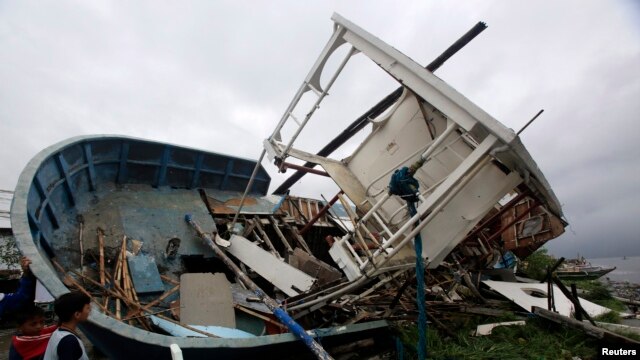
Typhoon Rammasun kills 38 in Philippines


Typhoon Rammasun is headed for China after battering the northern Philippines, where it killed at least 38 people.

Philippine officials say eight people are also missing after the storm cut a path across the main island of Luzon on Wednesday.

Hundreds of thousands are still without power in the capital, Manila, and surrounding areas, where trees and power lines remain down.

Most of those killed were hit by falling trees or other debris. In the city of Lucena, at least three people died when a wall collapsed on them.

Forecasters believe the storm will regain its category three strength as it moves over the warm waters of the South China Sea in the direction of Hainan Island, which is home to nearly 9 million people.

Rammasun, which means "God of Thunder" in Thai, is now a category one storm, with sustained winds of up to 130 kilometers per hour and gusts of up to 160 kilometers per hour.

The storm, which is moving northwest at about 25 kilometers per hour, is expected to make landfall in southern China sometime on Friday.

China's official Xinhua news agency said strong gales, downpours and high tides are expected along the country's southern coast.

It said shipping will be halted indefinitely starting Thursday morning in the strait between Hainan and China's southern Guangdong Province.

Ahead of the typhoon, Philippine authorities evacuated more than 400,000 people. This was in an effort to prevent a repeat of last November's typhoon Haiyan, which killed 6,300 people with its tsunami-like sea surges.

About 20 major storms hit the Philippines every year.

Thursday 17 July 2014

http://www.voanews.com/content/typhoon-rammasun-kills-38-in-philippines-heads-for-china/1959294.html

continue reading

Helicopter crash kills South Korean ferry rescue workers


In a fresh tragedy related to South Korea’s deadly ferry sinking, a helicopter carrying rescue workers who participated in the search operation for those still missing crashed on Thursday, killing all five on board.

The helicopter crashed onto a street in the southern city of Gwangju just before 11am while traveling back to a base in the north of the country. No other serious injuries were reported. The reason for the crash is unclear.

The crash comes almost exactly three months after one of South Korea’s worst-ever maritime disasters. At the site of the April 16 sinking, divers continue to search for missing bodies, while a key fugitive remains on the run and politicians are squabbling over the creation of an independent committee to look into disaster.

On Wednesday afternoon, 43 student survivors of the sinking arrived at the National Assembly in Seoul to support a hunger strike outside parliament by parents of their dead classmates to demand the swift passage of a bill to set up the committee. The students walked for two days from their high school in Ansan, a Seoul suburb, about 47 kilometers, or 29 miles, away.

Politicians are split over issues such as whether to give the committee power to investigate and prosecute. The ruling party opposes the idea, noting that the case is already being investigated by authorities and insisting that state powers can’t be given to a civil committee.

Opposition politicians and the families argue that the committee can’t function properly unless given such strong authority.

“We will do our best to get the bill passed in order to seek the truth and allow no ‘sanctuary’ of the investigation,” Kim Han-gil, co-leader of major opposition New Politics Alliance for Democracy, said during a meeting with family members.

Since the disaster, progress has been slow in leading the country out of national trauma.

In May, President Park Geun-hye made a tearful apology in front of the nation and promised to overhaul safety standards, get rid of social ills, including collusion between the government and civilians, and announced a set of measures to prevent a similar tragic case from happening again.

Separate trials of the owners of the ferry company and of captain Lee Jun-seok and 14 crew members of the sunken Sewol are in their early stages. Most of the bodies from the wreck have been recovered, although divers are still making daily searches of the murky sea in search of 11 missing people who traveled on the ferry.

Authorities are also still chasing a man and his son who are believed to been deeply involved in the operation of the doomed ferry.

If parliament fails to pass the bill by Thursday, which is the last day of the current parliamentary session, it will have to wait until next extraordinary session, likely later this month.

Thursday 17 July 2014

http://blogs.wsj.com/korearealtime/2014/07/17/three-months-after-ferry-sinking-families-seek-new-inquiry/

continue reading

Wednesday, 16 July 2014

18 killed in bus accident in Pakistan's Khyber-Pakhtunkhwa province.


At least 18 people were killed today when the driver of a passenger van lost control and the vehicle plunged about 150 metres into a ravine in the mountainous region of Pakistan's Khyber-Pakhtunkhwa province.

The van was on its way from Thakot to Battagram in Khyber-Pakhtunkhwa province when it plunged into the ravine near Kotgala village.

Eighteen passengers on board the van were killed when the driver lost control and the vehicle fell about 150 metres into the ravine, Noor Wali, a police official, said.

He said the rescue teams struggled to retrieve the bodies due to steep slopes and thick foliage.

The dead bodies were shifted to district headquarter hospital Battagram.

Road accidents are common in Pakistan where hundreds are killed every year due to traffic accidents.

At least 12 people were killed in a similar incident in Pakistan-occupied Kashmir over the weekend.

Careless driving, bad roads and faulty vehicles are common causes of such accidents.

Wednesday 16 July 2014

http://www.outlookindia.com/news/article/18-Killed-in-an-Accident-in-Pak/849938

continue reading

Phuket journalists saved 3000 lives but Tsunami death toll error continues


The Boxing Day tsunami was one of the deadliest natural disasters in recorded history. It caused serious damage to Thailand's west coast and killed more than 8000 people in Thailand.

THE TSUNAMI did not kill 8000 people in Thailand. The toll was just under 5400.

Sadly, an official Thai government document, published to mark the first anniversary of the tsunami that struck Phuket and the Andaman coast on December 26, 2004, carried the wrong figure of 8000 . . . and the inaccuracy has been repeated over and over again ever since.

Working in the aftermath of the tsunami, a colleague and I clearly established that the author of the government document had simply made the mistake of adding the known death toll and the so called total of ''missing.''

The author failed to take account of the wonderful work of the Thai Tsunami Victims Identification unit.

As the police, dentists and pathologists identified nameless body after nameless body, the names should have come off the ''missing'' list.

Unfortunately, because of the lack of coordination between Thai government departments at the time, that didn't happen.

So the mistake was carried in Associated Press and other international news organisations. The false figure even appeared in the closing credits of the the film, 'The Impossible,' last year.

It really is time that Thailand celebrated the work of the international and Thai team that identified the vast majority of the victims, leaving only 388 people who have yet to be identified.

Their bodies are buried in a special cemetery in Phang Nga, north of Phuket, each in a concrete tomb and a metal coffin, to preserve as much DNA as possible.

After nine years of this mistake being repeated over and over again, without journalists checking it properly, if there is one thing we wish for the tenth anniversary this December, it's for the Thai Government to finally correct the mistake.

Restore Thailand's reputation for accuracy.

Wednesday 16 July 2014

http://phuketwan.com/tourism/phuket-journalists-saved-3000-lives-tsunami-toll-error-continues-20633/

continue reading

Toll rises in boat accident off Malaysia


Malaysian maritime authorities have found two more bodies floating in the sea after a boat carrying illegal Indonesian migrants sank, raising the confirmed death toll to four with seven still missing.

The fibreglass boat, believed to be carrying 72 people, capsized late Monday off the southern state of Johor.

The Indonesians on board were trying to return home to celebrate the end of the Muslim fasting month of Ramadan.

A total of 61 including the two boatmen were rescued.

Two more bodies - both men - were found in the water on Wednesday, said Aminuddin Abdul Rashid, an official with the Malaysian Maritime Enforcement Agency.

He said the search for the seven still missing would continue.

The boat, heading to Indonesia's Batam island, sank while being pursued by a maritime patrol vessel.

Aminuddin had said the boat rammed into the agency's vessel when trying to escape, causing it to be damaged.

Boat accidents off Malaysia are common as migrants from Indonesia and other poorer regional countries flock to the relatively affluent Southeast Asian nation in search of work.

An estimated two million foreigners are believed to be in the country without valid papers, with many sneaking in and out along the long coastline.

Malaysian authorities have stepped up patrols this month as many Indonesians seek to return to celebrate Eid al-Fitr, Islam's biggest festival, which marks the end of the fasting month.

Wednesday 16 July 2014

http://www.sbs.com.au/news/article/2014/07/16/toll-rises-boat-accident-malaysia

continue reading

Tuesday, 15 July 2014

India: Government plans DNA database to help find missing people


The government told the Indian Supreme Court on Monday that it intends to create a database of DNA profiles for the first time to locate missing persons and to identify bodies, and a Bill in this regard is in the pipeline.

The decision is significant as approximately 40,000 unidentified bodies are disposed of every year, removing every trace of their existence.

At the same time, thousands are reported missing across the country.

The DNA profiles will be used to ascertain if there is a connection between unidentified bodies and missing persons.

The Centre provided the information in its response to a PIL filed by the NGO Lokniti Foundation, seeking a direction to the government to implement a scientific system of DNA profiling at the national-level for cross-matching missing persons reported from different parts of the country with unidentified bodies.

The PIL said it will also help establish the identity of victims in mass disaster situations like a tsunami, fire or terror attacks.

"Government is seized of the matter and will take an appropriate decision. We are not undermining the issue. But keeping in mind the expertise, expense and infrastructure involved, extensive consultation is required. We are even planning a bill on the issue," Additional Solicitor General Neeraj Kishan Kaul told a bench headed by Justice Dipak Misra.

The NGO'S lawyer, Ashok Dhamija, said the INTERPOL Global DNA Profiling Survey of 2008 showed that 120 of 172 INTERPOL member countries were using forensic DNA profiling in criminal investigation, and as many as 54 countries had set up full-fledged national DNA databases.


Tuesday 15 July 2014

http://www.dailymail.co.uk/indiahome/indianews/article-2692100/Government-plans-DNA-database-help-missing-people.html

continue reading

19 missing, two dead as boat with illegal immigrants capsizes off Malaysia


At least two people died and 18 others were missing after an overloaded fishing boat carrying illegal Indonesian immigrants capsized off the coast of southern Malaysia, a maritime official said Tuesday.

The small fibreglass boat overturned and sank late Monday with around 80 people onboard as a patrolling vessel was pursuing it off the state of Johor, the official with the Malaysian Maritime Enforcement Agency said.

"The boat carried illegal immigrants going back to Indonesia" to celebrate the end of Ramadan, the official told AFP, adding that 59 people had been rescued.

"The boat was small and... overloaded," said the official, who requested anonymity as he was not authorised to speak to the media.

He said the bodies of one man and a woman had so far been recovered.

The boat was heading to Indonesia's Batam island and sank three nautical miles off Tanjung Piai, peninsular Malaysia's southern-most point, he added, raising hopes that some of those missing could have swum to safety.

He said authorities were still investigating the accident but the boatman -- who is among those still missing -- may have panicked when he saw the agency's patrol vessel and lost control.

He denied local media reports that the two vessels collided.

Boat accidents are common as Malaysia draws hundreds of thousands of illegal immigrants from poorer regional countries who fill factory, plantation, construction and other mostly low-paid jobs shunned by locals.

Authorities have stepped up patrols along the country's long coastline during Ramadan as many from Indonesia seek to sneak out and return in rickety boats to celebrate Eid al-Fitr in late July, Islam's biggest festival which marks the end of the fasting month.

The government needed to crack down on agents and employers profiting from illegal labour and corruption among border authorities, said Aegile Fernandez, an official with Malaysian migrant labour rights group Tenaganita.

"Unless all this is addressed, this will happen again and again," she told AFP. More than a dozen people died and about two dozen others went missing last month in two boat accidents in rough weather off Malaysia's west coast.

The boats were also carrying Indonesians, trying to sneak out of the country for Ramadan.

Both Malaysia and Indonesia are Muslim-majority Southeast Asian countries.

About two million foreigners are estimated to live in Malaysia illegally, in addition to almost two million legal foreign workers.

Malaysia also draws refugees from strife-hit regional countries, such as Myanmar and Sri Lanka, who arrive illegally and hope to be resettled to the US, Australia or another nation that accepts them.

Tuesday 15 July 2014

http://www.hurriyetdailynews.com/two-dead-18-missing-as-boat-capsizes-off-malaysia.aspx?pageID=238&nID=69130&NewsCatID=356

continue reading

12 killed, over 160 injured as Moscow Metro carriages derail in rush hour


12 people have been killed and over 160 injured as several subway cars derailed on the Moscow Metro on the Arbatsko-Pokrovskaya dark blue Metro line on Tuesday morning.

“There are so far 12 [dead],” Vladimir Puchkov, the head of the Russian Emergencies Ministry (Emercom) told journalists.

“One hundred and twenty people have sought medical help, 106 were taken to hospital. About a half of them are seriously injured,” Golukhov told ITAR-TASS.

The driver of the train is among those dead, according to a source in the Moscow Metro.

Media reports have emerged of 16 people being dead. Those have not yet been officially confirmed.

The accident happened during the morning rush hour when the train was packed with passengers.

The first carriage of the train sustained most of the damage, according to an eyewitness of the accident who spoke to RT. Ivan, said he was in the second car when the train suddenly braked and the lights went off.

“I was tossed up in the air,” the young man says. “There was blood on the floor, heads bruised, arms broken. Panic broke out.”

Ivan also says after the train derailed there was a flash and then the tunnel was filled with thick smoke.

“The car was badly damaged. We started to get out. We saw a door in the tunnel’s wall. Men eventually broke that door and we saw workers, constructing a parallel tunnel. They helped us to get out.”

An eyewitness, who spoke to LifeNews, was in the fifth carriage and says they had to wait for 30 minutes before the evacuation started.

“So as we got out, we proceeded to march on foot, probably for two or three minutes - along the tunnel with cables underneath. The train driver had told us right away to stick to the right side, so we did. No sooner had we got to the surface than we realized it was a full-blown emergency.”

Andrey Zenin, another survivor in the accident, says he helped extinguish the fire in one of the carriages and he also was among the volunteers who helped to get the injured out of the tunnel.

“There was a man next to me and his head had been smashed by the handrail and he was unconscious,” Zenin told RT. “Some people had broken ribs and one person’s arm was injured. All in all, people were hysterical.”

Law enforcement officials told that three train cars had derailed, “but not overturned.”

Prime Minister Dmitry Medvedev has expressed condolences to the families of the dead and promised that the federal government will help in the post-accident clean-up.

Moscow authorities do not consider the cause the accident in the Metro could have been a terrorist act, according to Maksim Liskutov, the head of the transport department in the Moscow government, cited by Dozhd TV channel.

Moscow Mayor Sergey Sobyanin has promised to take tough measures against those responsible for the accident after visiting the crash site.

“I’m sure a criminal case should be launched into the accident, an investigation conducted and the toughest measures taken,” Sobyanin told journalists, after he visited a hospital where the injured had been taken.

Some passengers could still be at the site of the accident, according to Maksim Liskutov, Moscow’s deputy mayor.

Attempts are being made to try and evacuate the stricken passengers, who are stuck in a tunnel between Park Pobedy and Slavyansky Bulvar stations, in the west of Moscow.

News of the derailment was preceded by reports of smoke detected on the dark blue line of the Moscow Metro. Later, Moscow’s emergencies agency denied reports of smoke and said a sudden failure in the electricity supply to a conductor rail could have caused the accident.

A failure in the power supply led to a false alarm going off. The alarm was a signal to the train driver to immediately stop the train. The sudden braking led to the derailment of several carriages.

The press service says the train derailed because it had to brake too suddenly.

“At 8:39am Moscow time [04:39 GMT] on a stretch between stations of Park Pobedy [Victory Park] and Slavyansky Bulvar there was abrupt deceleration of a train,” Moscow emergencies agency 's press service employee told RT.

Sixty-six buses, 40 ambulances and eight helicopters have been deployed by rescuers for evacuations. Fifty people have already reportedly been evacuated from Slavyansky Bulvar and 200 from Park Pobedy.

The Investigative Committee (IC) has launched a criminal case over ‘violation of transportation security demands’, according to interim head of the Moscow’s Western District Department of the IC, Roman Syomushkin.

Tuesday 15 July 2014

http://rt.com/news/172808-train-moscow-metro-evacuation/

continue reading

Monday, 14 July 2014

One year since train crash killed 7 outside Paris


The crash happened in an instant one year ago on Saturday in the outskirts of Paris, but the image of a mangled intercity train has left an indelible image on the survivors.

“I clung on with my arm to keep from falling and when I looked down, I saw a passenger, half their body disappeared in a few seconds,” said Manou N’Diaye, a survivor who spoke to Le Monde newspaper.

Packed with 385 passengers, the train travelling from Limoges to Paris derailed some 32 kilometres from the capital and beneath a cloud of dust, split into two.

The train – No. 3657 – veered off the track as it entered the Brรฉtigny-sur-Orge station.

Cars ploughed into each other as it smashed into the platform, leaving seven people dead and dozens injured.

Last week, investigators cited a rail joint that worked loose gradually from a track in the absence of proper maintenance, but ruled out the accident as a “malicious act.”

More than 200 irregularities of varying degree were spotted on the surveyed stretch of track and had not been dealt with adequately.

One year on from the accident, 32 passengers of the 177 who reported physical or psychological injury have accepted an offer of compensation, according to report by the Secretary of State for Transport.

Passengers have not been the only victims of psychological trauma over the past year.

SNCF employees are often quoted as saying "before and after Brรฉtigny".

“I think of all of these people,” reportedly said the driver of the train during a ceremony on Saturday. “I think of them, that’s all.”

Monday 14 July 2014

http://www.english.rfi.fr/france/20140712-one-year-train-crash-killed-7-outside-paris

continue reading

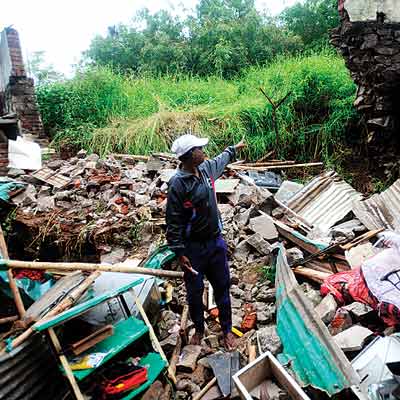
23 killed in Casablanca buildings collapse


The death toll after three buildings collapsed in Morocco's largest city and commercial capital Casablanca has risen to 23.

Fifteen bodies were recovered from the rubble in one day on Sunday, including two children and Moroccan actress Amal Maarouf and her mother, local authorities said.

News website Yibiladi said the actress had continued to respond to calls on her mobile phone for several hours after the calamity but did not elaborate.

Medics said earlier on Sunday that 17 people were still being treated in hospital, while authorities warned of more buried bodies.

Rescue operations were temporarily suspended on Sunday afternoon as emergency teams sought more sophisticated equipment, sparking anger from relatives of the missing.

By evening the site had been cordoned off and the media barred, drawing criticism.

"Search for bodies suspended, equipment deficient. Three days to notice it," the Economist newspaper scoffed in a post on its Internet site.

It was still not known why the three apartment blocks in El-Hank district collapsed on Friday.

Residents told AFP the accident probably resulted from "haphazard works" on the lower floors of the buildings, as well as a general lack of maintenance.

Casablanca has a population of around five million, with many living in squalid conditions in sprawling slums, some exposed to serious safety hazards.

Monday 14 July 2014

http://www.sbs.com.au/news/article/2014/07/14/23-killed-casablanca-buildings-collapse

continue reading

Costa Concordia raised: Divers to search and recover last missing body


Italian officials have pledged to search for the last remaining missing body within the partially submerged Costa Concordia wreckage as the salvage operation makes one final push this week.

Removal of the 290-metre vessel from the seabed will get underway today and last for several days, two-and-a-half years after it ran aground and capsized off the west coast of Italy.

Thirty-two people died in the incident, with most bodies since recovered except one – an Indian waiter.

Franco Gabrielli, from the Civil Protection Department, said it was a “great sorrow” that the final body has not yet been found.

He pledged that divers will continue to search for the last victim as the delicate operation to remove the ship begins this week.

Mr Gabrielli told reporters on the island of Giglio – off which the ship had sunk – that while the weather wasn’t optimal for the mammoth task of extracting the wreck, it was good enough to allow it to start.

The Concordia will be refloated and towed to Genoa on the mainland, where it will be used for scrap.

The cruise liner was successfully moved upright last September, with the hull currently resting on a false bed created at a depth of roughly 30 metres.

The comprehensive process of removing the ship from its current location means that an initial section of the structure will be floated first so that engineers can check for damage.

A pneumatic system will be used to pump water gradually from 30 caissons (airtight tanks) surrounding the wreck, filling them with air and pushing the vessel upwards.

Engineers will float a small section at first to check for structural damage. If the Costa Concordia cannot be moved in one piece, it will have to be dismantled where it is.

If the structure is safe, the ship will be moved 30 meters away from shore before being gradually refloated.

Each of the 13 decks will be examined as they emerge for any hazards that could seep into the ocean.

When the process is finished, a section of about 18 metres will remain submerged and the 114,500-tonne vessel will be tugged at a steady two knots to Genoa on a four-day journey over 190 nautical miles.

Monday 14 July 2014

http://www.independent.co.uk/news/world/europe/costa-concordia-raised-divers-to-search-and-recover-last-missing-body-officials-promise-9603926.html

continue reading

Friday, 11 July 2014

Overloaded China kindergarten bus crash kills 11


An overloaded minivan ferrying children home from kindergarten in China's Hunan province has crashed into a pond, killing all 11 people on board.

The van was carrying eight kindergarten pupils and two teachers, as well as the driver. It was meant to carry only seven people, according to Xinhua.

The crash happened in the late afternoon near the province's capital of Changsha, in a mountainous area.

Local media reported it was travelling on a narrow road that had no barrier.

The victims' family members told Xinhua that school buses in the region are often overloaded.

School transport is a particularly sensitive issue in China, where a series of accidents have heightened concern.

A shortage of education funds has seen school closures and children, especially those from rural villages, are often forced to travel far to get an education, according to agencies. They often have to take overcrowded buses.

In 2011, 18 children and two adults were killed when an overloaded school bus collided with a coal truck in foggy conditions. That bus had only nine seats but was packed with 64 people at the time of the accident.

The following year a school van plunged into a pond in Jiangxi killing 11 children, and three children on board a bus died in a traffic accident in Guangdong.

China's cabinet issued new rules governing school bus safety, setting out specifications for school buses and punishments for offences such as overloading.

Friday 11 July 2014

http://www.bbc.co.uk/news/world-asia-china-28258979

continue reading

Enduring anguish of ferry tragedy


When steel worker Huh Hong-Hwan heard his teenaged daughter might be trapped in a sinking ferry, he didn’t hesitate.

He jumped in his car and drove, sick with anxiety and panic, for five hours down to the southern island of Jindo where the rescue operation for South Korea’s worst peacetime disaster was gearing up.

Nearly three months later, he’s still there. “I never thought I would be waiting for her this long,” the 50-year-old said at a gymnasium that has been his home since the 6,825-tonne Sewol ferry capsized on April 16 with 476 passengers and crew.

“I’m totally exhausted, but parents can’t give up on their children even if the whole world does,” Huh said.

He is one of around 30 relatives who have maintained a bitter, defiant vigil in Jindo, as divers continue the increasingly desperate, dangerous search for the last remaining bodies trapped in the sunken vessel.

Just over 300 people died, the vast majority high school students on an organised outing.

A total of 172 were rescued before the ferry sank and a massive recovery effort involving hundreds of divers working in near zero visibility has since retrieved 293 bodies.

But 11 victims — including Huh’s daughter — are still unaccounted for.

Any hope of finding survivors inside the upturned vessel vanished within days of the accident, but the families of those missing are refusing to give up the search for a body they can bury and grieve over.

The last body to be recovered was more than two weeks ago on June 24 and there is no guarantee that the 11 missing are even inside the ferry.

Several bodies have been picked up dozens of miles away, suggesting a significant number may have been pulled out to sea by the powerful currents.

The 11 include five high school students and two teachers, one crew member and three other passengers.

In order to maintain a full-time vigil, some family members have quit their jobs and the lonely wait has taken a physical and mental toll.

In the immediate aftermath of the sinking, the Jindo gymnasium had resembled a refugee camp, packed with distraught relatives and a small army of volunteers helping to feed and comfort them.

But now the place is nearly empty and the default setting is of absolute silence, bar the muffled sound from a giant TV screen.

The screen had been brought in months ago to feed live pictures of the recovery effort at the offshore disaster site.

Now it is tuned to a news channel showing updates from the World Cup in Brazil.

There is nothing for the exhausted-looking family members to do, beyond sitting or walking aimlessly around the echoing gym.

Some stroll outside to smoke, through glass doors adorned with hundreds of wrenching post-it messages written by families and volunteers.

“My son, today is already May 16. Please come out of the cold water. Let’s go home with mom and dad,” one message read.

The volunteers, who once numbered in their thousands, are now down to around 200, working in shifts to provide what help they can to the remaining families.

“I never imagined the simple act of waiting could be this painful,” said Kwon Oh-Bok, a 59-year-old who lost a younger brother, sister-in-law and six-year-old nephew in the disaster.

Like Huh, Kwon drove to Jindo on the day of the sinking and he hasn’t left since, leaving his electrical business shuttered.

His days revolve around sleeping on a mattress laid out on the floor of the gym, eating meals provided by volunteers, attending daily meetings with rescue authorities, and endless hours of waiting.

“I’m so worried I’ll be the last one left,” he said, echoing a fear shared by many of the remaining relatives.

Kwon bristled at the idea of giving up, and said any move to call time on the recovery effort would feel like a death sentence.

“No one would give up if they were in my shoes,” he said, urging the government to step up search operations.

In the first few weeks, dozens of bodies were being brought up, but only five were recovered in the entire month of June.

Two divers have died and many others have had to be replaced because of sickness or exhaustion.

South Korean President Park Geun-Hye had initially promised that search operations would continue as long as the families wanted.

Park’s previously high ratings have plunged amid intense criticism of her administration’s response to the disaster, and there is little likelihood that she will go back on her vow anytime soon.

Anti-establishment anger is still running very high, and the greed, corruption and incompetence that led to the tragedy is repeatedly being highlighted at the ongoing trials of the captain, the crew and the ferry operators.

Some of the relatives still in Jindo spend much of their time at the island’s Paengmok harbour — the closest they can physically get on land to the recovery site.

Like the gym, the harbour had once been crammed with people, and was where family members were taken to identify bodies as they were brought in by the dive teams.

Now, the sound of a monk chanting and hitting a wooden gong echoes around the jetty, lined with several tents set up by religious groups.

“Please let everyone, to the last missing one, return to their families,” reads one large banner attached to a fence, along with hundreds of yellow ribbons.

“Three months is a long time, but for these families, their lives seem to be completely frozen in time,” said Lee Seong-Tae, a volunteer who has been at the site since the beginning.

Friday 11 July 2014

http://main.omanobserver.om/?p=94480

continue reading

Bosnia buries Srebrenica victims identified 19 years after the massacre


The remains of 175 victims of the Srebrenica massacre in Bosnia have been laid to rest in their final destination of Sarajevo.

After 19 years the pain remains raw.

In an annual event, newly found or identified remains of the victims are transported through the town, so that their loved ones can finally pay their respects before being laid to rest.

Fatima Efendic, lost her son Amir in the mass killing. Having found his remains she can finally begin to grieve.

“I am happy we found him,” she said fighting back tears. “I dreamt of him last night. I was looking for him in my dream. I found him on top of a house, I held him in my lap. My wish and dream finally came true. I just took him into my lap.”

Around 8,000 Muslim men were rounded up and killed when the town was seized during the Bosnian war on July 11 1995. Just over 6,000 have been exhumed from mass graves to be buried at Potocari cemetery.

At the International Centre on Missing Persons, the search continues for the remaining bodies.

“We calculate that there are still about a thousand persons missing,” explained Kathryne Bomberger, Director-General of ICMP. “But also, in addition to that, in addition to these thousand persons, there will be thousands of additional pieces of bodies, of skeletal remains that will also be uncovered that could be re-associated to the ones in the mortuary. So, this is an extremely complex process.”

Though many families wait to recover more complete remains before burial, for those yet to find their missing sons, brothers, husbands and fathers, discovering just one bone would be enough to provide closure.

Friday 11 July 2014

http://www.euronews.com/2014/07/11/bosnia-buries-srebrenica-victims-identified-19-years-after-the-massacre/

continue reading

Thursday, 10 July 2014

Landslides in southwest China kills 12, leaves 33 others missing


A dozen people died and 33 others were missing Wednesday after being swept away or buried by two landslides in southwestern China.

Heavy rains triggered the landslide in Fugong county of Yunnan province that killed six people and left 25 others missing while destroying a silicon mine, the official Xinhua News Agency said.

More than 140 rescuers, using excavators, fire trucks and ambulances, were searching the site of the landslide, which lies about 500 meters (550 yards) from the Nujiang river, Xinhua said.

The Communist Party chief of Fugong county said some of the missing people may have been carried away by the river or buried under debris, the report said.

Reached by phone, a woman who would only give her surname, He, from the general office of the Nujiang prefectural government said rescue work was still underway but hopes of finding survivors were dimming.

"The chance that those who are missing might be rescued alive is very slim," He said.

In Yunlong county on Wednesday, six people were killed and eight others left missing after another landslide buried houses.

Thursday 10 July 2014

http://www.startribune.com/world/266369171.html

continue reading

Wednesday, 9 July 2014

Eight dead as cracker factories collapse in heavy rain in Maharashtra


Eight workers, including five women and a child, were killed and a number of others injured as the roofs of two fire-cracker manufacturing units collapsed in the district this afternoon.

Some more workers are feared to be trapped under the debris.

Police sources said lightning struck the Welcome and Paris cracker factories at Terkheda village in Washi tehsil during a thundershower, causing first a blast, and then collapse of slabs.

It was difficult for rescue teams to reach the spot as Terna river was flooded, police said.

Eight bodies have been recovered from the debris so far but they were yet to be identified, police added.

Wednesday 09 July 2014

http://zeenews.india.com/news/maharashtra/eight-dead-as-cracker-factories-collapse-in-heavy-rain-in-maharashtra_946090.html

continue reading

13 illegal migrants found dead on Libya coast


Libyan authorities have found 13 decomposing bodies in a wooden boat off the coast of the southwestern town of Tagora, a Libyan navy official said on Tuesday.

The boat, which reportedly sank off the coast on Sunday, is suspected of having carried a group of Syrians trying to illegally migrate to Italy via Libya, navy spokesman Ayoub Qassim told Anadolu Agency.

He said the bodies of women and children were among those found on the boat, which was pulled from the water on Tuesday.

Qassim warned of increasingly frequent cases of illegal migrants drowning while en route to Europe, going on to accuse European governments of not taking firm enough measures to address the crisis.

Libya is a major transit point for African migrants seeking access to Europe, especially Italy, via the Mediterranean Sea.

From March to August of last year, more than 30,000 illegal migrants entered the troubled North African country, according to U.N. estimates.

UNHCR told reporters that so far this year more than 500 people are known to have died trying to cross the sea from Africa and Asia to various countries in Europe. A record 64,000 people traveling in small boats from north Africa have reached Italy alone this year - more than in all of 2013.

The Libyan coast guard informed UNHCR on Monday that the dead in the latest accirdent included three Syrians - including the mother and her children aged three and six -- three Eritrean nationals and six other Africans of as yet undetermined nationalities, spokesman Adrian Edwards told a news briefing.

The boat, which reportedly capsized off the coast of Tripoli, had a capacity of about 200 passengers and may have been carrying many more people, Edwards said. Search and rescue operations are ongoing and the fate of others who may have been aboard is unknown.

At least 217 people are believed to have drowned off the Libyan coast so far in 2014 while trying to cross the Mediterranean. Another 290 people are confirmed dead or missing from accidents in the waters off Italy, Turkey and Greece, bringing the death toll in the Mediterranean so far this year to over 500 people.

Wednesday 09 July 2014

http://www.worldbulletin.net/world/140319/13-illegal-migrants-found-dead-on-libya-coast

http://www.rttnews.com/2346702/syrian-mother-children-among-12-bodies-recovered-in-mediterranean-boat-tragedy.aspx?type=gn&utm_source=google&utm_campaign=sitemap

continue reading

Tuesday, 8 July 2014

27 Gambian migrants among dead aboard ship to Italy


At least 27 of the 45 illegal migrants found dead in a boat on its way to Italy last week were Gambian, police sources said Monday.

The victims were among hundreds of other African migrants trying to cross Libya to Italy. The dead were discovered by rescuers in the hold of a ship in waters off Sicily.

"It has been confirmed to us that 27 people among those who died last week are Gambians, which is sad news to us," a senior police officer told Xinhua on condition of anonymity.

"We are really worried and so concerned about the death of our citizens who do take this clandestine journey to Europe, through North African Arab countries. These are really our concerns," the officer added.

According to the Italian police, 45 African migrants were found in the narrowest part of the boat, which was carrying more than double its capacity, and are thought to have suffocated. 566 survivors were rescued.

Tuesday 08 July 2014

http://www.shanghaidaily.com/article/article_xinhua.aspx?id=228439

continue reading