Monday, 4 March 2013

6 charred to death in cracker unit blast


The state has been shaken yet again by a catastrophic cracker unit blast. Six persons were charred to death and one was seriously injured when a cracker manufacturing unit caught fire at Panniyankurissy near Cherpalassery on Saturday. Four persons died on the spot and two on way to hospital.

The accident occurred at 12.15 pm when a makeshift tent caught fire and exploded with a loud bang.

The deceased were identified as Katampazhipuram Sadasivan, Palathingal Sukumaran of Cherpalassery, Thazhathethil Musthafa of Nellaya, Cherikottil Suresh, 36, son of Chandran of Panniyankurissy, Raman of Puthenkurisshu and Puthenpidiykiyil Musthafa. Sadasivan, 46, died on way to the Kozhikode Medical College.

The seriously injured Mani of Kongad has been admitted to the Kozhikode Medical College.

The tent went up in flames and the tarpaulin was seen hanging from atop a nearby coconut tree. Grass and trees in an area of around 300 metres were blackened in the impact of the fire which blazed for more than an hour.

District fire officer K K Shiju said that four units from the fire stations of Shoranur, Mannarkad and Perinthalamanna battled for one hour to douse the fire.

The bodies were lying scattered in pieces and the locals could not go near the site as the fires were blazing and there were three more sheds with ingredients stored in them. It was only after the fire unit came from Shoranur that the people came near the site, said station officer of the Shoranur fire station S L Dileep.

Around 20 workers had taken permission to go for a marriage around 12 noon, just 15 minutes before the blasts, said M Madhu, the leading fireman. Or else, the casualties would have been higher.

The site of the accident was a plateau and there were three more sheds at the site on the higher and the lower reaches which did not catch fire.

Shiju said that one of the sheds was used for storing ingredients, one for casing and the other to fix the wicks to the crackers. In one shed, there were three categories of sacks. While one contained sulphur, the second was of charcoal and the third a white powder which resembled potassium nitrate.

Shiju said that it could also be potassium chlorate which was ten times more powerful than potassium nitrate. Only after examination at the laboratory, the ingredients could be identified. He said that the upper reaches were used to fix the wicks.

The personnel of the bomb detection and disposal squad and forensic expert Unnikrishnan were also at the site. Unnikrishnan said that finger prints could be collected even after the place was watered with hose pipes.

The site belonged to Kalakunnath Mohammed, who is the licensee. The licence was reported to be valid till the end of the current financial year.

Sunday 3 March 2013

http://newindianexpress.com/states/kerala/article1486351.ece

continue reading

Descendants of Flight 410 victim visit Blue Ridge Mountain site


With a light snow blowing under overcast skies, brothers Marshall and A.B. Reid clambered over car-sized boulders and between snagging mountain laurel branches trying to find every piece that remained of a Douglas DC-4 that crashed on Blue Ridge Mountain in 1947.

"It's amazing there's so much wreckage after these years," Marshall observed. "We'll be able to describe this for our mother. She never got to come up here."

"It will be an epilogue for our mother," A.B. added. "I'm glad to have seen it."

Marshall Reid, left, and A.B. Reid stand between the landing struts of a DC-4 that crashed on Blue Ridge Mountain in 1947. The brothers’ great-uncle, Cecil Eaton, was killed in the crash.

Their mother is Marjorie "Mickey" Reid, 83 years old, but in 1947, she was 18 years old and the man who had raised her as his own, Cecil L. Eaton, died in what was, at the time, one of the most deadly airplane crashes in the United States.

Eaton was her uncle, who, along with his wife and Mickey's aunt, Laura, took her in when she was orphaned at 9 years old. They lived in High Point, N.C.

The Reid brothers grew up in Raleigh, N.C., and drove to the Eastern Panhandle Saturday morning by way of Charlottesville, Va., where they stayed with friends.

"I heard the stories all my life," Marshall said. "I began searching for more information about a year ago."

His Internet search took him to the Shannondale & Beyond website, which is maintained by Willis Nowell. The website features a detailed history of the plane crash, which happened a little after 6 p.m. Friday, June 13.

Through the Shannondale & Beyond website, the brothers were able to connect with Nat Hughes, who lives not far from the crash site. He and his wife, Diana, hosted the Reids Saturday. Hughes, Nowell and local resident Carey Ingram took the Reid brothers on a tour of the site, which is on private property.

Pennsylvania-Central Airlines Flight 410 had left Chicago a little before 2 p.m. headed for Norfolk, Va., with stops in Cleveland, Pittsburgh and Washington, D.C.

Eaton, 53, boarded the plane in Pittsburgh. He was headed home to High Point at the end of the workweek.

A graduate of Rensselear Polytechnic Institute in Troy, N.Y., he was a consulting industrial engineer specializing in time and motion studies - he increased the efficiency of factories.

He was going to then-National Airport in Washington to catch a flight to North Carolina.

The weather was not good. It was raining with low-lying clouds, obscuring the crest of the Blue Ridge.

The plane was circling, waiting for air traffic control to clear it before descending to National.

When the pilot, Horace Stark, of Alexandria, Va., got the OK from air traffic control at National, he began his descent.

The airliner, with its 47 passengers and three crew, apparently flew directly into the side of the Blue Ridge near Lookout Rock. It disintegrated upon impact and burst into flames.

Everyone on board was killed.

"According to some reports, the pilot thought he was circling on the east side of the mountain, but he was on the west side and when he began his descent, he crashed into the mountain," Hughes said.

Lookout Rock is about 1,680 feet high. The surrounding mountain ridge is between 1,500 and 1,600 feet high. The plane crashed about 175 feet below the crest of the mountain.

Other reports conjecture that the pilot was trying to get below the cloud cover to find landmarks for his descent to National and did not realize he was as low as he was and as close to the mountain as he was.

Planes in those days were not equipped with the high-tech flight and safety equipment that are standard on today's aircraft.

According to the official report by the Civil Aeronautics Board, the precursor to the Federal Aviation Administration, "The Board finds that the probable cause of this accident was the action of the pilot in descending below the minimum en route altitude under conditions of weather which prevented adequate visual reference to the ground. A contributing cause was the faulty clearance given by Airway Traffic Control, tacitly approved by the company dispatcher, and accepted by Flight 410."

When Flight 410 did not arrive in Washington, the authorities throughout the region were notified.

The then-Martinsburg Journal reported the next day, June 14, 1947, "The local officials were alerted because the last word from the plane had been its routine report to Washington that it had passed just south of Martinsburg at an altitude of 5,000 feet with Washington only 20 minutes flying time away."

West Virginia State Police, Loudoun County, Va., sheriff's deputies and planes from Martinsburg scoured the countryside, but could not find the wreckage.

"The wreckage was finally located by James Franklin, of Washington, (Pennsylvania-Central Airlines) maintenance official, from a chartered plane which flew there and simulated what would have been normal flying practice for the airline," The Journal reported.

The debris from the plane was spotted by Franklin at about 8 a.m. the day after the crash. Parts were spread over a 100-yard area on the side of the mountain, reports said.

Reportedly, the search party was not able to reach the crash site until Sunday, June 15, 1947.

"Uncle Cecil was thrown free of the wreck - he was one of the few who wasn't burned," Marshall Reid said. "He was returned home to be buried in Greensboro (N.C.). He's with Aunt Laura now."

Included in Eaton's personal effects was his pocket watch, which was returned to his wife.

"Items that were recovered from his pockets were returned about two weeks later," Mickey Reid writes in a posting on Shannondale & Beyond. "There was a handkerchief which had minute tears all through it, currency and coins and his pocket watch. The watch crystal was broken and the watch had stopped at the exact time of the crash (6:16 p.m.). We wound the watch and it began working immediately. I have the watch and it works perfectly today."

Marshall said she keeps it in a glass case.

"Mom still works," he said. "She's still sharp. She does crossword puzzles to keep her mind sharp."

She was the first woman to graduate from Duke University with a degree in geology, Marshall said. She worked for the U.S. Geological Service for 30 years, he said.

She got $8,000 from the airline in a settlement agreement.

"I wonder how would my life have been if the plane hadn't crashed," Marshall said. "Would my mom have met my dad? In a split second, things can happen."

Strewn among the boulders and mountain laurel are several pieces of the plane's body still bearing green paint, the pistons from a couple of its four engines and engine cowlings with exhaust pipes as well as the front struts for the landing gears apparently all lying where they came to rest that evening in 1947.

The DC-4 was widely used by civilian airlines and armed forces around the world. It was a little over 93 feet long with a wingspan of 117 feet and 6 inches. It could carry up to 86 passengers.

The passenger list of Flight 410 included J.M. McIntosh, 29, who had graduated from Pittsburgh University the Wednesday before the crash; Mary Bryan and her 10-month-old baby from Indianapolis; Dr. Courtney Smith, Silver Spring, Md., the national medical director of the American Red Cross; David P. Godwin, Washington, chief of fire control for the U.S. Forest Service; and 17-year-old Margaret Kueppers of St. Paul, Minn.

Eight of the bodies could not be identified and were buried in a mass grave in Leesburg, Va. Two bodies were never recovered.

"It's important to get the individual stories out," Marshall said. "They all have stories. There are 50 stories there."

Sunday 3 March 2013

http://www.journal-news.net/page/content.detail/id/591643/Descendants-of-Flight-410-victim-visit-Blue-Ridge-Mountain-site.html?nav=5006

continue reading

Hopes dim for missing landslide victims


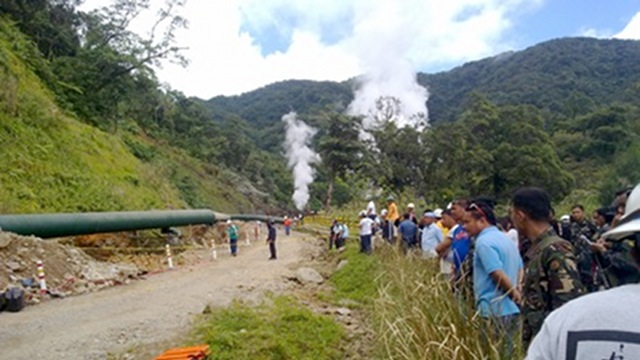
Rescuers will continue looking for nine workers buried alive in a landslide inside the geothermal complex of Energy Development Corp. (EDC) in Kananga town, Leyte, company officials said.

If no survivor will be found by Tuesday, operations will be downgraded to retrieval of bodies, said Alberto Ignacio, senior vice president of First Balfour, EDC contractor.

“We don’t want to prolong the agony of anyone. I cannot tell them (families of the missing workers) that it would be indefinite. So, there must be a timetable as to when we complete the rescue and retrieval operations,” Ignacio said.

“I am also a Christian and I’m hoping for the best,” he added.

A landslide hit EDC’s Pad 403 in Upper Mahiao, Barangay Lim-ao, while 45 workers were constructing a concrete shelter to protect steam pipes from cascading soil and rocks. Five workers were killed, while 21 others were hurt.

9 missing

Nine remained missing. They were identified as Abelardo Permanghel, Marlon Buanghog, Uldarico Taboranza, Salvador Yabana, Jorden Salcedo, Romeo Yazar, Salvador Lascañas Jr., Alfredo Arabis and Danilo Mabatis.

Rains and unstable ground had hampered efforts to locate the missing by 50 rescuers belonging to the safety and rescue teams of EDC, city government and the Army’s 19th Infantry Battalion based in Kananga. The group is led by Ross Taguiam, EDC chief of the health, environment, security and safety unit.

Ignacio said the company would provide financial assistance to the families of the victims.

Promise of work

The wife of Bonifacio Polinio, 33, one of the five workers killed in the landslide, was given burial and financial assistance, as well as a job at the EDC complex.

“They promised to give me work at EDC. I hope they will make good their promise,” said Ruffa Polinio, 21.

She said her husband’s death was painful, especially since they had planned to finally get married in March after living together for six years. They have a 4-year-old son.

Sunday 3 March 2013

http://newsinfo.inquirer.net/368015/hopes-dim-for-missing-landslide-victims

continue reading

Sunday, 3 March 2013

HK balloon victims all identified


All the bodies of the nine Hong Kong tourists who died in last week's hot air ballon disaster in Egypt have now been identified. The Chinese Ambassador to Egypt, Song Ai Guo, says he's now liasing with the authorities to get the death certificates as soon as possible so the bodies can be returned to Hong Kong.

He was speaking after meeting the Egyptian Minister of Tourism, Hisham Zazou.

Relatives of the Hong Kong tourists held a ceremony at the site of the crash, near Luxor, on Saturday to remember their loved ones.

Wearing face masks and carrying black umbrellas, some of the relatives broke down in tears during the ceremony.

When the victims' remains would be returned, however, was uncertain. Egyptian, Chinese and local officials yesterday merely said they guaranteed a "prompt and safe" final return trip for the deceased.

The Government Laboratory received the body samples after 10pm on Saturday and announced confirmation of the victims' identities in Cairo at 5pm Hong Kong time yesterday - just hours after relatives paid a tearful pilgrimage to Luxor.

Samples from three bodies and those of family members were collected for DNA analysis, according to a government chemist, Leo Lam Tze-tsun. Relatives had been unable to identify the three in Cairo due to the condition of the bodies, which had probably fallen from 300 metres.

Yesterday, neither China's ambassador to Egypt nor Hong Kong immigration officials sent to Cairo were certain when a flight could be arranged for the deceased.

Senior immigration officer Lee Kwong-wah said discussions were under way with insurance and medical transport companies, the embassy and the Egyptian authorities "in the hope that the bodies can be transported back ... within the shortest time".

The issuance of death certificates was ongoing, Lee said.

China's ambassador to Egypt, Song Aiguo, said he was pressing Egypt's tourism minister, Hisham Zazou, to speed up the process yesterday. Zazou said the Egyptian government would "facilitate all procedures for the loved ones' bodies to go home safely ... in a very short period".

Commenting on the issue of culpability, Zazou said: "Once we get [the results of] the investigation, if there's any wrongdoing, rest assured that they [those responsible] will be penalised."

Zazou also said the matter of compensation would be raised with the operator of the balloon that caught fire and exploded last Tuesday, killing 19 people.

Sunday 3 March 2013

http://rthk.hk/rthk/news/englishnews/20130304/news_20130304_56_906032.htm

continue reading

Saturday, 2 March 2013

9 dead, 9 missing in Lopez's Leyte power plant landslide


Nine are confirmed dead and nine are missing in a landslide that hit the Leyte geothermal power plant of the Lopez Group on Friday, March 1.

In a statement on Friday afternoon, March 1, Energy Development Corp. (EDC) said they are coordinating with the families of those affected by the landslide that occurred in its Upper Mahiao Geothermal Project in Leyte.

Upon confirmation with JA Arradaza Construction on Saturday, March 2, a subcontractor of First Balfour, which was working on the rig at the EDC plant in the mountains of Kananga, a total of 45 workers were affected by the incident.

This included some 21 workers who were receiving treatment in a clinic and 8 workers who were sent to hospitals.

Landslide

According to some survivors confined at the OSPA-Farmer’s Medical Center and Gatchalian Hospital, the landslide came rolling down from the top of a steep hill around 40 meters high near the rig.

They also shared that pandemonium broke out after a dense smoke enveloped the area where they were working. Due to panic, they just ran off in several directions.

They said they also heard a loud explosion, presumably the landslide. They were not sure if the the loud bang came first or the toxic fumes.

Confined at the Gatchalian Hospital are Ronelo Basan, 24; Romeo Binondo Jr., 32, Edgar Brigildo, 35; Mario Sergida, 22; Alimar Aseo, 19; Joebert Auman, 20 and Ramirito Manawatao, 40.

Attending nurses at the Gatchalian Hospital said that 4 of the confined patients suffered fractures while the remaining were confined for breathing problems after inhaling what is suspected as sulfuric smoke.

Treated for minor injuries were Roldan Rios, 28 and Bennie Leutero, 21.

Search and rescue

Rescuers are scrambling to find the 6 missing, hoping they still catch them alive.

“Time is of the essence here,” EDC Corporate Communications Officer Dave Devilles told local media. “EDC is using all its resources."

A joint emergency response team of EDC and the Leyte government is continuing their search and rescue operation for the missing workers.

"The Emergency Response Team and all available personnel as well as company resources and equipment have already been mobilized," the company said in the statement.

The staff of First Balfour, a sister firm of EDC, are prioritizing the retrieval operations but are sometimes interrupted by rain. They are awaiting a sniffing dog from the military.

Saturday 2 March 2013

http://www.rappler.com/nation/22868-9-dead-in-lopez-s-leyte-power-plant-incident

continue reading

Memorial: Bethnal Green Tube Disaster, 1943


Seventy years ago this weekend, 173 people died and 90 were injured on the staircase of Bethnal Green Tube station in the worst civilian disaster of the Second World War. Yet no bombs were dropped on East London that night.

As the air raid sirens rang out across London on March 3 1943, hundreds of people headed underground to safety at Bethnal Green where the tube station was under construction. Plagued by bombing raids, Eastenders were no strangers to taking shelter, even in the pitch dark of a blackout. Working their way down the temporary steps that night, however, a lady carrying a child fell. The crowd pressed on into the darkness not knowing about the accident in the stairwell below. The resulting crush led to the deaths of 173 people, including 62 children, and injuries to 90 more.

Kingston University graduate Harry Paticas, whose practice Arboreal Architecture is based just around the corner from the station, was unaware of the disaster until a plaque caught his eye one morning on his way to work. "Where it was placed was just the sort of spot that people would rush past on their daily commute," Mr Paticas said. "I was determined to find out more about the disaster and I couldn't understand why such a great loss of life warranted only a small plaque. I felt sure there was a way to use my skills as an architect to help create a fitting tribute for these people and their families."

After six years' fundraising, designing, planning and negotiation, phase one has now been completed. It includes a white concrete plinth set in a landscaped area of granite slabs. As well as listing all the names of those who died, bronze plaques placed along the memorial feature testimonials from survivors, emergency services personnel and relatives of the victims. A reclaimed teak bench overlooking the area offers passers-by and family members a place for reflection, while a small light set in the ground matches the 25 watt light bulb that served the stairwell that fateful night. Funds for a stairwell-shaped canopy, also to be made of reclaimed teak, are still to be raised. Mr Paticas hopes the memorial can be completed later this year - 70 years on from the disaster.

Mr Paticas had his model of the memorial accepted for the Royal Academy Summer Exhibition in 2012. "I wonder how many thousands have passed through the station and never known anything about this tragedy. This project has been a labour of love but I hope, once the memorial is complete, people will take the time to visit and learn more about this historic event."

Saturday 2 March 2013

http://www.thetimes.co.uk/tto/life/courtsocial/article3703400.ece

http://www.kingston.ac.uk/news/article/827/01-mar-2013-architecture-graduates-bethnal-green-memorial-marks-wwiis-worst-civilian-tragedy/

continue reading

Seven burnt to death in ambulance


An ambulance carrying a corpse and seven other persons ran into a bridge at Agona Bobikuma in the Central Region and caught fire, information reaching Adom News indicates.

All seven persons onboard were burnt to death.

An eyewitness, Kwame Addo told Adom News the unfortunate incident occurred at about 5.30pm Friday. He said the ambulance was carrying the corpse to a morgue.

Kwame added that the seven person who were burnt alongside the corpse included a Catholic priest whose name was only given as Father Yeboah.

Police and fire men have been called to the scene, he stated, and they are cutting away parts of the burnt ambulance to remove the bodies.

Friday 1 March 2013

http://edition.myjoyonline.com/pages/news/201303/102170.php

continue reading

Fight for justice: the Bugaled Breizh disaster

Nine years after their loved ones perished on board a trawler in a suspected submarine accident, the families of the dead sailors continue their campaign for justice.

The French vessel the Bugaled Breizh sank claiming the lives of all five sailors on January 15, 2004, about 14 nautical miles (26 km) southwest of Lizard Point, Cornwall.

The grieving families were due to arrive in Cornwall today to show a film of the disaster made by Jacques Losay who is a relative of one of the lost sailors.

Details of when and where the film (The silent killer),will be shown this month have yet to be confirmed.

Exactly how the tragedy happened has never been fully established.

However, many believe the trawler was pulled under the waves after a submarine accidentally snagged its nets.

A specific submarine could not be identified because at the time of the incident there were a number in the area.

The ship briefly radioed it was sinking and disappeared very quickly in good weather conditions.

Only two bodies were recovered at the time – a third body was recovered during salvage operations.

Friday 1 March 2013

http://www.thisiscornwall.co.uk/Bugaled-Breizh-families-plan-film/story-18286405-detail/story.html#axzz2MLZCJIV6

continue reading

Hope fades of recovering New Zealand mine blast victim’s body


The family of New Zealand mine blast victim Malcolm Campbell have finally given up hope that they will ever recover his body.

Malcolm (25), from St Andrews, died when a series of underground explosions ripped through the Pike River coal mine in November 2010.

On the second anniversary of the tragedy, his parents Malcolm and Jane, called for “definitive action” to recover his remains.

They travelled to New Zealand for a memorial service held in honour of the 29 workers, who included Pete Rodger (40) from Perth.

Independent experts had suggested it could still be possible to enter the collapsed mine to bring out the bodies.

This gave the Campbell family renewed hope that their son’s body could be retrieved and repatriated.

But, Mr Campbell, of Cameron, near St Andrews, told The Courier they had now all but given up on this after taking part in a video link discussion over a plan to recover the remains of the 29 men.

A group of around 20 from Pike River families, Solid Energy, the Mines Rescue Trust and the Government’s High Hazard Unit heard from UK experts via a video stream.

Mr Campbell said the New Zealand authorities had agreed to continue developing and assessing two potential methods of exploring the mine’s drift.

The aim of this is to seek further health and safety evidence that might help in prosecutions against the mine’s owners. The attempted recovery of the drift was a “massive and expensive task” costing tens of millions of pounds.

But Mr Campbell — who has talked about being on a “rollercoaster of emotion” — said it was clearly just too dangerous ever to attempt a recovery of the bodies.

He said: “We were speaking to the experts yesterday and they were saying it was unlikely they will ever go back into the main mine because it’s filled with 100% methane gas.

“They are going back into the drift to recover evidence, but they have no plan to go into the mine and are not going to get the bodies out. It’s just too dangerous.

“There’s no way we would ever want any more lives to be put at risk in that mine anyway, so as far as we’re now concerned it’s about us seeking closure. We just have to accept that’s where his body will be staying.”

Former Pike River Coal boss Peter Whittall has denied 12 charges of alleged health and safety failures over the disaster. He is due to stand trial on March 12.

However, Mr Campbell believes other mine managers might yet be held liable and the evidential search at the drift could be crucial.

Mr Campbell also remains hopeful that wider improvements to mine safety will result from the disaster, as New Zealand had one of the world’s worst mining safety records.

A report into the tragedy uncovered a catalogue of failures by the mine owner and New Zealand Government. At the start of November the New Zealand Royal Commission concluded the blast was “preventable”.

A statement on behalf of the Pike River drift exploration working group said a constructive meeting had been held. It had been agreed to continue developing and assessing two potential methods of exploring the mine’s drift.

Nicholas Davidson QC represents some of the Pike families at the meeting and said a deadline can’t be set just yet.

Family spokesman Bernie Monk said it will be an ongoing discussion, and they are not expecting a decision for months.

Friday 1 March 2013

http://www.thecourier.co.uk/news/local/fife/hope-fades-of-recovering-new-zealand-mine-blast-victim-s-body-1.72685

continue reading

Death toll in market fire rises to 20


A 48-year-old person, injured in the Surya Sen Market blaze on Wednesday, died at the NRS Hospital on Friday morning taking the death toll to 20.

Meanwhile, the three agencies involved in the rescue-probe efforts, fire brigade, KMC and police, blamed "human negligence" for the disaster in their preliminary report submitted to chief minister Mamata Banerjee on Friday. The "sabotage" whiff, which the CM hinted on the day of the fire, however, didn't figure in it.

Fire services minister Javed Khan said: "Complete human negligence was behind the fire, for which the owners are responsible. There was only one entry and exit point in the building of that size. The mezzanine floor was illegal." What the minister said was nothing new, for Muchipara police on Wednesday night itself lodged an FIR against the three owners and the market committee president, for the incident.

The illegal mezzanine floor was controlled by the market committee. Though a part of the main building, this 18-odd foot space was given out by the original promoter Naren Saha to old settlers who refused to part with their holdings. All the 23 people (19 of them dead) were recovered by rescuers in this part.

"Today one more person died in the hospital. He was admitted to NRS with 80% burns," Joint CP (crime) Pallab Kanti Ghosh said, adding that a case has been filed against four persons but no arrest has been made so far. Meanwhile, forensic experts visited the site again on Friday and collected further samples. Ghosh said a case has been registered against four persons in connection with the fire.

The latest victim has been identified as Shankar Debnath (48), a resident of Talikhole in Nadia. He was admitted to NRS along with another victim Dinesh Chatterjee - for the past three days. The body was handed over to his relatives after the post mortem was completed at the hospital. The deceased was working in a shop selling plastic materials at the market. The news of the death took the assembled traders and labourers - most of them victims of the fire itself - in shock as they tried to remember Shankar who had returned to the market a few days ago after quitting his job. Some traders alleged that while politicians went to the Medical College Hospital, none visited NRS.

"His family should be compensated," said Shankar Ghosh, a local.

At the Kolkata Police Morgue, two bodies and a body part, among the previous 19 victims, are yet to be claimed among the 19 previous victims. Of this, one person is believed to be a fruit seller who used to stay there overnight for long. Though locals seem to know him, no blood-kin has stepped forward for identification.

Of the remaining bodies, police suspect of the remaining two one could be that of Ratan Poddar's. Ratan's mother Moumita Dutta Poddar - who has already lost her husband Radha Govinda Poddar in the fire - said none of the bodies are that of her son's. Ratan remains untraced in any local hospital too. A DNA test will now be conducted to establish whether any of these charred bodies is that of Ratan's.

The Lok Sabha on Friday condoled the deaths in the Surya Sen market blaze. Speaker Meira Kumar told the House, "As you are aware, 19 persons are reported to have been killed and several others injured in a major fire that broke out in a market in Kolkata on February 27, 2013. The House expresses its profound sorrow on this tragic incident which has brought pain and suffering to the affected families."

Friday 1 March 2013

http://timesofindia.indiatimes.com/city/kolkata/Death-toll-in-market-fire-rises-to-20/articleshow/18758367.cms

continue reading

36 Mwingi bus victims buried in mass grave


Thirty–six killed in the Wednesday morning Mwingi town bus accident were buried in the afternoon in a mass grave at the Muslim Cemetery in town.

“Three others were taken by their relatives, who said they will bury them at their homes,” said Sheikh Abdalla, one of the imams who were conducted the burials.

Abdalla said there bodies was 39. Mwingi District Hospital medical boss Samson Mugane said six of the accidents injured had been transferred to Nairobi for specialised treatment.

Two injured were taken to private hospitals as advised by their relatives. “We don’t have any victims here. Some were discharged and others have been taken by their relatives to seek medical care elsewhere,” said Mugane.

The dean of students at Mt Kenya University Emanuel Owour said among the dead were eight university students. Owuor said one student survived. He added that the students were going to vote in Mandera on Monday.

“We condole the families of the bereaved. We wish the survivors a quick recovery,” said Owuor. “It was one of the worst accidents I have ever witnessed.”

Mwingi police boss Simon Birir said they have launched investigations into the accident and the police are searching for the bus driver who disappeared immediately after the accident. The bus was reduced to a wreckage.

Friday 1 March 2013

http://www.the-star.co.ke/news/article-109934/36-mwingi-bus-victims-buried-mass-grave

continue reading

FBI artists craft more busts to try to ID the dead


One man had a laminated card that said "Protect the Traveler."

Another wore a jogging shirt with the words "Snake Creek."

Both came to a lonely end three decades ago in Chesapeake, their remains discovered by strangers and never identified.

One died of a gunshot wound, the other of an unknown cause.

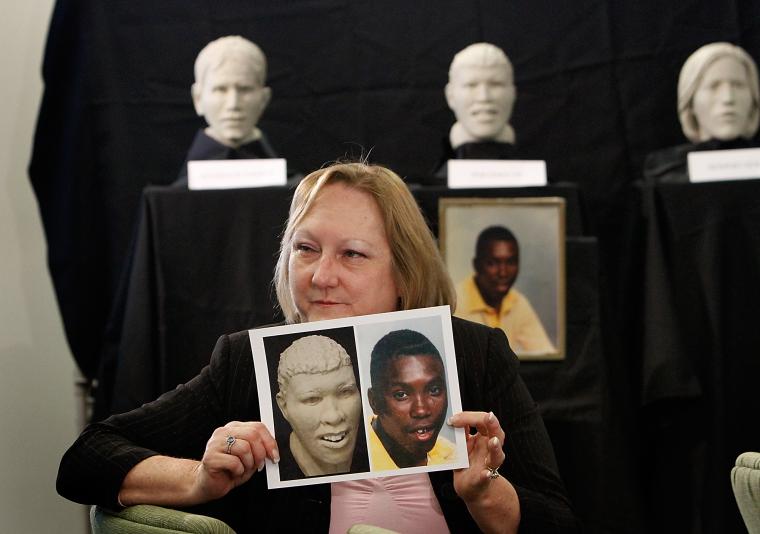
Now FBI artists have used their skulls to construct "facial approximations" in hopes the public can provide clues in identifying them.

Leah Bush, Virginia's chief medical examiner, presented the busts at a news conference in Norfolk on Thursday. FBI forensic artists and anthropologists at the FBI in Quantico crafted the busts from plastic and modeling material, using digitized computer imaging and skulls that Bush provided.

Bush oversees the remains of bodies that have never been identified, some dating back to the 1970s. There are some 200 of them, about a third of them homicide victims.

In 2011, she began collaborating with the FBI on facial approximations. A total of 15 have been presented across Virginia. Three have led to identifications - one each in Portsmouth, the Eastern Shore and Richmond.

Thursday's cases consisted of two from Chesapeake and two from Newport News. In a twist worthy of a "Bones" television episode, one case was first presented at a 2011 news conference in Norfolk as a woman, age 35 to 50, found near a Newport News warehouse. DNA testing later showed the body was a man's, so a new facial approximation was created and presented on Thursday.

The fourth bust was that of a man found floating in a Newport News boat harbor in the Chesapeake Bay.

Bush said identification can bring closure for family members who don't know what happened to their missing relatives, and also helps investigators in homicide cases.

"We have murderers walking free because we can't identify the decedent," Bush said. "This aids the police and it aids the family, so it's win-win for everybody."

Every year, about 4,000 unidentified bodies are recovered across the country. At the same time, as many as 100,000 people are listed as missing.

A clearinghouse called the National Missing and Unidentified Persons System, or NAM/US, tries to make connections by cross-referencing databases of missing persons with another that lists characteristics of the unidentified dead.

Launched in 2009 by the U.S. Department of Justice, the site automatically sifts through the data, matching up cases with similar characteristics. It's often used by law enforcers and medical examiners, but it's free and available to anyone.

More sophisticated DNA testing has been helpful and is often included in the clearinghouse data. Facial approximations by FBI forensic artists also bring fresh attention to cases.

Anyone with information is asked to call the Office of the Chief Medical Examiner at 683-8366.

Friday 1 March 2013

http://hamptonroads.com/2013/02/fbi-artists-craft-more-busts-try-id-dead

continue reading

8 die, 9 missing as restaurant boat sinks in Baghdad river


A crowded floating restaurant loaded with dozens of guests sank in the Tigris River in central Baghdad late yesterday, leaving at least eight people dead and several others missing, according to officials.

The tragedy appeared to be an accident, with police saying the boat was over its capacity when it went down. Iraqi river police and a security official said there was no indication that a terrorist act was to blame.

Divers worked through the night and into Friday in murky waters to recover bodies from a partially sunken floating restaurant in Baghdad after an accident killed nine people attending a party for the local Caterpillar distributor.

The body of one man dressed in a black jacket was pulled to the surface around midday, drawing plaintive cries of "Allahu Akbar," or "God is great," from waiting family members on the banks of the Tigris River.

Plates of half-eaten food remained on restaurant tables onshore, a testament to the previous evening's panic.

The vessel was part of a popular Lebanese restaurant establishment in the Iraqi capital’s Karrada district.

The restaurant is one of several new businesses that have sprung up as Iraq’s economy has begun to improve in the years since the US-led invasion nearly a decade ago.

Ameer Ahmed was on board the boat when it started to go down and managed to swim to safety. He said the whole accident happened in a matter of minutes, and that there was a stampede as crowds tried to escape through the narrow door.

"The windows on the right side smashed inwards, flooding us with water," he said. "The scene reminded me of the movie 'Titanic.' I was lucky because I know how to swim."

Those on board the boat were attending an employee appreciation event for the local distributor of the bulldozer and heavy machinery manufacturer Caterpillar Inc.

At least eight bodies were pulled from the river, and the whereabouts of another nine people were unknown, police and hospital officials said. About 30 people were rescued initially, they said.

The muddy river water left divers with zero visibility, forcing them to search only by hand as they avoided chairs and other debris inside the submerged restaurant, he said. He spoke on condition of anonymity because he was under orders not to talk to the media.

Local TV aired footage showing people gathered at the entrance to the restaurant as bodies in black bags were loaded onto ambulances.

According to police, the boat had been moored to the riverbank and there appeared to be signs of decay on the metal joints that kept it attached to shore.

Baghdad Fire Chief Laith Yas Abbas happened to be dining at the onshore part of the club when the accident occurred. He returned to the site Friday to help oversee the recovery effort.

He told The Associated Press that about 120 people were trying to take a group photo on one side of the boat when it began to take on water. That sparked a panic as guests rushed toward the exit.

It is unclear whether the facility was up to safety standards. Regulatory oversight remains weak and corruption is deeply entrenched in Iraq.

The officials spoke on condition of anonymity because they weren’t authorized to release details to the media.

Friday 1 March 2013

http://www.arabnews.com/middle-east/8-die-9-missing-restaurant-boat-sinks-baghdad-river

http://abcnews.go.com/International/wireStory/restaurant-boat-sinks-baghdad-dead-18622370

continue reading

Six of the nine Hong Kong victims in the hot-air balloon crash in Luxor identified


Six of the nine Hong Kong victims in the hot-air balloon crash in Luxor have been identified by relatives but the remaining three are too badly disfigured and will need forensic or DNA tests.

Chief inspector Cheung Wai-man of the Hong Kong police said in Cairo yesterday that three men and three women had been visually identified. Two men and a woman remained unidentified although all three were confirmed to be from Hong Kong.

The relatives of the victims from three families spent nine hours visiting four Cairo hospitals where the bodies of all 19 crash victims are being stored.

They visited four Cairo hospitals with SAR government forensic experts. Police chief inspector Eric Cheung from the disaster victims identification unit said the process had not yet been completed, but he was confident the remaining three bodies would be identified.

Mr Cheung explained that the families had provided photos and other information to help the work, but there had been some difficulties over bodies that had been badly burned.

The relatives had been due to travel to the ancient city of Luxor, where the accident happened, to pay respects to the dead and perform rituals, but have now postponed the trip.

It had previously been stated that it wouldn't be possible to identify the bodies until Monday -- but the Chinese ambassador to Egypt, Song Aiguo, said his embassy had asked the local authorities to speed up the process

Forensic pathologist Dr Lai Sai-chak, one of 16 government officers sent to Cairo to assist the relatives, said some bodies could not be identified visually as their faces were disfigured. "This could be due to the fall from height," he said, referring to the stricken balloon's 300-metre plunge.

Psychologist Rosalie Lo Shuk-yee, sent to Cairo by the Hospital Authority, said the relatives were calm during the identification process.

When an accident unfortunately happens, we are all very sad and what we can do is to improve on all sides to reduce the possibility of it happening again

Meanwhile, Spanish balloon maker Ultramagic, which made the crashed balloon, offered condolences to the victims and their families. But it said balloons were still safe, with over 100,000 flights a year and very few accidents.

"When an accident unfortunately happens, we are all very sad and what we can do is to improve on all sides to reduce the possibility of it happening again," it said. The company said it had been told by a trustworthy source at the scene that the fire that caused the fatal crash was sparked by a gas leak from a hose broken by a rope that was wrapped around it. The rope was dropped to the ground and the hose began to leak when the ground crew pulled it.

"The gas escaping then started to burn and the balloon pilot had some fire in his face and he and another passenger jumped out of the basket," the firm said.

Friday 2 March 2013

http://www.scmp.com/news/hong-kong/article/1167635/relatives-identify-luxor-crash-victims

continue reading

Friday, 1 March 2013

Chinese families visit Egyptian hospitals to identify victims of balloon explosion


Several families from China's Hong Kong visited hospitals in Egypt's capital of Cairo on Thursday evening to identify victims of a tragic hot balloon explosion in Luxor.

On Tuesday, a hot balloon carrying 21 people caught fire and exploded in Luxor city, about 670 km south of Cairo, killing 19, including nine tourists from China's Hongkong, and injuring the other two.

The Chinese families, accompanied by Chinese embassy officials, Chinese foreign ministry officials and a delegation from Hong Kong, planned to visit several hospitals to identify the victims, starting with Nasser Institute Hospital which hosted three bodies.

"We have three dead bodies here in the hospital, one of whom was identified in the morning to be a Japanese man, another was now identified by the families to be a Chinese man, while the third body is of a female and has not yet been identified but is believed to be a Chinese woman," Osama Saeed, the hospital's deputy director and head of operation department, told Xinhua.

Saeed added that the hospital is currently performing DNA tests with the third body.

The families left Nasser Institute Hospital around midnight, but were scheduled to visit another three hospitals before returning to their hotel in Cairo.

Earlier Thursday, Song Aiguo, Chinese Ambassador to Egypt, said at a press conference that the embassy had urged the Egyptian government for fast procedures to identify the bodies of the victims.

Friday 1 March 2013

http://news.xinhuanet.com/english/china/2013-03/01/c_124401457.htm

continue reading

Coroner declines Accident Bureau’s request in Dana plane crash inquest


A Lagos coroner, Oyetade Komolafe, on Thursday turned down requests by the Accident Investigation Bureau, AIB, to invite one of its consultants to the ongoing inquest on the victims of the June 3 Dana Air plane crash.

According to the Chief Medical Examiner of Lagos State, John Obafunwa, during his cross examination at the last sitting, AIB consultant, Kunbi Banjo, a professor of Anatomical Pathology, had tried to dissuade the state from conducting postmortem examinations on all the victims of the June 3 Dana Air disaster. Instead, Mrs. Banjo had asked the team of pathologists to restrict their examination to only the bodies of the pilot and co-pilot.

The AIB vehemently denied the claims during Thursday’s inquest.

Chinedu Anene, AIB’s counsel, requested that Mrs. Banjo, a pathologist at the Lagos University Teaching Hospital, be invited to state her account of events.

“From Prof. Obafunwa’s testimony, there were assertions of what the AIB did or did not do and what somebody said or did not say,” Mr. Anene, who also represented the Aviation Ministry and Nigeria Civil Aviation Authority, said.

“We have not been able to refute, challenge, or corroborate the testimony. And we do not expect her (Mrs. Banjo) to go to the pages of newspapers to defend herself. It will be a contempt of court,” he added.

Obi Okwusogu, counsel to the Nigerian Airspace Management Agency, added his weight to the request, stating that the pathologist be invited “in the interest of justice.”

“I hope that the court has not concluded that Prof. Banjo be excluded (from giving witness),” said Mr. Okwusogu, a Senior Advocate of Nigeria. “I consider that her evidence will be very important to this court and the country as well.”

Mrs. Banjo’s efforts to dissuade the pathology team earned her an exclusion from the medical team who eventually went ahead to perform postmortem examination on the over 150 corpses.

While he was being cross examined on Thursday, Mr. Obafunwa admitted that the Dana crash investigation was his first shot at a large scale postmortem examination but it wasn’t Mrs. Banjo’s first.

“I was informed she was involved in a helicopter crash up north in which two or three people died,” he said, adding, “I’ve not seen the report. I don’t know exactly what she did.”

Another senior advocate, Bolaji Ayorinde, while supporting Mrs. Banjo’s invitation said that the inquest could benefit from her experience in air accident investigations.

“Unlike the eminent prof. who is doing this for the first time, even though on a large scale. Let her come, she may be able to throw some light,” Mr. Ayorinde said.

Mr. Komolafe, the coroner, turned down the requests.

“I don’t think the witness will add any value to the inquest,” he said.

“We are concluding. The only witnesses remaining are the Dana (Air) witness and Prof. (Obafunwa). We don’t have any intention of extending. Everyone has been given a chance to call their witness, if they have failed to do that, it’s their business,” Mr. Komolafe declared.

The coroner adjourned till April 18 and 19 for the continuation of Mr. Obafunwa’s cross examination.

Oscar Wilson, Dana Air’s Director of Flight Operations, entered the witness box next. He had earlier, repeatedly, failed to attend the inquest for his cross examination.

Mr. Wilson stated that the AIB had admitted making some errors in their interim report on the Dana Air accident.

The AIB report stated that Peter Waxtan, the American pilot of the ill-fated plane, was employed by the airline in March, 2012, began “line operations” in late May and had accrued over 120 hours before the crash.

“That is not correct,” Mr. Wilson said.

According to Mr. Wilson, a commercial airline pilot flies 100 hours in one month, four hours a day, and two compulsory consecutive days off every week.

“He (Mr. Waxtan) started making commercial flights in May. Prior to the incident, he had been flying for about one month on his own,” said Mr. Wilson.

“We brought it up with the AIB and they said they made a mistake in that statement, that there was an error in the figures,” he added.

Friday 1 March 2013

http://premiumtimesng.com/news/122462-coroner-declines-accident-bureaus-request-in-dana-crash-inquest.html

continue reading

Japan investigation team joins Luxor hot air balloon crash probe


Investigations into the deadly Luxor hot air balloon crash that claimed 19 lives on Tuesday have revealed that civil aviation officials were present where the hot air balloon was parked on Luxor’s west bank, and permitted it to take off. The pilot’s license and the balloon’s license were both found to be valid.

According to the state-run news agency MENA, the pilot, Mourad Momen is seriously injured, and is currently being treated at a military hospital in Cairo.

State TV reported earlier on Thursday that a Japanese investigation team had arrived in Cairo to support the investigation. Four Japanese nationals were among the dead.

Six bodies had already been identified and transported to embassies in the capital, said Ihsan Kamil Georgy, chief medical examiner on the case, according to the state TV website.

Georgy added that three emergency teams had been formed to examine the bodies. The medical examiner has asked embassies to contact families of the deceased for photos to helpo identify the remaining victims. If that fails, the teams will analyze DNA.

An Egyptian youth was also killed when the hot air balloon burst into fire and crashed into a field after falling 1,000 feet, Georgy said. Her body was returned to her family.

Thursday 28 February 2013

- See more at: http://www.egyptindependent.com/news/update-papers-were-order-pilot-balloon-deadly-luxor-crash-officials-say#sthash.QRhjN1z6.dpuf

continue reading

Thursday, 28 February 2013

Six of 19 hot-air balloon victims identified: Egypt forensics chief


The bodies of six of the 19 tourists who died on Tuesday in a hot-air balloon crash in the Upper Egyptian city of Luxor have been identified, according to Egypt's forensic chief Ihsan Kameel Georgie.

Following the accident, the bodies of the victims were transported from Luxor to several different hospitals in Cairo. Victims included foreign nationals from the UK, France, Belgium, Hungary and Japan, along with nine tourists from Hong Kong.

The bodies have been identified by representatives of the British, French, Japanese and Hungarian embassies. According to Georgie, embassy officials were asked to bring photos with which to identify them.

The forensics chief added that DNA tests would be conducted on the bodies that could not be identified by photographs. DNA samples, he explained, would be taken from victims' relatives and checked against those taken from the bodies.

Georgie added that preliminary investigations had revealed that most of the victims had died from burns or from the long fall from the hot-air balloon.

The balloon exploded at dawn on Tuesday as the pilot attempted to land it following the discovery of a leaky gas cylinder. The crash left only two survivors: Michael Rennie, a Briton, and the pilot, both of whom jumped out of the balloon in an effort to escape the inferno.

Egyptian Prosecutor-General Talaat Abdallah has since ordered an investigation into the incident. The Egyptian Ministry of Tourism, meanwhile, has drawn up a committee to determine the cause of the disaster.

The last hot-air balloon accident in Luxor, which left 16 people injured in 2009, led to a six-month moratorium on all hot-air balloon activity until additional safety measures had been put in place.

Egypt witnessed other hot-air balloon accidents in 2007 and 2008, but neither of these led to any deaths.

Thursday 28 February 2013

http://english.ahram.org.eg/NewsContent/1/64/65804/Egypt/Politics-/Six-of--hotair-balloon-victims-identified-Egypt-fo.aspx

continue reading

Hong Kong forensic experts to examine bodies of Egypt balloon accident victims


Hong Kong’s forensic experts will soon examine the bodies of nine Hong Kong tourists who died in a hot-air balloon accident earlier this week.

The experts – including a forensic pathologist and a specialist in the identification of bodies – are part of a seven-member team who arrived in Egypt on Thursday to join another team of government officers to help the victim’s families.

They will assess the condition of the bodies before helping the victims’ relatives to identify them, senior immigration officer Lee Kwong-wah said in Cairo on Thursday.

The nine Hongkongers were among 19 tourists who died after the sightseeing hot-air balloon they were aboard burst into a fireball shortly before landing in the ancient city of Luxor. Their bodies are badly burnt.


The pilot and a British tourist survived. They were both injured. The pilot suffered severe burns and remained in an intensive care unit in hospital.

The accident is understood to have happened when a cable got tangled around a gas tube and a fire broke out.

Thursday 28 February 2013

http://www.scmp.com/news/hong-kong/article/1163077/hong-kong-forensic-experts-examine-bodies-egypt-balloon-accident

continue reading

No bodies, no compensation for heirs


Several months have passed since the fire erupted at the garment factory in Baldia Town, but dozens of families are still waiting for the victims’ bodies as well as for the compensation amounting to Rs900,000 for each victim’s family.

There are still 23 legal heirs of the victims who have not been compensated because their DNA samples did not match the bodies that were recently buried.

Nazia Parveen is one such legal heir. She is the widow of Riaz Ahmed and the sister of Rafaqat Ali. Ahmed and Ali both lost their lives in the fire at Ali Enterprises, the garment factory.

However, despite providing DNA samples thrice, she was not handed over her husband’s body and is yet to be compensated as well.

Parveen, along with other heirs of the victims, had recently staged a demonstration in front of the Sindh Assembly to demand the victims’ bodies and compensation.

Following the protest, the authorities concerned had held a dialogue with the heirs and persuaded them to allow the burial of 17 bodies that were kept at the Edhi morgue since the time of the incident. After the heirs’ permission, 17 unidentified bodies were buried on Sunday.

After the fire on September 11 last year, which claimed the lives of around 300 workers, the prime minister, the provincial government and Malik Riaz had announced Rs400,000, Rs300,000 and Rs200,000 as compensation for the family of each victim.

Initially, in the absence of a proper mechanism, several heirs allegedly took bodies from the hospitals and the mortuary and buried them.

Since several remaining bodies were apparently beyond identification because they were badly burnt, the government took DNA samples from the affected families, but the resultant report has yet to be released.

Parveen, who played an important role in assembling the heirs to hold a demonstration in front of the Sindh Assembly, told this correspondent that after the demonstration, the Karachi commissioner had claimed that he had the compensation for all the victims’ families.

She said they were requested to allow the mass burial because the sanctity of the bodies was being affected.

She revealed that after the mass burial, there were still five bodies at the Edhi mortuary that have been identified through DNA, but their legal heirs had yet to collect them since they had already buried someone else in their place.

Parveen said when she asked for compensation, she was told to present the death certificate of her husband, which she did not possess.

Her brother’s body was recognised and compensation amounting to Rs700,000 was awarded to his legal heirs.

“I have been desperately going from pillar to post to get the body of my husband and the lengthy and torturous process has made my life miserable,” she said.

She said she lived in a rented house with three children to look after, adding that she did not know when the government would compensate her.

“Government functionaries are asking me to produce proof of death of my husband. That is not my responsibility. The government should have arranged these documents,” she added.

National Trade Union Federation (NTUF) Deputy General Secretary Nasir Mansoor, who has been a strong supporter of the victims’ families, said the government had arranged the mass burial of 17 bodies to get rid of the issue for good.

He said that the victims’ families would continue to suffer as long as the government does not compensate them.

The NTUF is planning to sue the international audit company that had awarded a clean chit to the garment factory two weeks before the fire broke out there, he added.

Thursday 28 February 2013

- See more at: http://www.thenews.com.pk/Todays-News-4-162525-No-bodies-no-compensation-for-heirs#sthash.O18J9Sx7.dpuf

continue reading