Thursday, 17 January 2013

Arizona: Naming the dead from the desert


It's the job of a forensics team in Arizona to identify the bodies of migrants found in the desert. Anthropologist Robin Reineke describes how she pieces together the sad jigsaw puzzle of personal attributes and belongings.

There are many ways to enter the US. The way that's taken by the very poorest is to come through the Sonoran Desert on foot.

It's a very forbidding place - the temperatures in the summertime are regularly in the triple digits Fahrenheit and there's no water.

Groups of people will walk for three to five days, travelling by night and drinking out of cattle troughs or whatever they can find. It's unlikely they will see other people for the duration of the trip.

At present, Tucson, Arizona has almost 800 unidentified bodies of migrants who didn't make it to the other side.

They were found by border patrol, by citizens of the Tohono O'odham Indian reservation, or by ranchers or hikers. I compare these unidentified remains to lists we have of missing persons, collected from families of migrants last known to have been attempting the crossing.

When there is a possible match, I call the family.

Recently, I called the wife of a missing man. "There's someone who could potentially be your husband," I told her. "Can I ask you some questions?

"Did he have any tattoos? You said that he was missing an upper molar. Could you tell me more about that?"

One day in the desert heat is enough to make a body unrecognisable, so the possessions that are found with the remains can be incredibly important to the family.

There's often an interesting combination of objects. Mostly it is the normal stuff that anyone would take with them on a trip - toothpaste, socks, snacks, water.

But then there are these very personal items - photographs of loved ones, handwritten notes from family members, kids' drawings.

The letters are from the children or wives of those we've found dead, wishing them luck and telling them that they're loved, that they should be very careful on the journey, that the family's prayers are with them, that the family's hopes are with them.

And the photos have been touched and pulled out over and over again, then folded up and put back carefully.

Some of the items have unspoken stories.

There was a young kid - he was probably only 15 or 16 years old - and the soles of his shoes were just completely worn off. He had been carrying one orange paper flower.

I remember a man who had a small dead hummingbird in his pocket. I know that for a lot of indigenous North American peoples hummingbirds hold a sacred significance - they represent hope and love and they're a powerful protective symbol.

With certain objects, my familiarity with Mexican and Central American cultures helps me to make a guess about where someone came from.

For example, many migrants carry prayer cards - small cards with a saint or a holy scene printed on them with an accompanying prayer. A prayer card of the Virgin of Juquila is likely to have belonged to a Oaxacan traveller, since it is there that she is venerated.

You can think of it like a puzzle - a puzzle which has a great deal of importance to a lot of people.

While most anthropologists who work in human identification are physical or forensic anthropologists who specialise in skin and bone, I am a cultural anthropologist focused on the social world.

My training helps me bridge the gap between forensic scientists and the families of the missing, who are generally indigenous people.

The forensic scientists and I have a lot of faith in science, which is a belief system. It requires trust in officials, in the scientific method, in technology. Many families of missing migrants are coming from communities in Mexico or Central America that have been violated for centuries by officials, scientists and technologies. There is a lot of mistrust.

Moreover, the family is looking for something recognisable, something that carries the trace of the person they knew.

______________________________

Case ML #10-00533
The owner of these prayer cards was found by an off-duty border control guard while he was hiking on a remote mountain, on 12 March 2010

The male, aged between 22 and 35, had likely died years earlier, since little more than his skeleton remained


______________________________

They can get fixated on details scientists might consider nearly irrelevant, like the buttons on a pair of trousers or a brand of tennis shoes. These are things that have meaning to them. They are also things that someone can change, unlike their DNA or fingerprints.

So while I might be trying to arrange a DNA comparison with a family, they'll be asking to see photos of the remains. Sometimes they show up in my office, having driven for hours, asking to see the body.

Generally, we don't allow this unless the dead person is recognisable. Some might argue that it is not our job to protect families from the truth. But if they see an unrecognisable, decomposed corpse or skeleton, they may not only be traumatised, they may simply reject the identification. I've been involved in a few of cases where we have come very close to a positive ID and the family suddenly rejects involvement or says we're lying.

Because of the highly decomposed nature of the bodies, the calls I make are never as simple as, "I am sorry to inform you…" Instead, it's the beginning of a process that could take months. It unfolds as a kind of a negotiation between the scientists and the families. Both sides have the same goal - to find the missing person.

But for the scientists, the problem is an unidentified dead body, whereas for the families, the problem is a missing living person. These realities pull them in opposite directions.

And, coming after a long period of not hearing anything, these are months of agony for families. What they have already endured is terrifying. You cannot grieve without a body - without certainty that the person is gone. Every single day that you are living a normal life, you know they could be suffering.

One case that stands out is a large group of Guatemalans that were all from the same town, who attempted to cross in the summer of 2010.

The man who was leading the group had crossed before, maybe five or 10 years earlier. But the border had completely changed - it is a lot more difficult to cross over now. The man got lost with this whole group of friends and relatives following him.

One of them was able to call his wife and tell her that they were lost, that they had been walking for seven days, that they were out of food and water, that some of the group had been vomiting blood, that they knew they were going to die.

I received all the reports of the missing and a big sleuthing operation began. Three sets of bodies were found in different locations, months apart. We were able to identify five of them. The other seven or eight remain missing.

I went to Guatemala with my husband in the summer of 2011 to meet the families of the dead and missing from this group. I was struck by the difference between those whose loved ones had been identified and those who were still waiting.

Even with the knowledge that the whole group had been lost in the desert, and that some of them had come home in coffins, the families of the missing were distraught - sickened by the condition of not knowing. Their faces are burned into my memory.

I won't pretend that I have an easy job and that I don't take some of it home. I work with an incredible team, who have taught me everything. And I have a wonderful husband and a fuzzy dog at home to keep me sane.

And I feel very honoured to be doing this work. The unidentified are here in Tucson and I feel an obligation to them.

The immigration issue is tough but it's not intractable.

For me, it's frustrating that there is so much attention on the physical line of the border, and on border security. When hundreds are dying each year, their bodies rotting in the desert, we have to think about what is an effective border, what is effective security - and security for whom? It is time to really think about what we have done as a continent to cause people to risk their lives in such large numbers.

Immigrants are being blamed for a lot at the moment - they're being scapegoated. I feel that these people were, by and large, good, hard-working people that did not mean any harm. By attempting the crossing they were trying to do the very best for their families.

I would definitely do the same thing.

______________________________

Case ML #11-00206


Money

Many migrants carry all the money they have. Before they meet up with their coyote (guide) they are often carrying the payment with them in cash, which is usually more than $2,500.

This is very dangerous. Every year, hundreds of Central American migrants fall prey to criminals, especially drug cartels and gangs.

False Mexican Voter ID card

When false Mexican ID is found with unidentified remains, Robin’s team look at their missing lists from neighbouring countries – in this case, the owner was Honduran.

He would have needed false ID to travel through Mexico, where he would also have been considered an “illegal”. Another reason for the fake ID is that if he had been caught trying to cross into the US, he would only have been deported back to Mexico rather than all the way to Honduras.

SIM cards

These are not uncommon. Migrants often carry them as back-up in case their cell phones get taken.

List of names and numbers

This is one of the most common items found with migrants. The guides often take their cell phones at the start of the journey, so the migrants carry numbers with them instead.

The numbers were key to helping the team identify this individual, who was found in January 2011, about 10-15 months after his death.

Someone from the Mexican consulate called one of the numbers and spoke to a person who knew a man using false ID. He was ultimately identified through a DNA match, thanks to the Argentine Forensic Team, which funds a large number of DNA comparisons for Central Americans.

Prayer card

The words read “Cristo mi piloto” (Jesus is my pilot) with a prayer on the back.

Wallet

Since all travellers carry wallets, and many of them are very similar, these rarely help in the identification process.

______________________________

Thursday 17 January 2013

http://www.bbc.co.uk/news/magazine-21029783

continue reading

Mastung bombing: Funerals offered for 15 victims


The Shia community of Rawalpindi offered funeral prayers on Wednesday for 12 persons killed in the Mastung terrorist attack after their identities were determined through DNA testing a day earlier.

Before handing over the 12 bodies, which included two women, the Shia community offered their funeral prayers at IJ Principal Road near Muhammadi Imam Bargha in New Katarian.

The bodies of three victims hailing from Rawalpindi were earlier handed over to their relatives for burial, while the other 12 were given to their relatives after the collective funeral. Five of the dead bodies would be taken to Sindh, and rest to different areas of Punjab for burial.

Four other dead bodies remain at Holy Family Hospital.

Speaking after the funerals, Majlis Wahdat Muslimeen (MWM) Pakistan Secretary General Allama Nasir Abbas Jafri criticised the government for their failure to curb terrorism and especially the targeted killings of Shias in Balochistan.

He said if governor rule was rescinded as demanded by the Balochistan Assembly, they would start protesting against the federal government as the elected government of Balochistan’s only achievement was five years of failure to protect the common man.

All politicians are gathered in Lahore to safeguard their interests but they had never sit together to bring out a collective policy against the terrorism in the country.

DNA verification

On Tuesday, the district administration of Rawalpindi received identity confirmation of 18 out of 19 bodies from the Mastung attack and had initiated the process of handing them over to their heirs.

In response to a request from the medical superintendent of Holy Family Hospital (HFH), where 16 dead bodies were kept after being brought from Quetta two weeks ago, the Institute of Biomedical and Genetic Engineering (IBGE) Islamabad on Tuesday sent the reports for samples from 18 victims.

The Rawalpindi district administration took samples from the bodies and blood samples from relatives of the unidentified and sent them to IBGE for DNA profiling.

The bodies, which could not be visually identified due to the circumstances of their deaths, were flown in to Rawalpindi from Quetta on a C-130 on January 1 after the December 31, 2012 bombing of a bus carrying Shia pilgrims near Mastung.

Apart from the 16 bodies at HFH, three were kept at District Headquarter Hospital (DHQ) and the administration waited for the arrival of samples of the bodies taken at Quetta to match them with samples from claimants.

After a wait of 10 days, the Rawalpindi administration was informed that the samples taken at Quetta had been lost and new samples should be taken for further identification of the bodies.

A senior doctor at HFH said they had to pay Rs10,000 per sample to the IBGE and the bodies were to be transported to their native areas in Punjab and Sindh.

Rawalpindi District Coordination Officer (DCO) Saqib Zaffar said the administration was trying to contact the relatives of the dead and leaders of Shia community to hand the dead bodies.

He said there were three dead bodies from Rawalpindi, while the rest were to be transported to different areas of Punjab and Sindh.

Regarding the 19th victim, the DCO said it was being kept under consideration for further test to determine the relationship between the deceased and the claiming relative.

About the transportation of the dead bodies, he said it was preferred that the families themselves collected the bodies, however, if they could not afford to, the district government would help them in the process.

Thursday 17 January 2013

http://tribune.com.pk/story/495001/mastung-bombing-funerals-offered-for-15-victims/

continue reading

String of bomb blasts in Iraq kill at least 22, mostly Shiite pilgrims


Insurgents unleashed a string of bomb attacks mainly targeting Shiite Muslim pilgrims across Iraq on Thursday, killing at least 22 people and extending a wave of deadly bloodshed into a second day.

The eruption of violence follows nearly two weeks of relative calm, and threatens to enflame rising tensions among Iraq’s ethnic and sectarian groups.

The worst attack took place near Dujail, 80 kilometers (50 miles) north of Baghdad, where a pair of car bombs exploded near pilgrims who were traveling on foot to a shrine in the town of Samarra.

The head of the Salahuddin provincial health directorate, Raed Ibrahim, said 11 people were killed and more than 60 were wounded in that attack.

“We heard thunderous explosions, and everybody went outside and saw burning cars and several bodies on the ground. Market stalls on both sides of the road were on fire,” said Naseer Hadi, who works in the Dujail post office.

The pilgrims were heading to Samarra to commemorate the death of two prominent Shiite Imams who are buried in the al-Askari shrine there.

A 2006 bombing at the gold-domed shrine that was blamed on al-Qaida in Iraq set off years of retaliatory bloodshed between Sunni and Shiite extremists that left thousands of Iraqis dead and pushed the country to the brink of civil war.

The attacks in Dujail came hours after a car bomb struck a bus carrying foreign pilgrims near the southern Shiite holy city of Karbala. Four people were killed and 12 were wounded in that attack, according to police and hospital officials.

The explosion tore through the undercarriage and blew out most of the windows of the white and blue tour bus that got hit. Nusaif al-Kitabi, deputy chairman of the Karbala provincial council, said the bus was carrying pilgrims from Afghanistan.

In the town of Qassim, 125 kilometers (78 miles) south of Baghdad, a parked car bomb exploded near a bus stop, killing five people and wounding 20. The casualties included Shiite pilgrims who were heading to Karbala, said police and hospital officials.

Shiite pilgrims are a favorite target for Sunni insurgents who seek to undermine the country’s Shiite-led government and provoke a return to sectarian fighting.

In northeastern Baghdad, a roadside bomb apparently meant to hit an army patrol missed its target and struck a civilian car, killing 2 passengers and wounding two others, said police and hospital officials. Like most other officials, they spoke on condition of anonymity because they were not authorized to release the information to reporters.

Thursday’s bloodshed comes a day after a wave of attacks killed at least 33 people across Iraq in the country’s deadliest day in more than a month.

Thursday 17 January 2013

http://www.washingtonpost.com/world/middle_east/iraqi-officials-car-bomb-attack-kills-4-shiite-pilgrims-heading-to-shrines-south-of-baghdad/2013/01/17/47d7d3b8-6079-11e2-bc4f-1f06fffb7acf_story.html

continue reading

Truck hits bus; 6 dead, 57 hurt


Six people were killed and 57 others were injured, many of them critically, when a trailer truck rammed a passenger bus in the City of Naga Wednesday afternoon.

Traffic investigators of the Naga City Police Station believed that the accident was caused by a mechanical malfunction, which caused the truck, driven by Antonio Umagay, to lose its brakes.

Owners of the trailer truck and passenger bus and Representative Pablo John Garcia (Cebu Province, 3rd district) have committed to shoulder the medical expenses.

Garcia and his wife Karen said in their Twitter accounts that the congressman’s staff was working 24 hours to help the accident victims, which included arranging for the burial of four persons and providing the meals of those brought to the hospital.

Police Officer 2 Cristito Canono of the Naga Police Station told reporters the accident occurred around 4:30 p.m. in a steep portion of the Naga-Uling Road in Sitio Gaway-gaway, Barangay Uling.

Umagay, who was driving a trailer truck owned by WT Construction Inc. (WTCI), was supposed to deliver a bulldozer to Carcar City. His boss, Eddie Lopez, confirmed that Umagay had left their office in Asturias to make the delivery.

But while crossing Sitio Gaway-gaway, he suddenly lost his brakes, causing the large vehicle to speed downhill.

A passenger bus belonging to the Calvo Bus Liners Inc. was also moving uphill in the same area. The bus, driven by Jimmy Limoran, reportedly carried more than 50 passengers bound for Toledo City from Cebu City.

Umagay allegedly drove to the opposite lane, in an attempt to stop the truck.

Instead, it hit the mid-section of the passenger bus and sent it down a roadside canal.

Umagay, along with four unidentified passengers of the bus, reportedly died on the spot. Police investigators reported that an unidentified passenger died while en route toward the Toledo District Hospital.

At least 27 passengers were brought to a hospital owned by the Carmen Copper Corp. in Toledo City, while 30 others were brought to the Toledo District Hospital. Eventually, the 57 surviving passengers were brought to different hospitals in Cebu City for further treatment.

Canono said that as of 10 p.m. Wednesday, six deaths were confirmed, not eight as earlier reported.

Rescuers from the Naga City government and from Carmen Copper needed about five hours to remove all passengers from the wreckage. The last fatality, an unidentified man, was removed from the wrecked bus at 9:30 p.m.

After hearing of what happened to her husband, Jessica Umagay immediately went to the scene of the accident. One of her seven children accompanied her.

As she saw her husband’s body, Jessica said she regretted that they never found peace together. She told reporters that while she and Umagay shared a home, they were estranged.

Umagay and the bodies of the five victims (whose identities could not be confirmed last night) will be brought to the St. Francis Funeral Homes in Naga City.

Alvin Calvo, who represented Calvo Bus Liners, also told reporters that they are willing to shoulder the medical expenses.

Lopez, representing WTCI, said he has yet to take up the accident with management

Thursday 17 January 2013

http://www.sunstar.com.ph/cebu/local-news/2013/01/17/truck-hits-bus-6-dead-57-hurt-263332

continue reading

Medical Examiner Trying to ID Four Bodies


Right now authorities are working at least 140 cases across Virginia where bodies found cannot be identified.

Wednesday, authorities put faces on four of these cases and then took their work to the media for help.

These four cases - one each from Pittsylvania, Carroll, Alleghany and Lee Counties - are just the latest in a series of clay busts that have been produced in an effort to solve some of these cases with the oldest being 25 years old.

When they were found, nothing but bones remained, however enough of the skull of each one of them survived, giving authorities a new chance at solving some of their old cases.

"Our goal is to reunite deceased persons, who are currently unidentified, back with their families," said Donna Price with Medical Examiner's Office.

In the spotlight are four men: A Hispanic male found in Lee County in 2011, another Hispanic man found in southern Carroll County just last year, a third Hispanic male found in Blairs in 2005, and a fourth man believed to have been missing since the flood of 1985.

All of the first three are suspected of being migrant workers, which has made identifying them nearly impossible.

"We have an idea of who he may be but he has no known relatives in the area and the only relatives we know of that may be in Mexico... we've been unable to locate them at this time," said Lt. Todd Barrett with the Pittsylvania County Sheriff's Department.

The fourth man was found in the Jackson River in 1986. But like the other three, the suspected man is not local - officials believe originally from Ann Arbor, Michigan, they just can't verify it through a DNA match.

"It's just a strong feeling that we have. The age is within the range. The problem we have is none of his family is still alive in the area," said Sheriff Kevin Hall with the Alleghany County Sheriff's Department.

But investigators hope their luck will change as these faces, and their possible connections, go public.

All four of these men are part of the National Missing and Unidentified Persons System - also called the "NaMus System" - which is a national database, open to everyone, that compiles information in an effort to get deceased people identified.

Thursday 17 January 2013

http://www.wset.com/story/20607086/medical-examiner-trying-to-id-four-bodies

continue reading

Bus crash kills 14 in Yobe


Fourteen people have been killed and four others seriously injured when their bus crashed into a truck and caught fire in northern Nigeria, a road safety official says.

"At around 6:30 am (1630 AEST) today a commuter bus which was carrying 18 passengers crashed into an abandoned truck in the middle of the road that had lost control and fell on its side overnight," Usman Masari told AFP.

The crash happened near the town of Potiskum, capital of Yobe state, added Masari, head of the state Federal Road Safety Commission.

"The bus caught up in flames, resulting in the death(s) of 14 passengers while four others sustained serious injuries," he said.

Nigeria, Africa's most populous nation, has one of the worst road accident records in Africa, with poor roads, badly maintained vehicles and reckless driving conspiring to kill thousands every year.

At least 27 people on a truck laden with cattle and sheep drowned after their vehicle plunged into a river in northwest Sokoto state last month, officials said.

Thursday 17 January 2013

http://www.vanguardngr.com/2013/01/bus-crash-kills-14-in-yobe/

continue reading

Wednesday, 16 January 2013

Philippines govt gives up search for missing fishermen


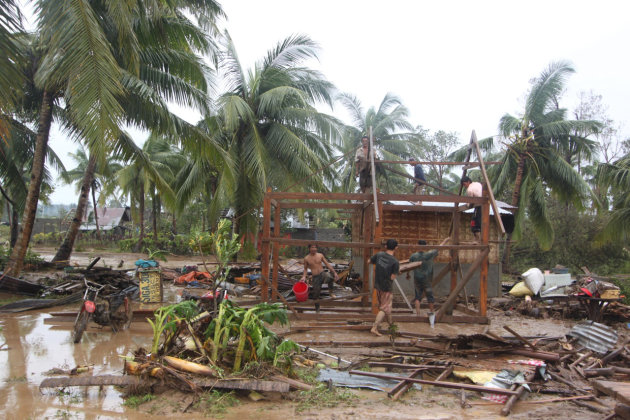
Lt. Gen. Jorge Segovia, head of Task Force Maritime Search SarGen, on Wednesday said the search and rescue operation for the still missing 352 fisherman has been called off, more than a month after super typhoon Pablo unleashed its wrath in eastern Mindanao.

“Our operations is shifting to support and rehabilitation operations and to deliver aid to survivors,” Segovia said in a press conference.

Segovia was accompanied by Mayor Darlene Antonino-Custodio who said the city has to move on.

Custodio said the city will be giving assistance to families of the missing fishermen as they recover from the loss of their loved ones.

At least 378 fishermen were reported missing several days after Pablo hit landfall in Davao Oriental that also left more than 1,000 dead.

Of the listed missing fishermen, 18 were found alive while 8 dead bodies were recovered from 51 fishing vessels from at least 10 fishing companies here that were caught in the middle of the storm.

Four of these fishing vessels were confirmed by survivors to have sunk at the height of Typhoon Pablo.

Only last week, Segovia refrained from issuing a statement on the fate of the missing fishermen.

“It is a sensitive issue especially for the families (of the victims),” he reasoned out.

At least three Philippine Navy ships and two floating assets of the Philippine Coast Guard were involved in the search and rescue mission.

A P-3C Orion maritime surveillance aircraft from the United States Navy as also dispatched to the area to help search for more survivors.

The operations however failed to recover any survivor other than those rescued by passing fishing vessels early in the tragedy.

Some relatives are hoping the fishermen are still alive.

Ana Lou Caspi-Nemenio, whose father is the ship captain of a catcher vessel of the Salazar-owned Thidcor fishing company, said she received reports that the crew of two of his father’s light boats were found in a state of shock while riding a bus somewhere between Leyte and Surigao.

She could not verify the report however.

Owners of the missing fishermen are still giving cash advances to the families of the missing fishermen.

But one fishing company has reportedly offered a cash assistance of P50,000 in exchange of a waiver and quit claim.

Rosanna Contreras, executive director of Socsksargen Federation of Fishing and Allied Industry (SFFAI), however said she has not received any information about the reported cash assistance.

SFFAI is handling all cash advances of families of the missing fishermen.

SFFAI said the Pablo tragedy was a big blow to the tuna industry. The federation said the lost fishing vessels valued up to P640 million.

Wednesday 16 January 2013

http://asiancorrespondent.com/95532/govt-gives-up-search-for-missing-fishermen/

continue reading

Death toll of Egypt’s building collapse rises to 16


The death toll of the building collapse on early Wednesday in Egypt’s northern seaside city of Alexandria rose to 16, and 10 injured people have been rescued under the rubble, Health Ministry’s spokesman, Ahmed Omar, told Xinhua.

Omar said that the dead bodies were transferred from the collapse spot to the morgue of Koum al-Dikka in Alexandria while the injured people were taken to nearby hospitals at Alexandria’s Abou Qir area.

Omar confirmed to Xinhua that the death toll of the collapse was 16 so far, although Egyptian state TV said it was 17.

An eight-storey building in Alexandria’s suburb of Maamoura collapsed early Wednesday and the civil protection authority said that the building was illegally constructed in a narrow street without an official permit.

The rescue teams are currently continuing their efforts in search for more survivors.

Wednesday 16 January 2013

http://www.nzweek.com/world/death-toll-of-egypts-building-collapse-rises-to-16-43141/

continue reading

Vietnam’s Buddhist response to disaster


Buddhist monks, nuns and their followers have long contributed to Vietnam’s disaster relief efforts. Sometimes equipped with canoes filled with instant noodles, woollen hats and psychosocial counsellors, this local cadre may lack standard operating procedures, but it constitutes a largely undocumented and significant disaster relief system running parallel to governmental efforts.

Buddhist temples’ (or any religious organization’s) contribution to disaster relief is still under-studied by international donors and NGOs working on disaster response, despite their growing role in a number of places, says Ian Wilderspin, a technical specialist on disaster risk management for the UN Development Programme (UNDP) in Hanoi.

However, Bui Viet Hien, a UNDP programme analyst, co-authored a 2011 study in collaboration with the Ministry of Sciences and Technology on the role of informal organizations in boosting community resilience to flooding in a district of the coastal Binh Dinh Province in south-central Vietnam.

Groups identified in the study included, among others, business leaders in the rice industry; boat owners who lived closest to the pier and provided emergency transportation during flood seasons; and dyke protection brigades nominated by village elders to supervise dykes during rainy seasons. The study broke down each group’s contribution to boosting resilience, concluding that people in the above three groups had the most impact on their villages’ ability to get through disasters.

There has not been a similar effort to assess informal organizations’ contribution to disaster response, she told IRIN last September. “It is an important question to ask [religious organizations’ contribution to disaster relief and prevention], but we simply do not know.”

Eric Debert, a programme manager with international NGO CARE in Vietnam, said though religious groups are not targeted directly in CARE’s work with communities on disaster risk reduction, they may be represented in other community associations and groups CARE consults.

Nevertheless, it could be a “gap”, he noted. Since 2006 CARE has coordinated the Joint Advocacy Network Initiative (JANI) funded by European Union aid body ECHO.

JANI includes 18 international and local NGOs as well as mass organizations (like Vietnam’s Women’s Union, whose stated membership is 13 million) which promote a community-based approach to help residents in disaster-prone areas face increasingly frequent and more intense natural hazards.

Buddhist operating procedures?

“They [Buddhist temples] have good intentions, but little strategy,” said Nguyen Huu Thang, the vice-director of social welfare and disaster for the Vietnam Red Cross (one of two groups nationwide authorized to receive disaster relief donations) which has collaborated with Buddhist temples organizing relief trips. Temples’ lack of formal training in humanitarian response can lead to “confusion or chaos” if relief groups deliver goods haphazardly without coordinating with local officials, said Thang.

But the leader of Quan Dinh temple on the outskirts of Hanoi, who goes by her Buddhist `dharma’ name (given during an initiation ceremony), Sister Peaceful Light, told IRIN the temple always goes through an official structure, whether it is Vietnam Red Cross or provincial authorities.

Pagoda leaders in or close to disaster-stricken areas often meet and guide arriving groups on hikes or by canoe to provincial authorities, who then direct them to villages most in need.

Thang said Buddhist temples were more active in organizing disaster responses than other religious groups.

In a country where more than half the population declares itself Buddhist, the network is wide - some 25,000 temples staffed with monks or nuns nationwide as of five years ago - Vietnam’s Buddhist Association reported to international media.

But the count then, and now, is only approximate. “Not all temples are registered with us. Some villages put joss sticks in an urn with rice and have a nun that visits occasionally. Is that a temple? Perhaps, but not known to us,” said an association staff member.

Tracking informal giving

“Why do you need to know how much we gave? Is it not enough that we did?” asked the nun overseeing one of the most well-known Buddhist pagodas in the central city of Hue, Tay Linh temple, who goes by the name of Sister True Compassion.

Buddhist temples file annual reports with the national Vietnamese Buddhist Association which lists donation amounts and how the money was spent: Surviving families of canoes which sank; children in a leper colony; cancer patient’s home visit. And in late 2011 when storms battered the southern tip of Vietnam, killing an estimated 85 and forcing another 13,000 families from their homes, Tay Linh temple’s disaster relief activities filled almost an entire page.

In 2011, the temple’s charity board, which Sister True Compassion heads alongside her position as vice-director of the regional charity board representing all Buddhist temples in Hue, calculated it gave some US$24,000 to communities hit by disaster.

When IRIN asked the national Buddhist association for a breakdown of how much money from overseas was sent to Buddhist temples in Vietnam, and how much money was donated to disaster relief efforts, officials said they had not formally analysed giving or disaster relief activities.

Not an uncommon response, noted local NGO Vietnam Asia Pacific Economic Centre, which published a study in 2011, with support from Asia Foundation, on philanthropic giving in Vietnam. The study noted that while in recent decades there has been “substantial individual giving... to alleviate the suffering of others particularly in times of disaster,” there has not been “systematic research or reports on giving patterns”.

Based on interviews with 200 households and 100 businesses nationwide, the NGO learned that “informal channels” - including pagodas, churches and community groups - received most charitable giving, while “official channels”- corporate organizations and funds for the poor - received but a fraction (27 percent in urban areas, 9.4 percent in rural ones).

“We do not work like formal organizations. Please do not call me a leader of anything,” said Sister True Compassion. “We are only trying to alleviate suffering and build compassion. That is all.”

Wednesday 16 January 2013

http://www.irinnews.org/Report/97256/Vietnam-s-Buddhist-response-to-disaster

continue reading

300 families missing due to rain disaster in Mozambique


The Mozambican authorities said on Tuesday that they are searching for 300 families who went missing due to a storm that hit the central province of Zambezia.

The families went missing in the districts of Mocuba, Milanje, Namarroi, and Gile, after their homes were swept away by the fury waters.

A team from the government, involving personnel from the country’s natural disasters office, the police and the army are looking for the missing ones.

The calamity has cut off several regions of Zambezia from the outside world, according to Rita Almeida, spokesperson for the National Disasters Management Technical Council (CTGC).

So far this year at least six people have died in severe storms in Mozambique and 572 have been displaced from their homes, she said. The six confirmed deaths were all reported from the northern city of Nampula. Some of the victims were drowned and others were electrocuted, when cables were blown down by strong winds.

The mayor of Nampula, Castro Namuaca, explained that some Nampula neighborhoods, such as Namutequeliua and Muatala are crossed by rivers, which people walk across without any difficulty in the dry season.

But they become raging torrents during the rains. “Some people were not sufficiently cautious, and were swept away by the waters, ” said Namuaca.

According to Almeida, two other deaths have been reported, but bodies have not yet confirmed them.

She said 447 people have been displaced in Panda, and 45 in Homoine, both districts in the southern province of Inhambane.

These CTGC figures do not take account of the destruction of houses in Nampula. According to the municipal authorities, over 1, 000 houses built of flimsy materials, state buildings and electricity transformers were damaged or destroyed.

The City Council is using sheets of tarpaulin to improvise shelter for those who have lost their homes.

The damage to the electricity supply occurred mostly in parts of the city that are plagued with illegal, clandestine connections to the grid, particularly the neighborhood of Namicopo.

The Mozambican Electricity Company (EDM) said it will take 150, 000 U.S. dollars to install a reliable electricity network in Namicopo.

The CTGC declared an “orange alert” across the country on Friday, and is preparing for possible flooding in the main river basins.

The National Water Board (DNA) has warned of significant rises in the levels of the Zambezi and Buzi rivers in the center of the country, the Messalo in the north and the Inhanombe in the south.

The Buzi reached flood alert level at Goonda, in Sofala province, on Sunday night, and the flood surge is now travelling downstream towards Buzi town.

The Zambezi is above flood alert level at Caia and Marromeu, on its lower stretches. The DNA also warned that one of the major rivers in the south of the country, the Save, may reach flood alert level at Massangena, in Gaza province, on Tuesday or Wednesday.

It is recommending that people take precautions, such as moving equipment and property away from river banks, and avoiding crossing rivers.

Tuesday 15 January 2013

http://www.nzweek.com/world/300-families-missing-due-to-rain-disaster-in-mozambique-42952/

continue reading

Two Bodies Found On Costa Concordia


The bodies of the two last missing victims of the Costa Concordia cruise ship disaster may have been found, according to reports in the Italian media.

The news comes exactly one year after the huge liner — more than twice as big as the Titanic — ran aground off the Tuscan coast of Giglio, Italy.

The Concordia struck a rock and capsized on Jan. 13 near the island of Giglio after captain Francesco Schettino allegedly drove the ship on an unauthorized route too close to shore, ripping a huge gash in the hull. The ship tumbled onto its side with more than 4,200 people aboard, and 32 lives were lost.

Among them, Sicilian passenger Maria Grazia Trecarichi and Indian crew member Russel Rebello are still unaccounted for and presumed dead.

“Not being able to give back these bodies to their families is now the biggest tragedy,” Franco Gabrielli, the head of Italy’s civil protection agency, said at a poignant day-long commemoration at Giglio on Sunday.

But according to reports in the Italian media, the bodies were known to be located in the most unreachable area of the wreck near the stern.

“I was told four months ago that my brother’s body had been found, but recovery is impossible until the rotating of the ship,” Kevin Rebello, Russel’s brother, told the daily Il Tirreno.

Engineer and fire brigade chief Ennio Aquilino confirmed that the two victims are most likely trapped near the stern, where the ship collapsed.

“That’s our guess. We won’t be able to reach the bodies until we move the ship,” he told the daily La Nazione.

But the companies undertaking the refloating and removal of the Concordia – American Titan Salvage and Italian firm Micoperi – denied that the missing bodies had been located in the wreck.

Meanwhile, Gabrielli told reporters that plans for what is considered the largest re-float in history were behind schedule.

He announced that the 950-foot-long, 116-foot-wide, 114,500-ton carcass of the Costa Concordia will be refloated and towed from Giglio’s waters no earlier than September.

Originally, officials said they hoped to tow the ship away and break it up by early 2013.

The cost of the operation has also risen from the $400 million originally estimated to $530 million.

Prosecutors are seeking a 20-year prison sentence for Captain Francesco Schettino. He is facing accusations of manslaughter, causing a shipwreck and abandoning the ship. Prosecutors say he caused the disaster by sailing too close to shore and maneuvering the ship “as if it were a canoe.”

Tuesday 16 January 2013

http://news.discovery.com/human/two-missing-bodies-likely-found-on-costa-concordia-130115.htm

continue reading

NBI returns to get DNA samplings from exhumed remains, relatives


The forensics team of the National Bureau of Investigation (NBI) has returned here to get DNA samplings from the exhumed remains of unidentified victims who perished during typhoon Pablo on December 4.

At the public cemetery in Purok 4, Barangay Cabinuangan on Monday afternoon, MindaNews saw a team of the NBI’s Disaster Victim Identification (DVI), working on the remains exhumed from the niches and compartments that were temporarily sealed as of December 26.

Nearby, funeral parlor attendants sprayed disinfectants on the white caskets and body bags containing the remains.

A total of 384 bodies had been buried as of December 26. But the municipality’s records showed 426 “bodies found.” As of January 15, the number of “bodies found” had reached 437, Marlon Esperanza, information officer, said.

Esperanza acknowledged on December 27 that the figures do not tally. A total of 426 bodies were supposed to have been found, according to the Incident Command Center’s listing but only a total of 384 had been buried as of December 26, with the supposed remaining 42 bodies unaccounted for.

He explained they were still validating the list. But he noted that some relatives apparently claimed to have identified their loved ones from among the remains just so they could secure death certificates. Death certificates are required to avail of government’s P10,000 financial assistance for each slain relative, or to claim insurance.

Relatives of those who died had repeatedly asked them when the NBI would come to take their DNA samples, Esperanza said.

Bernardita Pebujot, municipal sanitary inspector, told MindaNews on Monday that the NBI team informed them they would finish the sample-taking at the cemetery in three days.

Pebujot said the team finished taking samples from 60 remains on Monday. At least 269 remains awaited exhumation for tissue sampling as of December 26.

Tissue sampling from the surviving relatives will be done in the municipal gym after the NBI is done with the cemetery samplings, she said.

New Bataan had the highest death toll of all the towns along Pablo’s path across Mindanao, Visayas and Luzon: some 400 out of at least 1,000 dead.

To commemorate the 40th day of their death, memorial walls were erected in two areas: at a makeshift shed outside the San Antonio de Padua parish on Sunday and a concrete wall at the former site of the barangay hall in Andap on Monday.

Fr. Edgar Tuling, parish priest, blessed the white streamer cloth containing the names of those who perished, shortly before the 8:30 a.m. mass on Sunday. Relatives lit candles and offered flowers in their memory.

A total of 527 names were listed but the list soon bore erasures and additions. As it turned out, some of those listed dead were actually alive while some of those who were killed were not listed.

Luciana Ditros, 53 of Purok 14, San Juan Village in Andap, told MindaNews her name was included among the dead but her slain husband, Pabian, 57, was not on the list. She said they borrowed the black pen marker used in writing the names, added Pabian, and struck lines across her name and her nine-year old nephew’s, Judito Chris Salopan, who was riding the motorcycle with his father on this Sunday morning.

Aside from Pabian, Salopan’s mother, Epifania and cousin Princess May Conate, 12, were also killed.

At the memorial wall in Andap at least 569 names of the dead and missing were handpainted. But before it was unveiled Monday morning, relatives and neighbors requested sign artists to delete the names of survivors and add the names of those who were slain but were not listed.

As of 1 p.m. Monday, 25 names had been deleted from the church memorial wall while 11 other names were added.

Tuling said it is good that relatives or neighbors are making the corrections – whether on delisting the name of a survivor, adding the name of a slain relative or correcting the spelling of names.

In Andap, two residents told the sign artist early Monday to change the spelling of Tulio to Julio.

There may be more misspelled names on the list but there may be no chance to make the corrections. In both memorial walls, most of the victims had the same family names, among them Abonero. Pontijon. Magbutong. Rebucas. Babag. Canillo. Unselagan.

Tuesday 15 January 2013

http://www.mindanews.com/top-stories/2013/01/16/nbi-returns-to-get-dna-samplings-from-exhumed-remains-relatives/

continue reading

Tuesday, 15 January 2013

In zee gevonden man stuurman Baltic Ace (in Dutch)


(translate with Google Translate at the bottom of the page)

De man die 19 december dood in de Noordzee werd gevonden, blijkt de eerste stuurman van de Baltic Ace te zijn. Dit vrachtschip verging op 5 december op ongeveer 75 kilometer uit de kust ter hoogte van Goeree-Overflakkee.

Van de 24 bemanningsleden konden er 13 worden gered. Vijf opvarenden werden dood geborgen, zes lichamen werden nog vermist. Met de vondst van de 31-jarige Poolse stuurman is het aantal vermisten nu nog vijf.

Het Korps landelijke politiediensten maakte dit dinsdag bekend. De politie kon de man identificeren aan de hand van vingerafdrukken.

Een Nederlandse kotter vond het lichaam van de Pool op 19 december ruim 20 mijl westelijk van IJmuiden. Het stoffelijke overschot werd door een reddingsboot geborgen en aan de politie overgedragen.

Duikers van de marine hebben afgelopen weken rond en onder het wrak van de Baltic Ace gezocht, maar troffen geen lichamen aan. De vermisten waren kort na de ramp al doodverklaard.

Tuesday 15 January 2013

http://www.telegraaf.nl/binnenland/21221508/__Stuurman_Baltic_Ace_gevonden__.html

continue reading

Landslide kills 6 in Bogor


Six people were killed when a landslide off a 30-meter cliff swept through 10 houses and a mosque in Cipayung, Bogor, West Java, on Tuesday.

The six victims were identified as Roni, 17; Aris, 50; Hendri, 7, and 45-year-old Karmina with her two children, Robi, 21, and Ita, 12.

Bogor Disaster Mitigation Agency (BPBD) head Yos Sudrajat said that the search and rescue team had found two victims, but were still searching for the four others.

“It was difficult for the team to find the victims because the area was inaccessible,” he said, adding that the rescue team was forced to search for the victims without heavy equipment.

Yos said that his agency had also provided a shelter for the victims whose houses had been destroyed. “We have sent 47 people to the shelter,” he said, as quoted by tempo.co.

A local resident, 30-year-old Suma, said the accident occurred at around 6 a.m. “The rain had been pounding the village since last night and suddenly we heard a rumbling sound above our houses,” he said.

Tuesday 15 January 2013

http://www.thejakartapost.com/news/2013/01/15/landslide-kills-6-bogor.html

continue reading

Spectrometry to the rescue!


The next time a major earthquake strikes it could be an ion mobility spectrometer (IMS), not a sniffer dog, searching for people trapped in the rubble. New research has demonstrated that the instrument can detect a pattern of 12 chemicals that signal the presence of life. This could eventually lead to a handheld device to guide search and rescue teams.

Using chemistry to find people trapped in disaster sites makes sense, according to Wolfgang Vautz, of the Leibniz Institute for Analytical Chemistry, Germany, who helped develop the techique. Sniffer dogs are normally used for this purpose, but they need breaks and can get confused when there are lots of dead bodies around.

Vautz’s idea was to find survivors by detecting signature chemicals in human breath. To identify candidate molecules Vautz and his team sealed volunteer graduate students in a small office for six hours. The air from the room was sampled and put through a GC–IMS instrument – the latter is a type of spectrometer that separates ions according to their size and shape.

Carbon dioxide concentration was the control variable in Vautz’s experiments, as this could only originate from the volunteers’ respiration. At a real-life disaster site though, the situation could be complicated by other potential CO2 sources like fires. IMS analysis revealed that 12 simple organic chemicals – such as octanal and benzaldehyde – emanated from the graduates and increased in line with the CO­2.

By taking samples from inside a void and measuring their chosen chemicals the researchers could reliably discern whether a human was inside. Each sample took three minutes to analyse, and the test was very sensitive. Vautz says it even showed when one volunteer left briefly to use the bathroom.

Stephen Barton, a principal lecturer in analytical chemistry at Kingston University London, UK, says the concept is ‘interesting, not least because of the future possible advances, such as getting an indication of the health of the trapped person’.

Health monitoring is one of Vautz’s longer-term goals for the device. But the immediate challenge is deploying the technique in disaster zones, rather than a laboratory. Vautz says his team ‘struggled’ to carry the 25kg instrument around in a recent field test. But he is confident they can lighten it by choosing only the hardware necessary to analyse the 12 chemicals. ‘There are many examples of handheld IMS detectors already in use,’ he says, ‘one being for the detection of chemical warfare agents.'

Another obstacle is finding out how chemicals from fires and breached industrial faculties would interact with the analytes in real life. ‘Next we will need to find a partner from the search and rescue services to work with, so we can test this properly, in an ethical way,’ Vautz says.

Tuesday 15 January 2013

http://www.rsc.org/chemistryworld/2013/01/ion-mobility-spectrometry-sniffer-dog-natural-disaster-survivors

continue reading

Eight killed as truck turns turtle in Gazipur


Eight people were killed and three others injured as a fertiliser-laden truck overturned on the Dhaka bypass road near Ulukhola Bridge in Kaliganj upazila in the early hours of Monday.

Identities of the deceased could not be known immediately after the accident.

Police said a Rajshahi-bound truck loaded with fertiliser from Sylhet skidded off and turned upside down on a road divider in the area at about 3:00am after its driver lost control over the steering wheel, leaving eight people dead on the spot and three others injured. The people were travelling in the fertilizer-laden truck.

Police said the eight passengers died on the spot and three suffered injuries as the fertilizer bags fell on them.

On information, police recovered the bodies and rescued three injured removing piled up sacks of fertiliser.

Of the injured, one Mujibur was admitted to Tongi Upazila Health Complex and two others were sent to local clinics.

Sub-inspector Murad Hossain of Kaliganj police station said 12 day labourers were on the truck carrying fertilizer.

It is assumed that they could be hailed from different areas of the northern region and were travelling back home.

But police failed to trace whereabouts of the driver and helper of the truck.

Tuesday 15 January 2013

http://www.dailyprimenews.com/details.php?id=5231

continue reading

Ten killed in Sukhothai collision


Ten people, among them a five-year-old boy, were killed on Tuesday in a head-on road accident in Sukhothai's Khiri Mat district.

The tragedy took place on the Sukhothai-Kampaengphet road at about 8.30am when a green pickup loaded with workers heading out of Muang district crashed head-on with a bronze pickup heading to Muang district.

Police arriving at the scene found bodies scattered on the road while others remained trapped in the vehicles.

The driver of the bronze pickup, who was identified as Shinakorn Soikham, was found dead at the wheel. Three passengers in the green pickup were killed and trapped in the car. Four of eight passengers who were thrown out of the back were killed. The rest were injured and rushed to a hospital nearby. Two of them, a mother, known only as Nam as well as her five-year-old son succumbed to their injuries.

Police are investigating the cause of the crash.

Tuesday 15 January 2013

http://www.nationmultimedia.com/aec/Ten-killed-in-Sukhothai-collision-30197954.html

continue reading

NEMA Recovers Three Bodies, Six Vandals' Boats


Following the pipeline explosion, which occurred at the weekend, leading to the death of over 25 persons at Arepo village in the Obafemi-Owode Local Government Area of Ogun State, the National Emergency Management Agency (NEMA) yesterday said it had recovered three charred bodies as well as six boats belonging to suspected vandals.

This is just as the state Governor, Senator Ibikunle Amosun, accused the Nigerian National Petroleum Corporation (NNPC) of complicity in the incessant cases of pipeline vandalism across the state.

No fewer than 25 suspected pipeline vandals who had allegedly gone to siphon petrol from a ruptured NNPC pipeline were burnt to death when the pipeline exploded.

However, according to an eyewitness account, the casualties were not only vandals but also security guards attached to the area.

It was gathered that prior to Saturday's explosion, the vandals had engaged officials of the Nigeria Security and Civil Defence Corps (NSCDC) guarding the area in a gun duel on Friday during which about five persons were killed.

Speaking to THISDAY, the NEMA spokesperson in the South-west zone, Mr. Ibrahim Farinloye, said about three charred corpses had been recovered from the swampy area, adding that evacuation was ongoing.

He, however, lamented that the evacuation process was being slowed down given the swampy terrain of the location.

He said: "Evacuation of bodies will commence tomorrow (today) but three bodies have been recovered so far. We saw one body at our first visit and two more bodies were seen coming up from under the river.

"The agency will employ the services of those who know the terrain well to recover more bodies."

But he urged the state government to stop trading blame and seek sustainable ways to end the incessant pipeline vandalism in the area.

On how to prevent disasters of such magnitude from recurring, Farinloye said such could only be achieved when state governments become pro-active and work with NEMA.

He said: "Prevention can be achieved when state governments leave blame apportioning and work towards closing the gaps for effective disaster management. We are incapacitated until the state governments are ready to do their job.

"In our line of work, the state and local governments are very important and it is only when the two tiers come together and work with us that maximum success will be achieved.

"At a point we set up the grassroots disaster management organisations to reduce the risk of disasters but no sooner had we handed them over to the state and local governments, did they abandon it."

Meanwhile, Amosun who was on an on-the-spot assessment tour of the fire scene lamented that the swampy nature of the terrain made it difficult to organise effective rescue operations.

He said: "This is clearly failure of governance. Indeed, I have to say that the NNPC by their inaction are aiding and abetting this and I want to believe they are part of the pipeline vandalism.

"In fact, people here are endangering their lives because there is no access to this place. Look at the canoe that NNPC is using in this time and age to protect a billion-dollar investment.

"Even if the place is combustive, can't they use solar-powered boats? For me, it is straightforward, if NNPC supports us, we will get the whole place cleared."

He noted that if the corporation provides the state government with about five to 10 swamp boogies, the entire area would be cleared and platforms erected in its place as well as electronic chips.

He added that Close-Circuit Television (CCTV) would be mounted with a control room where the entire area will be monitored mechanically.

He said: "How can vandals hold us to ransom? Just look at dead bodies littering everywhere. It took us 45 minutes to access the place because it is hard to access the place.

"I even understand that it is the same spot where the three NNPC officials were killed last year. Since oil is the bedrock of the nation's economy, investing in security which will protect oil facilities cannot be over-emphasised."

Also, the House of Representatives yesterday condemned the incessant incidence of oil pipeline vandalism in parts of the country and its negative impacts on the economy. Aside the Arepo explosion, another oil pipeline vandalism was reported by the Joint Task Force (JTF) at Ovade, Oghara, Ethiope-West Local Government Area, Delta State.

Chairman, House Committee on Petroleum Resources (Downstream), Hon. Dakuku Peterside, who condemned the incidence, observed that in recent weeks, Nigeria had witnessed needless deaths and damage to property following the attacks on oil pipelines in different parts of the country. The lawmaker said that oil pipeline vandalism poses grave security, health and environmental risks and results in enormous economic consequences.

"My grievance is with those who vandalise our pipelines and I condemn in strong terms the sponsors and perpetrators of this evil. Pipelines are used all over the world to distribute petroleum products; therefore Nigeria should not be an exception.

"This continuous sabotage of our commonwealth has continued for too long because culprits have not been adequately sanctioned. I call on the relevant security agencies to be up and doing in the protection of our oil facilities," he said.

According to Peterside, pipeline vandalism was largely responsible for the use of trucks in transporting petroleum products across the country.

He drew a nexus between this system of transporting fuel and the recent inferno that occurred when a fuel tanker crashed and exploded into flames at Mbiama in Rivers State. At least, one person was killed and many others seriously injured at the Mbiama incident.

"This is due to the fact that our petroleum pipelines are not safe and functional, thus the resort to the use of tankers to convey products and its associated risks. The dead victim, it was gathered was selling drinks at a spot very close to the scene of the accident. This incident occurred just seven months after several people who were scooping fuel from a damaged tanker in the same area were killed in an explosion.

"The repeated tanker accidents in Mbiama axis of the East - West Road also brings to the fore the urgent need to fix the road which has been on for over five years. The East- West Road is a critical road infrastructure that should be given priority attention," he said.

Tuesday 15 January 2013

http://allafrica.com/stories/201301140784.html

continue reading

Chinese authorities apologize for rapid cremations


Authorities in southern China have offered a rare apology for failing to consult with relatives before rapidly cremating the remains of 46 victims of a landslide blamed by some on a local mining operation.

Officials had hoped to avoid spreading disease and spare relatives the trauma of viewing the mangled remains, state media reported Tuesday. They also said the morgue in the remote part of Yunnan province had no refrigerator, requiring that remains be dealt with swiftly.

"We did that because we were afraid that the bodies would start to decay, and some bodies have been damaged in the landslide and we thought the family members would be too distraught to see them," Hu Jianpu, deputy head of Zhenxiong county, where the disaster occurred, told state broadcaster CCTV.

The official Xinhua News Agency and CCTV reported that county officials issued their "sincere apologies" to the relatives.

Residents who usually bury their dead after elaborate funerals protested the rapid cremations, prompting the unusual apology.

Stability-obsessed local Chinese authorities sometimes seize the bodies of accident victims to prevent emotional scenes that could develop into protests against them, as well as to persuade relatives to quickly agree to compensation offers.

Calls to Zhenxiong county and Communist Party offices rang unanswered Tuesday, and a local spokesman did not answer calls to his cellphone.

The cause of Friday's landslide amid steep, snow-dusted mountains remains under investigation, with some villagers blaming a local mining operation.

Xinhua quoted some villagers as saying blasting and other mining work had opened up huge fissures in the mountain looming over the villages of Gaopo and Zhaojiagou, where 14 homes were smothered.

A preliminary investigation last week blamed saturation from more than 10 days of rain and snow for the disaster.

Tuesday 15 January 2013

http://www.mercurynews.com/breaking-news/ci_22375361/china-authorities-apologize-over-rapid-cremations

continue reading

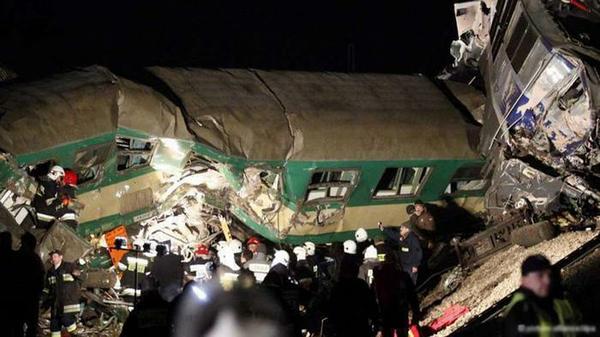
Egypt train crash kills army recruits


At least 19 people have died and more than 100 injured in a train derailment south of Cairo, according to officials.

The official Mena news agency quoted health ministry officials who said 107 wounded were being treated in hospitals near the site of the accident in Giza's Badrasheen neighbourhood over Monday night. They said the number of dead was expected to rise.

The train was taking young recruits from south Egypt to a military camp in Cairo when two carriages went off the rails shortly after midnight in the Giza neighbourhood of Badrasheen, officials said.

More than 60 ambulances were sent to the site of the accident, where rescuers were working to extract survivors and bodies from the twisted heap of metal on the side of the rails.

Prime Minister Hesham Qandeel was met with howls of outrage when he arrived at the scene, with local residents shouting, "You have blood on your hands, Mr. Hesham." His security quickly whisked him away, an AFP photographer said.

The injured have been taken to local hospitals for treatment, the health ministry said.

The accident comes less than two weeks after a new transportation minister was appointed to overhaul the rail system, and just two months after a deadly collision between a train and school bus.

The state-owned Ahram website reported that the 12-carriage train was carrying 1,328 conscripted Egyptian soldiers headed north from Assiut to Cairo.

Roy Hamad Gaafar, a survivor, said he was on board when the last two carriages detached from the rest and derailed.

Images carried on Egyptian satellite channels showed residents using flashlights to help rescuers reach people trapped in the wreckage.

According to media reports, it is the fifth deadly train accident since President Mohamed Morsi was sworn in as Egypt's first Islamist president in June.

Morsi's tenure so far has been marked by political divisions over the role of religion in politics and freedoms, but the latest accident is a further test of how his government will deal with Egyptians' everyday problems.

In a message on Twitter, the president's Muslim Brotherhood said "sincere condolences go out to the families of the victims of the horrific train crash in Badrasheen, we pray for speedy recovery of the injured."

The spokesman of the armed forces also sent condolences on his official Facebook page.

Transport minister Hatem Abdel Latif, a member of the Muslim Brotherhood, said an investigation will be launched into the accident.

President Mohammed Morsi named a new transportation minister on 6 January in an effort to improve railway safety. The post had been left vacant in the aftermath of an accident that killed 49 kindgergarten pupils in November 2012 when a speeding train hit their school bus.

Accidents due to negligence regularly killed scores over the three-decade rule of Hosni Mubarak. The railway's worst disaster was in February 2002 when a train heading to southern Egypt caught fire, killing 363 people. Media reports quoting official statistics say rail and road accidents killed more than 7,000 people in 2010.

Egyptians have long complained that the government has failed to deal with the country's transport problems, with roads as poorly maintained as railway lines.

Tuesday 15 January 2013

http://www.guardian.co.uk/world/2013/jan/15/egypt-train-crash-army-recruits

http://www.middle-east-online.com/english/?id=56452

continue reading

Young tribals want tattoos erased


As soon as she secured admission in a Ranchi college, Anita Oraon made her mind up - she would have the tattoos on her face removed as soon as she could. Like most girls from the Oraon tribe, Anita in her childhood was tattooed with three marks on the brow and two on each temple. But little did she realize then that the ink would become a burden too heavy to carry all her life.

Often ridiculed at school and on the streets of the city because of the marks on her face, Anita decided she would go for a laser tattoo removal process before her life in college began. "Traditionally, girls from the Oraon tribe get tattoos - know among us as godna - on their faces at childhood and as they grow up they got more on the arms and the back. I got mine removed before joining college because I knew my classmates would make fun of me. I did not want them to believe I was different from them."

Anita is not the only young tribal who has chosen to get rid of the ink and the ancient tribal art is now on the brink of disappearing. Youngsters are reluctant to get a godna done and those who already have are queuing up at skin clinics to get them removed.

Dr Saroj Rai, the only dermatologist in Ranchi to offer tattoo-removal facilities, said: "Almost 10 to 15 tribal girls approach me every month to get their godnas removed. Most of them are young and are about to join college or are going for job interviews. They believe that the godna is embarrassing and people look at them differently and with repulsion because of them. Some married women also approach us for the therapy, but their numbers are not as large."

The various tribes of Jharkhand had different reasons for marking themselves - while some did it to prepare the young folk for the mental and physical pains of life and help distinguish them from people of other tribes, others believes it was a form of a permanent ornament, something that would stick with them even in the afterlife.

Girdhari Ram Gaunjhu, former head of the tribal and regional languages department at Ranchi University, said: "For the Ho folk, godna was a sign of purity, the Santhals believed that a tribal without a tattoo would be eaten up by insects after death and the Khariya people looked at it as a mark of courage and valour. Every tribe had different tattoo designs to distinguish themselves from each other," said Gaunjhu.

Unlike the simple tattoo process used by the ubercool in cities these days, getting a godna can be very painful. Women artists - known as 'malaarin' - used to go from village to village and make godna on girls above the age of 10. Gaunjhu said: "The girl is held tightly and a piece of cloth is stuffed in her mouth. A bundle of seven needles - dipped in a mixture of kajal and the milk of a lactating woman - is used to carve the pattern on the girl's face. The wound is covered with fresh cow dung, which works as an antibiotic. The whole procedure of making a godna takes at least three days and the pain can last for weeks."

So why have the tribals who have gone through such pain to ensure their traditions do not disappear are now choosing to get rid of them?

Gaunjhu believes that people do not want to be recognized as tribals anymore. "Except for some who flaunt their tribal legacy for political interests, most believe they are looked down upon by the so-called upper classes," he said. "Students in particular do not want to be identified as tribals - they are apprehensive that even if they get admissions for higher education on merit, they will be discriminated against on the pretext of being from a reserved quota," Gaunjhu added.

Migration to urban centres for jobs and livelihood is another reason for the tribals to ditch their tattoos. "Many tribal folk are now settled in big cities and they do not see this art form on the streets there. Their sensibilities have been altered by the life in metros and they do not want their children to undergo the pain they have been through," Gaunjhu said, adding that Body piercing, another traditional tribal art, is also going the godna way into oblivion.

Though some tribals lament the loss of tradition, most are not in favour of godna. Budhni Oraon, a 75-year-old, said: "I know that godna is an integral part our culture and lifestyle, but they are more of a problem in this era. I still have the tattoos that I got in my childhood while I was living in my ancestral village where everybody had a pattern on their bodies. But I do not want my grandchildren to get them done."

Budhni added: "After I moved to Ranchi with my family, the people here started treating us badly and did not give us any respect. The sight of a godna invites ridicule in cities and I do not want my children to go through the insults that I have had to face."

Ironically, the urbanization that is causing the disappearance of tribal arts could also lead to their revival. Tribal tattoos have now been adopted by the city youth as a style statement and people flock to the dime-a-dozen artists to get themselves inked. Mike Cowasji, a prominent Delhi-based tattoo artist, gets at least four to five youngsters a month demanding a tribal pattern - mostly Maori or Celtic - on their bodies. "Tribal adaptations of zodiacs and animal figures are among the most preferred and many also choose the warrior and valour symbols," he said

The trend has been evident in Jharkhand as well. Gaunjhu said: "We do see some youngsters making a traditional godna or getting ears pierced, but they are now doing it to make a fashion statement, not to uphold tradition."

Tuesday 15 January 2013

http://timesofindia.indiatimes.com/city/ranchi/Young-tribals-want-tattoos-erased/articleshow/18026824.cms

continue reading

Monday, 14 January 2013

Six Dead in Mpulungu Fatal Accident


More than five people have been knocked down in Mpulungu district of Northern province while seventeen are in a critical condition.

A Truck Registration number ABV 9630 belonging to Agro-Fuel Investment killed six people on spot at Mpulungu central town after the driver lost control from Mbala 48 kilometers away from Mpulungu .

The vehicle has damaged property worth millions of kwacha for Mpulungu prominent businessman Alex Sinyangwe popularly kwon as MAPS Hardware as his scania truck registration number ACP 9440 was not spared.

Others businessmen affected are Urban Life, Amos Grocery, Lucey Hair Saloon, and Matete General Dealers,

Mpulungu District Commissioner Julian Chuzu has confirmed the development to the press who rushed to the scene and she has since described the incident as a disaster.

Chuzu said a combined team of security personnel and stakeholders are still scavenging for bodies as the trailer and bags of cement are believed to have buried some vendors who were selling their merchandises at the main gate of Mpulungu main market.

Chuzu said the seventeen victims have been referred to Mbala General Hospital for further medication.

She has since thanked the people of Mpulungu for having worked hand in hand with government officials in rescuing the victims adding that the spirit of unity should continue prevailing in the district.

Meanwhil,e hundred bags of cement have been destroyed while the vehicle is beyond recognition.

Agro Fuel Investment is the major exporting company of cement to Zambia’s neighboring countries through Mpulungu port.

This is first tragedy accident which has occurred in the district for the year 2013.

Sunday 14 January 2013

http://zambiareports.com/2013/01/14/six-dead-in-mpulungu-fatal-accident/

continue reading

Families protest unapproved cremation of landslide victims


About 40 family members of landslide victims in southwest China's Yunnan Province have protested after their loved ones' bodies were cremated without their approval.

The people gathered on the road to the landslide rescue and disaster relief headquarters in Zhenxiong County on Sunday night, blocking dozens of vehicles, Zhu Henghui, office director with the Zhenxiong County Committee of the Communist Party of China (CPC), said early on Monday.

The crowd did not disperse until 2 a.m. Monday, according to Zhu.

The landslide, which occurred in the Zhenxiong village of Gaopo on Friday, killed 46 villagers and injured another two.

Government authorities had cremated all the bodies by Sunday, triggering anger from the victims' family members. According to the tradition of the village, where dwellers are mostly of Yi ethnicity, bodies of the dead are usually buried instead of cremated.

Moreover, the family members, most of whom worked in cities and escaped the disaster, said they did not even have a chance to say goodbye to their deceased relatives because of the unapproved cremation.

"I had expected to have a final look at my child," said Zhao Mingcai, a migrant worker who rushed home from the provincial capital of Kunming on hearing the news.

Zhao lost nine of his family members in the landslide, including his child, his brother and sister-in-law.

Lei Chuying, deputy chief of Zhenxiong County, said cremation orders were given with consideration to epidemic prevention as well as the family members' emotions.

"Many parts or organs were missing when the bodies were dug out, and the scene may have left the families devastated," said Lei.

The landslide is believed to have been caused by heavy precipitation, as well as earthquakes that struck a neighboring county last year.

More than 500 villagers have been moved to makeshift tents near the village over fears that a secondary disaster triggered by the landslide could endanger their homes. Others have gone to stay with relatives and friends in other villages.

Makeshift houses will be built to replace the tents and provide shelter for disaster-affected residents, and plans to rebuild the village have been launched, according to Chen Xiangjin, vice secretary of the CPC Zhenxiong County Committee.

Chen added that a daily subsidy of 12.5 yuan (2 U.S. dollars) will be given to those affected by the landslide for the next three months.

Monday 14 January 2013

http://www.globaltimes.cn/content/755664.shtml

continue reading

Sunday, 13 January 2013

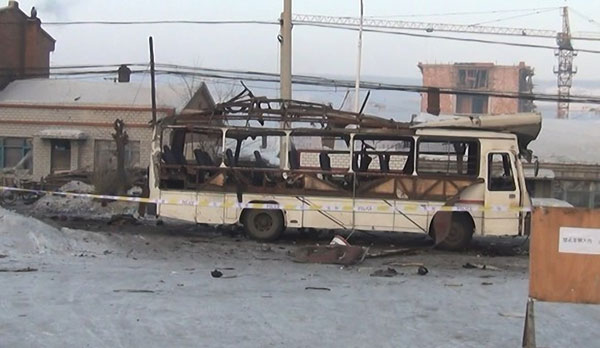
Key Suspect Dead in NE China Bus Explosion


The key suspect in a bus explosion that killed 11 people in northeast China's Heilongjiang Province has been found dead in the blast, local government said Sunday.

A police investigation showed, Gao Wanfeng is suspected of placing the explosives on a commuter bus that blasted around 6:30 a.m. Friday in the Lingdong district of the city of Shuangyashan, according to a city government statement.

The explosion also hit a coach in the opposite lane.

Seven of the van's occupants, as well as four of the coach's, were killed in the explosion.

Police on Sunday also released an initial list of victims which was drafted after relatives identified the bodies in person.

The exact list will be released after DNA testing precisely verifies the victims' identities, the statement said.

The injured are receiving medical treatment.

Sunday 13 January 2013

http://english.cri.cn/6909/2013/01/13/2724s743344.htm

continue reading

5 dead, 19 injured in SW China coach accident


Five people died and 19 others were injured after a coach rolled over Sunday morning in southwest China's Guizhou province, local rescuers said.

A coach collided with a guardrail and rolled over around 5 a.m. Sunday on an expressway in Xifeng county, rescuers said.

Five people died at the scene. The injured have been taken to local hospitals, where four of them are in critical condition.

Sixty people were onboard when the accident happened.

The cause of the accident is under investigation.

Sunday 13 January 2013

http://www.china.org.cn/china/2013-01/13/content_27672308.htm

continue reading

Police Find Corpses Of Women In Ritualists’ Hideout


Police detectives in Asaba, the Delta State capital have uncovered a hideout/operational base of suspected ritualists with scores of unidentified corpses of women.

The police command spokesman, Assistant Superintendent of Police (ASP) Famous Ajieh, said the detectives acted on a tip-off to swoop on the suspects in their operational base in Okpanam village where four of them were arrested. The police, he said, found scores of mutilated and decomposed bodies of women.

It was learnt that the replacement of commercial motor cycles with tricycles popularly known as “Keke” had led to the influx of suspected ritualists who use the new means of transportation to charm unsuspecting passengers and take them to the hideouts where they are allegedly killed with vital parts of their bodies removed.

LEADERSHIP SUNDAY gathered that activities of the ritualists increased during the Yuletide in Asaba and its environs when they caught a pregnant woman on her way to church service along Nnebisi Road and allegedly hypnotised her. They allegedly took her to their hideout where she met other persons being held by the suspects.

But through divine intervention, she was said to have been pushed away when it was her turn to face the ritual exercise.

Police sources however, confirmed that four persons were arrested including their kingpin identified as Simeon (surname withheld), who upon interrogation confessed to the gang’s atrocities while three others are on the run.

Ritual activities allegedly thrive in Ibusa, Ogwashi-Uku, Ubulu-Uku and Okpanam.

While warning passengers to be wary of the operators of the “Keke,” Ajieh said their activities had been placed under serious surveillance.

Sunday 13 January 2013

http://leadership.ng/nga/articles/44907/2013/01/13/police_find_corpses_women_ritualists_hideout.html

continue reading

Five Feared Dead, Others Injured As Vandals Set NNPC Pipeline On Fire


About five people were feared dead Friday night during a violent clash between suspected pipeline vandals and security operatives at Arepo, in the Obafemi-Owode Local Government Area of Ogun State.

Sources say the suspected vandals and armed guards monitoring the area both suffered casualties.

It was learnt that the suspected vandals had threatened to set the pipeline ablaze, following a disagreement between the two sides.

The ones who had escaped unhurt, reportedly regrouped and attempted to evacuate the corpses of their slain colleagues, threatening not to allow anyone to enter or leave the area until they have recovered the bodies.

The vandals were also reported to have violently resisted attempts by officials of the Nigeria Security and Civil Defence Corps and other villagers to conduct a rescue operation in the area.

A source, who spoke to The Guardian, said he could not ascertain the number of persons killed, but that he counted five bodies in the river.

Public Relations Officer of the NSCDC, Ogun Command, Mr. Kareem Olanrewaju, confirmed the incident but denied there were casualties.

He said the inferno, which was first noticed Friday night might have been caused by the suspected vandals, adding that the surveillance team of the corps had earlier reported suspicious movement around the Arepo waterways.

He said that when the fire outbreak occurred, a team was instructed to move in for possible arrests but that no arrests were made, as the vandals fled.

Sunday 13 January 2013

http://www.ngrguardiannews.com/index.php?option=com_content&view=article&id=110322:five-feared-dead-as-pipeline-vandals-security-men-clash-in-arepo&catid=1:national&Itemid=559

continue reading

SHC seeks comments on delay in identifying victims


The Sindh High Court (SHC) on Saturday issued notices to the interior secretary, the provincial police chief and the SITE station house officer on a petition over the failure of the authorities to identify two victims of a Baldia garments factory fire despite the lapse of over four months.

Hussain Ahmed and Dilawar Hussain submitted that their sons, Sharjeel and Asif Aziz, who were worked as a helper and a pressman in the ill-fated factory, Ali Enterprises, lost their lives in the September 11, 2011 blaze, which claimed the lives of more than 250 employees.

They said the authorities obtained blood samples twice for identifying the victims, but despite the lapse of over four months the bodies had been neither identified nor handed over to them for funeral.

The petitioners said that despite a government announcement of compensation for the legal heirs of the victims, they were not being given any compensation. They claimed that the tragic incident had taken place due to lack of safety measures and dishonesty and negligence on the part of the factory owners, other shareholders and government departments, including labour, environment, civil defence, social security and buildings control.

They said their sons were the only breadwinners of their families, and prayed to the court to direct the authorities concerned to expedite the DNA matching process and ensure the compensation amounts as promised by the government.

A division bench, headed by Chief Justice Mushir Alam, issued notices to the interior secretary, the provincial home secretary, the IGP and the SITE SHO for January 15, and called their comments.

The SHC had earlier taken notice of the delay in the identification of 33 victims of the factory fire, and directed the police to obtain DNA reports from the Islamabad laboratory so that the bodies could be handed over to the affected families within 15 days.

Sunday 13 January 2013

http://www.thenews.com.pk/Todays-News-4-154021-SHC-seeks-comments-on-delay-in-identifying-victims

continue reading

Prosecutors approve search for Gacy victims


Detectives who have long wondered if John Wayne Gacy killed others besides the 33 young men he was convicted of murdering may soon get to search for bodies underneath an apartment complex where his late mother once lived, a law enforcement official said Saturday.

Frank Bilecki, a spokesman for Cook County Sheriff Tom Dart, confirmed a Chicago Sun-Times report that Cook County State's Attorney Anita Alvarez agreed to ask a judge for a warrant to search the housing complex on the city's Northwest Side. Such requests for search warrants are routinely approved.

Dart has been pushing Alvarez's office for months to sign off on the warrant, but Bilecki said the sheriff's office was asked for more evidence. Dart's office then found records showing that Gacy, a contractor, had done handyman work at the complex, and it located witnesses whose sworn affidavits raised intriguing questions about Gacy's activities there.

"These people in their affidavits stated that he was seen at odd hours doing odd jobs around the building," said Bilecki.

Bilecki said that investigators would bring in high-tech thermal imaging devices that detect that detect underground anomalies indicating something may have been buried. At the same time, searchers would bore holes in the ground and have FBI cadaver dogs sniff the holes' openings for the scent of human remains.

"It should initially be a pretty non-invasive (search)," said Bilecki, adding that the search could become much more involved if the initial search indicates any sign of human remains.

A search would be the latest twist in one of the most terrifying crime sprees in American history, one that ended when investigators discovered 29 bodies buried in the crawlspace of Gacy's Chicago-area home and yard in the 1970s. Gacy, who was arrested in 1978, convicted in 1980 and executed in 1994, has been the subject of countless articles and books, as well as at least one movie.

Gacy's case has remained in the headlines thanks largely to Dart, who has been trying to identify the remains of still unknown victims and who has voiced questions about whether there may be victims whose remains either haven't been found or haven't been linked to one of the most notorious serial killers in American history.

A few weeks ago, the sheriff's department announced it was submitting the DNA of Gacy and other condemned murderers who were executed in Illinois to a national database in the hopes of clearing the coldest of cold cases across the country. Detectives say that because Gacy traveled extensively, he may have killed people in other locations. Dart previously exhumed for DNA testing the remains of young men whose bodies were found in Gacy's crawlspace but never identified, an effort that led to the identification of one of the young men.

The apartment complex was searched in 1998, and more than a dozen underground anomalies were located, but for whatever reason, not all of those sites were investigated further, Bilecki said.

Sunday 13 January 2013

http://www.thepublicopinion.com/news/associated_press/national/us/article_da809ff9-29ed-5e13-a5fd-1f850d8a9bd2.html

continue reading

Forensic scientists are working to identify thousands of anonymous corpses along the U.S.-Mexico border


At the bottom of a freshly opened grave, two young women use brushes and dustpans to sweep the last traces of powdery south Texas soil off the coffin. It’s a little before 8 a.m. on a cloudless May morning, and the punishing sun will soon push the temperature into the 90s. Up on ground level, the excavation’s super​visor, a sprightly forensic archaeologist named Lori Baker, snaps photos of the work. All around them, granite headstones display the names of the dead buried here in the city of Del Rio’s Westlawn Cemetery—Connor, Pennington, Ramirez. Baker has come here from Baylor University in Waco, Texas, to determine the identity of the others, the ones without headstones or whose resting places bear a single word: Unknown. Many of them, she believes, are illegal immigrants who drowned in the Rio Grande or died from heat exhaustion—and whose families have no idea what became of them. “It doesn’t matter if they disappeared in the 1990s,” Baker says. “People don’t stop searching.”

Baker’s team soon gathers around the grave, and two students pry open the coffin with hammers. Inside lies a woman’s body, partially mummified. A clump of hair rests alone, like a bird’s nest, on the pillow. “Where’s the head?” someone asks. Then they spot it. Her head lies at the foot of the coffin, next to two cotton slippers—a final indignity for a woman buried without a name. The cemetery’s gravedigger says the head must have fallen off and rolled there years ago, when the coffin was dug up and moved to make room for another grave.

The decapitated woman’s exhumation is the first of many in Baker’s efforts to identify anonymous immigrants’ corpses in Texas. She will provide samples of DNA extracted from the bodies’ bones to match against databases compiled by the Mexican and U.S. governments. Her painstaking work, she hopes, will give closure to families who don’t know whether a vanished relative has died, been kidnapped, or is simply out of touch.

The number of undocumented immigrants caught by the U.S. Border Patrol has plummeted from a peak of 1.2 million in 2005 to 340,252 last year. But the number of deaths has not fallen apace; hundreds of corpses are still found every year. In 2011, 42 percent of the 357 deaths reported by the Border Patrol were in Texas, where many of the bodies are recovered from the thorny scrub of ranches. And that’s only the bodies the patrol found. My visits to county offices and graveyards, together with surveys by government officials, suggest that thousands of anonymous corpses have been buried in Texas over the last 20 years. A statewide law directs officials to collect DNA samples from unidentified corpses, but both funeral directors and law-enforcement officers tell me that doesn’t always happen. After all, only one of the 15 border counties in Texas has a fully equipped medical examiner’s office.

It’s a long-standing problem all along the border. Several years ago, Bruce Anderson of Arizona’s Pima County Office of the Medical Examiner was facing a surge in unidentified deaths, from an average of just a dozen a year to 200. “We had 100 bone samples in our freezers,” he recalls. He contacted Baker for help, knowing she had used genetics to study ancient American migrations. Baker paid her own way to Pima County and started taking DNA samples. She soon cracked her first case, identifying the remains of a mother of two who twisted her ankle while crossing into Arizona and was abandoned by her companions. The woman’s family broke into tears when television reporters interviewed them about the discovery.

The Mexican government soon gave Baker grants to sequence the DNA of 250 more bodies, yielding about 70 matches. In 2004, the U.S. Department of Justice began paying for the sequencing of the roughly 4,000 unidentified remains recovered on U.S. soil each year, wherever they’re found. By now, Anderson has identified 65 percent of the 2,000 anonymous cadavers found in Arizona over the past decade.

Baker, meanwhile, has shifted her modest lab’s focus to long-buried bodies. In addition to looking at DNA, she’s also analyzing trace elements found in the remains. The elements can show evidence of the person’s diet, which can help separate foreigners from locals.

Last spring’s trip to Del Rio proved how grueling her project will be. She first tried the city’s San Felipe Cemetery, but the aging groundskeeper couldn’t recall where he had buried unidentified bodies. So she moved on to Westlawn Cemetery, several miles away, which seemed to have better records. One team of her students, however, spent four days digging in the 100-degree heat before they uncovered a corpse clasping a plastic-wrapped Bible—from the Retama Manor Nursing Center. Not an unknown body after all. Baker had already spent an afternoon in the emergency room with a serious bout of heatstroke and was not pleased with one more frustration.

After 10 days of work, the group packed six bodies into the back of its trailer and headed north to begin the laboratory work. Just a few days later, a call came in to a nearby sheriff’s office. A body had been found on a remote ranch. It was going to be a long summer.

Sunday 13 January 2013

http://www.salon.com/2013/01/13/whose_body_is_this/

continue reading

Costa Concordia: Hunt For Russel Rebello's Body


Missing waiter Russel Rebello last spoke to his family six days before the Costa Concordia went down.

In a phone call, he wished his wife and son a happy new year, adding how sorry he was work had taken him away from the celebrations.

Witnesses have said the last positive sighting of the Indian-born 32-year-old was as he made his way to a muster station at the restaurant at the back of the Costa Concordia, on deck five of the ship.

He is one of two people whose bodies have still not been recovered a year after cruise ship hit rocks and ran aground.

The crew member's brother Kevin has maintained a constant vigil, shuttling from his home in Milan to the island of Giglio every few weeks.

Kevin has also set up a Facebook page in memory of his brother in which he asks anyone who may have any information to contact him.

This weekend, Kevin made the journey to Giglio to gather with survivors and rescuers to remember the tragic events of January 13 last year.

He said: "I've not lost hope. I know the official search stopped a long time ago but I will continue to look for my brother's body.

"I watch every news bulletin or programme on the Concordia in the hope of finding some piece of information that will help me find my brother.

''I'm doing it not only for my own peace but also for the sanctity of my parents who are both very old.

"All they want is to give my brother a proper Christian burial. They want a tomb so that they can go there and pray for him. We are all very religious.

''For us this is something that has not stopped it has continued for weeks, months, and now we have reached the first anniversary.

"The circumstances for us are very different as we do not have a body, and we are not the only ones in that situation - one of the female passengers is also still missing.

''Those 30 people who lost loved ones on the Concordia have some closure as they have a body that they have buried and maybe a gravestone to pray at, but we don't have anything.

"More than anything we would just like to find Russel's body so we can bury him and draw a line on what happened.''

Kevin paid tribute to the islanders on Giglio and said: ''They have been so welcoming and friendly towards me. They have made me feel welcome and at home each time I go to Giglio - the mayor above all has been very friendly and warm. Giglio has become my second home."

Kevin revealed he has had several phone conversations with the Concordia's captain, who is accused of multiple manslaughter, causing a shipwreck and abandoning the ship while dozens of the 4,200 passengers and crew were still on board and waiting to be rescued.

Francesco Schettino has not been charged but is living under court-ordered restrictions pending a decision on whether to indict him.

Kevin, who runs a fitness centre in Milan, said he bore no grudges against the captain, who is said to have altered the ship's course so he could carry out a sail-by-salute of Giglio and took the Concordia onto rocks, tearing a fatal 70-metre gash in its hull.

He said: ''We last spoke the day after Christmas. I wished him a merry Christmas - it was the fourth time we have spoken and we both wished each other a merry Christmas. We have never gone into the details of what happened that night. It's not up to me to judge him, that is for a court.

''I know many people would be surprised to hear that I have no bitterness towards him because people think he was responsible for what happened to my brother, but do you think by not speaking to him I will get my brother back?

''He said he regretted the incident, but what I will say is that I'm not so sure it was ultimately his fault - I think there were others involved and many people had a share of responsibility.''

Kevin added: ''All we want is for my brother's body to be found - this is very hard for all of us and I wouldn't wish it on any other family.

"My brother has a son Rhys, who is four years old - he doesn't really understand what has happened but when he is older we will tell him what a kind and good man his father was.

''We just want a body so that we can put an end to this - no-one can give us the answer to the question we want, my parents have been crying all the time, they just want my brother's body so they can grieve for him properly.

''Of course we understand that it is a difficult job, it is a massive operation and it's not something that can be done in a matter of days or weeks. When I am not on Giglio I keep track by looking at the webcam pointed on the Concordia.

''My only other prayer apart from getting my brother's body back is that no-one is killed or seriously hurt while working on salvaging the Concordia.''

Kevin also revealed how for the first time he was apprehensive about returning to Giglio for the commemoration.

'I'm looking forward to going back as I'm always made so welcome - but this time will be exactly a year after my brother was lost. It will be difficult for me and for the others there.

''When I see the ship I will be thinking of my brother, of how kind and helpful he was and how the last time he was seen he was giving life jackets out to the passengers and crew. That's the sort of man he was, he would always help people and he was always happy and smiling.

''It's difficult to put into exact words but I think this time it will be frightening to see the ship.

"A lot of people have said how it looks like something from the movies, but this isn't Hollywood this is real life.''

Sunday 13 January 2013

http://news.sky.com/story/1037400/costa-concordia-hunt-for-russel-rebellos-body

continue reading