Tuesday, 11 December 2012

13 killed as bus plunges into Taiwan ravine


Thirteen people were killed and ten others injured Sunday when a bus they were travelling on plunged into a ravine in a mountainous area of northern Taiwan, rescue workers said.

The bus, carrying 22 passengers, veered off the road and rolled down a steep mountainside in Hsinchu county at around 3:00 pm (0700 GMT), the Hsinchu County Fire Bureau said.

"Most of the passengers were in their 50s and 60s," an official at the bureau told AFP. "Our understanding is that they were all Taiwanese."

The ten injured passengers were taken to a local hospital, one with serious injuries. The bus driver was among the survivors, according to the official.

Tuesday 11 December 2012

http://www.bangkokpost.com/news/asia/325339/13-killed-as-bus-plunges-into-taiwan-ravine

continue reading

Bus accident leaves six dead and 41 wounded


The victims were identified as Rocio Allen Marroquin, 1 year; Wilson Alexander Diego Lopez of 2 years and 9 months, Alicia Lopez, 20, Maria Gil Sarazua Algeria, 37, and also two women aged 25 and 30 who have not been identified.

The bus crashed Carrillo Transport is carrying about 50 people of Antigua Guatemala, Sacatepequez to Chimaltenango.

Witnesses reported that the collective unit was overloaded and the driver was driving at excessive speed. They explained that before reaching the kilometer 56, where the descent begins, the driver tried to stop, but he heard a noise and the bus lost control and went into a ravine.

Relief Corps moved 41 people to the National Hospital of Chimaltenango and Antigua Guatemala, Sacatepequez.

According to the National Civil Police, the driver fled the scene mass transit.

Wilson Lopez Appen Audy, husband and father Aliai Judith Wilson Lopez, two of the deceased, said he had gone for a walk with your family because it met five years of marriage. "I was alone, I'm going to do. Only my child I was ..." he sobbed.

Translated by Google Translator. Tuesday 11 December 2012

http://www.prensalibre.com/chimaltenango/Accidente-autobus-deja-muertos-heridos_0_825517571.html

continue reading

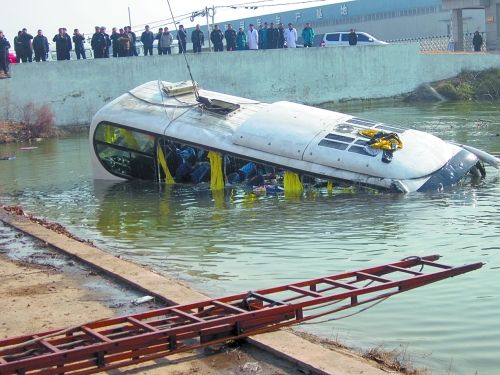
12 dead in central China road accident


12 people died after a bus hit an electric bicycle and ended up in a roadside pond in central China's Henan province on Sunday morning, authorities said Monday.

The accident occurred at 11 am when the bus carrying 34 people ran into the electric bicycle, hit a tree, and then went into the pond in Minquan county in the city of Shangqiu, a county government spokesman said.

As of Monday morning, 12 people, including the bicycle rider, died despite medical efforts, the spokesman said.

23 other people were in a stable condition after being taken to hospital.

The bus, with a load capacity of 30 passengers, belongs to a local transportation company. It was heading for the provincial capital of Zhengzhou from Shangqiu when the accident happened, according to the spokesman.

An initial investigation showed that the accident was caused by the bus driver's improper operation of the vehicle. A further investigation is under way.

Tuesday 11 December 2012

http://www.chinadaily.com.cn/china/2012-12/10/content_16002798.htm

continue reading

9 killed in western Colombia traffic accident


At least nine people were killed and at least 10 others were reported wounded Monday after a bus falls of a 300-meter cliff in western Colombia.

The bus crashed in the department of Tolima while en route to the city of Medellin.

The vehicle fell about 300 meters off the rural road which, due to Colombia’s mountainous terrain, can often be precarious and sometimes dangerous to maneuver.

Colonel Javier Herrera, the department’s police chief, was quoted as saying "The bottom line of this tragic event is 9 people dead and another 10 are injured," going on to claim that "The cause is bad weather, fog, rain also, the bus tried to avoid a rock that had fallen on the road."

Initially five people were reported dead. However, four more died on the way to the areas hospital, reported Colombian newspaper El Tiempo.

Tuesday 11 December 2012

http://colombiareports.com/colombia-news/news/27354-9-killed-in-western-colombia-traffic-accident.html

continue reading

Report on deadly accident to be submitted in two weeks: minister


Minister of Transportation and Communications Mao Chi-kuo said Monday that the investigation report on a deadly coach accident that left 13 dead and 10 injured in northern Taiwan's Hsinchu County will be submitted in two weeks.

The accident occurred Sunday on County Road No. 60 in Jianshih Township, which is administrated by the local government, Mao said during a legislative session.

The Directorate General of Highways has set regulations on medium- or large-sized tour buses driving on provincial highways in mountainous areas, Mao noted.

The ministry will help local governments fully review county roads in mountainous areas across Taiwan to ensure safety, the minister said.

The accident, which occurred Sunday afternoon, involved a bus that fell about 300 meters into a ravine after it reportedly backed off the road leading to Smangus Village. The bus was carrying a driver and 22 tourists, who mostly came from Taishan District in New Taipei.

Family members of the deceased planned to hold a ritual for their late relatives at the scene of the accident on Dec. 13, according to the Taishan District Office.

A Christian church in the Atayal aboriginal village has already performed a ritual for the dead at the crash site.

Local residents, including aborigines from Smangus that helped with the rescue mission, prayed and sang a hymn at the occasion.

According to Hsinchu County Police Bureau's Hengshan branch, the accident spot is in a steep location and the wreckage of the coach is scattered over a large area.

The Hsinchu District Prosecutors Office sent three prosecutors to interview injured passengers and others who have knowledge of the accident, said Chen Chia-hsiu, a prosecutor from the office.

The dead bodies have undergone post-mortem examinations, she said.

She added that prosecutors will determine the cause of the accident after reviewing testimonies and evidence, including video footage from a vehicle's on-board camera that showed the bus going backwards and falling into the valley.

The prosecutors and the police said that cause of the accident can only be completely verified when the wreckage has been removed from the ravine.

Tuesday 11 December 2012

http://www.chinapost.com.tw/taiwan/national/national-news/2012/12/11/363691/Report-on.htm

continue reading

310 tuna fishermen are still missing


Typhoon "Pablo" may have spared this city, but the long wait is tearing apart the families and loved ones of the more than 310 tuna fishermen who are still missing.

The fortunate ones who survived the rough seas on that fateful day had chosen to remain silent, unable to muster the courage to talk about what happened.

It doesn't help that the disaster occurred on December 3, the week leading to the fight of this city's favorite son, Manny Pacquiao, in Las Vegas. To the families of the victims, it hurts that many seemed more preoccupied with the monumental loss of the city’s iconic figure last Sunday, December 9, than the fate of the missing tuna fishers.

News of the missing tuna fleet did not spread until we wrote about it Thursday last week, citing information we gathered from some of the vessels' owners who were in Manila for the Western and Central Pacific Fisheries Commission (WCPFC) meeting held on December 2-6.

It is easy to blame greed for the alleged failure of vessel owners to recall all their fishing fleets in the area. Or to put the blame on the Philippine Coast Guard for allowing them to set sail despite the storm warning.

But most of these fishing boats were already out in the sea weeks before the storm developed into a super typhoon. Medium-sized purse seines can stay up to 6 months in open sea, regularly receiving fuel and food supplies from carrier ships.

Marfenio Tan, former president of the Socsksargen Federation of Fishing and Allied Industries (SFFAI), said most of the missing boats were caught in the middle of a perfect storm at the unholy dawn hours of Monday, December 3, when most radio communication units in base companies were either unmanned or had been turned off.

The typhoon was predicted to make a landfall on December 3. On the morning of December 4, a worried Dominic Salazar, a ship owner, told colleagues they had lost contact with one of their catcher vessels. Salazar however said all 3 crew members of a support light boat had been found alive after their own vessel sank.

Later in the morning, I met John Yap of Rugela Fishing who said two of his catcher vessels were also missing, including their complement of light and ranger boats.

Jake Lu, president of SFFAI, quoted survivors as saying that they saw at least 3 dead bodies and a capsized catcher vessel. “Ga-tumbling daw,” Lu said (It was tumbling all over).

The manager of RR Fishing said one of their catcher vessels was forced to make a port call after "Pablo" triggered giant waves before slamming into the coastal villages of Davao Oriental and Surigao del Sur.

The next day, December 5, former SFFAI president Tan arrived at the WCPFC meeting in Manila and told the Philippine delegation that 6 catcher vessels could no longer be traced and that as many as 300 fishermen were missing.

Before that, Tan made frantic calls to the Philippine Coast Guard and the Philippine Navy. He was told that the available floating assets of both the coast guard and the Navy lacked the capability to a launch a search and rescue operation without endangering their own crew. At that time, the seas were still dangerous for light vessels.

On December 7, I called PCG eastern Mindanao chief Commodore George Ursabia who said 3 of their floating assets were just on their way to Davao from Zamboanga, while the Philippine Navy had already deployed a ship to begin the search and rescue mission. But the Navy ship was to reach the area on December 8 yet.

A survivor said waves of more than 3 stories high slammed into his outrigger handline tuna fishing boat. He refused to give further details, saying the tragedy that claimed some of his companions is still too grim to be retold.

Light boat operator Montgomery Montealegre, whose son Mark Gil is still missing, said their fish carrier loaded with fish left the mother boat (catcher vessel) on November 30, some 302 kilometers off Baganga town in Davao Oriental. The mother boat owned by LPS Fishing was to follow the following day.

Montealegre reached the port of Mati on December 2. He was expecting his son to dock at the same port for refueling before heading back to General Santos City the following day.

They have not made it and it is already Tuesday, December 11.

He and his wife have been going daily to the command center of Task Force Maritime Search at the adjacent wing of the General Santos City Police Office in Camp Lira.

Task Force Maritime Search operations chief Commander Lued Lincunan said they have officially listed 306 fishermen missing from General Santos City and nearby Sarangani alone from the total 46 fishing vessels also reported as missing. (The national government put the missing fishermen at 310.)

Lincunan fears the number could rise because several complainants are claiming to have relatives on board these vessels whose names are not on the official list submitted by vessel owners to authorities.

“We are still on a search and rescue mission,” Lincunan said with cautious optimism.

Tuesday 11 December 2012

http://www.rappler.com/nation/17756-pacquiao-s-city-weeps-but-not-over-him

continue reading

Attorney general applies to quash Hillsborough inquest verdicts


The attorney general Dominic Grieve has formally applied to the High Court for the verdicts of the original Hillsborough disaster inquests to be quashed.

A total of 96 people lost their lives in the Hillsborough disaster

Mr Grieve said there was a ‘good case’ to quash the accidental death verdicts following a damning report that revealed a cover-up and attempt to shift the blame on to the victims.

Ninety-six Liverpool fans were killed following the April 15, 1989, disaster at Sheffield Wednesday’s stadium during the FA Cup semi-final clash with Nottingham Forest.

‘I believe that the case for the High Court to quash the original inquests is a good one,’ Mr Grieve said, adding that he planned to appear in the High Court himself to petition for new inquests.

‘My application has now been lodged with the Court. It is my intention to appear to argue the case at the hearing that will take place in the High Court.’

If the High Court accepts the attorney general’s application it can order new inquests in the district where they were originally heard, in this case either Sheffield or Doncaster, but the Hillsborough families want any new inquests held in Liverpool.

Margaret Aspinall, chairwoman of the Hillsborough Families Support Group, whose 18-year-old son James died in the Hillsborough disaster, said: ‘We have waited over 20-years for these verdicts to be overturned and I’m sure all the families will be delighted to hear that these steps are being taken.

‘It is a great step towards getting the justice we have fought for.’

Last week MPs approved new powers for the Independent Police Complaints Commission, which is investigating actions of up to 2,400 retired or serving officers, to compel serving officers or staff on other bodies to attend interviews.

The legislation is yet to be approved by the House of Lords, however.

Tuesday 11 December 2012

http://metro.co.uk/2012/12/10/attorney-general-applies-to-quash-hillsborough-inquest-verdicts-3310763/

continue reading

Death toll from 'Pablo' now up to 714, at least 800 more missing


The death toll from Tropical Cyclone Pablo (Bopha) went up to 714 as of early Tuesday as more bodies were recovered from areas hit by Pablo Monday night.

National Disaster Risk Reduction and Management Council head Benito Ramos said at least 861 more remained missing, radio dzBB's Rodil Vega reported Tuesday morning.

Ramos was quoted in the report as saying at least eight bodies were found in Cateel in Davao Oriental province on Monday night.

At least 1,906 people were reported injured in the wake of Pablo, which dissipated after reaching Northern Luzon last Sunday night.

Tropical Cyclone Pablo plowed through parts of Mindanao and Visayas and then headed for Northern Luzon, but weakened and dissipated once over the Ilocos area.

Tuesday 11 December 2012

http://www.gmanetwork.com/news/story/285856/news/nation/death-toll-from-pablo-now-up-to-714-at-least-800-more-missing

continue reading

Monday, 10 December 2012

Mass grave found in Tripoli


One-hundred and three bodies have been discovered in a mass grave in the Gergarish district of Tripoli.

The find was made on Tuesday at the Sidi Hamid cemetery as part of a broader search for missing persons killed by the former regime that is ongoing across Libya. The entity responsible for the excavation is the Tripoli Missing Persons Committee, which falls under the SSC.

It is reported that some of the bodies have been identified as being from Zawia, and it is believed they were killed during the 2011 revolution. DNA samples from the bodies will be sent for testing to try and establish the identities of each of the dead individuals.

In the past 12 months, mass graves have been discovered in numerous Libyan towns and cities, including Tripoli, Benghazi, Zliten, Ajdabiya and Sirte.

Monday 10 December 2012

http://www.libyaherald.com/2012/12/06/mass-grave-found-in-tripoli/

continue reading

At least 13 dead after floods in Congo


At least 13 people have died in the Republic of Congo and two dozen others were injured after torrential rains caused homes to collapse in southern Brazzaville.

A Red Cross official said 13 bodies had been recovered over the weekend, while Laurel Kihounzou, mayor of the southern Brazzaville district of Makelekele, told reporters that at least 26 people were injured.

According to witnesses, dozens of houses collapsed after a river in the Makelekele neighbourhood burst its banks.

Police confirmed the death toll, adding that they had provided shelter to nearly 600 residents affected by the flooding.

Monday 10 December 2012

http://www.theaustralian.com.au/news/breaking-news/at-least-13-dead-after-floods-in-congo/story-fn3dxix6-1226534116686

continue reading

Baldia fire tragedy: Fresh samples for DNA test sent to Islamabad


Police investigators have sent fresh samples, collected again from the 33 unidentified bodies at the Edhi morgue, to a forensic laboratory in Islamabad for DNA matching with the families whose loved ones have been missing since the Sept 11 Baldia Town factory inferno.

The exercise for the identification of the 33 bodies, which are beyond recognition, was started afresh following a recent Sindh High Court directive in the Baldia factory fire case, while the families of many victims desperate to know their fate for the past three months have been told to wait for another two weeks.

The process, officials said, could take 15 to 20 days.

“We had collected the samples on Nov 30,” said Dr Jalil Qadir, the police surgeon who heads a medical team tasked with the job.

He said: “Thirty one complete bodies are beyond recognition, while two others can’t be said complete bodies but fragments of bodies. The samples of all 33 objects were collected and handed over to the police investigators for further process.”

He said the Sindh health department had conducted a similar exercise some three months ago. However, there were some ‘complications’ that could not lead to complete results of the sampling.

His observations matched comments of Sub-Inspector Jehanzaib of the SITE-B police station, the investigation officer of the Ali Enterprises inferno that killed more than 250 people in September.

“In the previous exercise, we had sent samples of 76 unidentified bodies,” the police officer said.

“We kept sending reminders and requested them to expedite the process. Once or twice they mentioned some lacking or something missing but mostly the delay was on the part of the laboratory,” he added.

He said the fresh identification process was initiated under the Sindh High Court directives to make the process more transparent and flawless.

This time, he said, extra care had been taken in collection of bodies’ samples as well as blood samples of the claimant of the bodies for matching.

“But it would take 15 to 20 days to complete the process. I agree it is hard to satisfy the family members of the missing workers and to give them an exact timeframe for the completion of the process after so much delay,” he added.

While hearing two petitions related to the Baldia Town factory fire, the Sindh High Court earlier last week was informed that only 16 bodies could be identified through the earlier DNA testing.

The bench ordered the case investigation officer to take fresh samples from the family members to test the 33 unidentified bodies.

The authorities had declared a total of 259 deaths in the fire that engulfed the Baldia factory on the eve of Sept 11 and took more than 18 hours to extinguish with over 50 firefighters taking part in the operation using almost all available machinery and equipment of the fire department.

As the process of bodies’ identification remained inconclusive, the agony of the victims’ families has yet to end. It also gave birth to challenges for other institutions involved in the process.

The Edhi Foundation, which has been looking after the unidentified bodies for almost three months at it morgue, has finally asked the authorities to settle the issue or allow it to bury the remains.

“It’s quite difficult for us to manage the task,” said Anwar Kazmi, the administrator of the Edhi Foundation.

“Last week, we informed the police authorities and sought permission from other relevant authorities for the burial in our Mowach Goth graveyard within the next 10 days. However, the plan was put on hold on a police request and also under the Sindh High Court directives.”

Monday 10 December 2012

http://dawn.com/2012/12/10/baldia-fire-tragedy-fresh-samples-for-dna-test-sent-to-islamabad/

continue reading

Officials hope to find more Pablo survivors


A week after typhoon Pablo wrought havoc in wide areas of Mindanao, national and local disaster officials are not giving up hope to find more survivors in still-isolated mining villages around the gold-rich Mt. Diwata (Mt. Diwalwal) in Monkayo, Compostela Valley and as well as those in Davao Oriental.

As this developed, separate search and rescue operations are being conducted in the waters of the Sulu Sea and adjoining areas for the 315 fishermen from General Santos City who were reportedly caught in the eye of storm after embarking on a tuna fishing expedition last Nov. 20. Since then, they have made no contacts with their waiting families back home.

“We are not giving up hope that there are survivors still out there waiting to be rescued, especially in the high-land villages that are still isolated,” National Disaster Risk Reduction and Management Council (NDRRMC) Administrator and Office of Civil Defense Executive Officer Benito Ramos said.

Ramos added that the 315 tuna fishermen are still classified as missing persons.

As such, he said, a separate massive search and rescue operation is being undertaken to locate the missing fishermen, whom the NDRRMC has included in its long of lists of missing persons due to the onslaught of typhoon Pablo in the country.

“They (fishermen) could just have sought shelter in several islands and other safer areas at the height of the storm,” Ramos said.

Over in Compostela Valley, Ramos said an organized search and rescue as well as retrieval operations are being carried out in the hope of finding survivors as well as to retrieve of those who have perished in the flashflood and landslides.

Saying that search and rescue teams have yet to cover all the areas devastated by Pablo especially highland and upstream villages around Mt. Diwata, Ramos said they are still expecting to rescue survivors out there.

Continuous retrieval operations are also being conducted by combined Army and police troops along with civilian rescue groups in New Bataan, the worst-hit town in Compostela Valley, he said.

The same efforts are also being done in the badly-devastated villages in the towns of Baganga, Cateel and Boston in Davao Oriental, Ramos added.

“For as long as we believe that there are still survivors out there and there are bodies to be recovered, our search and rescue as well retrieval operations will continue. I am still hopeful that we will find survivors,” Ramos said.

As of Monday, the death toll left by Pablo as reported by the NDRRMC has risen to 647 while 780 others still missing and with 1,482 persons injured.

A total of 29,390 families or 133,892 individuals totally displaced by Pablo with no homes to return to are still staying in 172 evacuation centers.

Monday 10 December 2012

http://www.philstar.com/nation/2012/12/10/884462/officials-hope-find-more-pablo-survivors

continue reading

Latin singer and reality TV star Jenni Rivera, 43, dies in plane crash while flying over Mexico as search teams find her driver's license among wreckage


The plane carrying Latin singer Jenni Rivera was revealed to have malfunctioned in 2005 as it is now believed that the Rivera and six others died when the plane crashed on Sunday.

Seven years ago, a fuel system malfunction caused one of the plane's wings to weigh more than another while it was attempting to take off from an Amarillo airstrip. No one was injured in the 2005 incident.

The cause of Sunday's crash remains unknown, but investigators now believe that all of the passengers and crew died on board, with Rivera's presence confirmed by the discovery of her half-melted driver's license.

The wreckage was spread 300 feet from the point of impact outside Monterrey, Mexico. Rivera and the six other people aboard the plane - two pilots and four members of her entourage - are presumed dead, though authorities have found no bodies amid the debris.

'There is nothing recognizable, neither material nor human in the wreckage,' transportation ad communication minister Gerardo Ruiz Esparza told the Televisa network.

The 43-year-old mother of five is already being mourned by her family in Lakewood, California, and her millions of fans.

River was revered for her soulful voice and her openness about her personal struggles.'I want to thank you all for your support, and please remember her with all your heart,' Rivera's father Pedro said outside his Lakewood, California, home. The U.S.-registered Learjet 25 went missing early Sunday after taking off from the city of Monterrey.

Jorge Domene, spokesman for Nuevo Leon's government, said the plane left Monterrey about 3.30am after a concert there and aviation authorities lost contact with the craft about 10 minutes later.

It had been scheduled to arrive in Toluca, outside Mexico City, about an hour later. Jose Antonio Gonzalez, the mayor of the town of Iturbide in Nuevo Leon state, said earlier the plane had been located in the municipality of Los Tejocotes.

Domene says a search for the plane was launched early Sunday, with helicopters from the local civilian protection agency flying over the state.

Seven people including the star's publicist, Arturo Rivera, lawyer, makeup artist, Jacob Yebale, and the flight crew were believed to be aboard, the ministry of transportation and communication said in a statement.

Monday 10 December 2012

http://www.dailymail.co.uk/news/article-2245506/Jenni-Rivera-dies-plane-crash-Mexico-search-teams-drivers-license-wreckage.html

continue reading

647 confirmed dead, 780 still missing from typhoon Pablo


The death toll from typhoon “Pablo” (international name” Bopha) that struck several provinces in the Visayas and Mindanao last week has climbed to 647 as rescue workers continued to search for 780 individuals who remained missing as of Monday, the National Disaster Risk Reduction and Management Council (NDRRMC) said.

Benito Ramos, NDRRMC executive director, said the government has been preparing for a possible mass burial of at least 217 unidentified victims whose remains were still unclaimed by their relatives.

Out of the total number of fatalities, he said 400 were already identified and retrieved by their families.

In Compostela Valley and Davao Oriental alone, the military reported that 641 residents died due to falling trees, flashfloods, landslides and other incidents triggered by the powerful typhoon.

“If nobody will claim the bodies in the next 48 hours, we may bury them in mass graves. But all the bodies will be placed in caskets and will be tagged,” Ramos told reporters.

He said the government had prepared at least 500 caskets for the unclaimed cadavers “so there is semblance of decent burial.”

“For those looking for their relatives, we urge them to coordinate with the municipal health officer to check if their loved ones had already been buried,” Ramos said. In its latest report, the NDRRMC said 1,482 people were injured while 109 were rescued in typhoon-hit provinces in Mindanao and Visayan regions.

It said a total of 487,364 families composed of 5,412,140 individuals in 38 cities and 30 provinces in nine regions were affected by the killer typhoon, which spawned floods, landslides and storm surges.

According to the NDRRMC, a total of 133,892 persons are still staying in evacuation centers. It said the typhoon damaged 70,869 houses.

Monday 10 December 2012

http://newsinfo.inquirer.net/321893/647-confirmed-dead-780-still-missing-from-typhoon-pablo

continue reading

Thursday, 6 December 2012

Grim search for bodies: Mass graves in Compostela eyed as death toll soars

A father lifted a plastic sheet, and wept as he recognized the body of his child among a row of bodies caked in mud and laid out on the ground.

A mother, on the other hand, went away in tears, unable to find her missing loved ones. “I have three children,” she said over and over, flashing three fingers before a TV cameraman.

Residents of this town in Compostela Valley yesterday went about the grim task of searching for missing relatives amid a growing pile of bodies.

As of early yesterday afternoon, at least 342 people had been confirmed killed, with over 400 more missing from landslides and floods triggered by super typhoon “Pablo.”

Along coastal communities and farming and mining towns in Compostela Valley, the hardest hit province, authorities mulled mass graves as the death toll soared and health personnel worried about the spread of diseases.

Interior Secretary Manuel Roxas II, however, said they would need the approval of families to bury the dead in mass graves.

Dionisia Requinto, 43, felt lucky to have survived with her husband and their eight children after rampaging floodwaters engulfed their home. She said they managed to climb a hill while bracing themselves against boulders and fallen trees.

“The water rose so fast. It was horrible. I thought it was going to be our end,” Requinto told journalists.

Compostela Valley registered the highest number of fatalities at 214, while 395 remained missing.

Among its worst-hit towns were New Bataan with 59 dead; Monkayo, 55; Compostela, 21; Mabini, four; Maragusan, three; Montevista, 10; Mt. Diwata, 11; Nabunturan, nine; Maco, three, Pantukan, two, and Laak, two.

The deaths came despite efforts by the government to force residents out of high-risk communities as the typhoon approached.

Last Wednesday, the sun shone brightly over the typhoon-ravaged areas, prompting villagers to bring their soaked belongings out to dry.

But when night fell, rain started pouring again, triggering panic among those fearful of a repeat of the previous day’s flash floods.

Davao Oriental Gov. Cora Malanyaon told The STAR that as of yesterday afternoon, the death toll in her province had reached 177. She said they didn’t know where to take the evacuees since all the evacuation centers lost their roofs.

Among the province’s worst-hit towns were Cateel with 59 dead; Baganga, 31; Boston, 27; Caraga, nine; and one each from Tarragona and Manay.

“Two days after typhoon Pablo hit Davao region, hundreds of dead bodies were retrieved and thousands of homeless people were left distressed on how to start anew,” Lt. Col. Lyndon Paniza, spokesman for the 10th Infantry Division said.

Paniza said rescuers are still trying to find seven persons in Cateel, Davao Oriental swept away by the rampaging floodwaters, while 13 others were also reported missing in Baganga town, and one from Manay. Rescue teams have yet to report on the exact number of missing from Boston town.

Aside from the high number of fatalities in the region, four persons also perished in Central Visayas, two in Eastern Visayas; 10 in Northern Mindanao and seven in Caraga region.

The National Disaster Risk Reduction and Management Council (NDRRMC) said the number of deaths is likely to increase as hopes dim to recover alive the missing individuals.

Thursday 6 December 2012

http://www.philstar.com/headlines/2012-12-07/882157/grim-search-bodies-mass-graves-compostela-eyed-death-toll-soars

continue reading

Families try to prove that loved ones were lost in fire


Syed Nazeef Shah believes his son is dead – for all he knows is that young Obaidullah was working at Ali Enterprises on September 11, 2012 when a raging fire killed more than 250 people at the factory.

But what he does not have is closure as his son’s body was never found and the DNA test reports came back without any answer. Without proof, he cannot get a death certificate issued as well. Obaidullah reportedly joined the factory two weeks before the fire broke out but when asked for documents that could verify his employment, his father hands over irrelevant papers such as a matriculation certificate instead of a company card.

The only verification Shah can offer is through his neighbours and other residents, such as the shopkeepers and the bus conductors, who he says can vouch that Obaidullah worked at the factory.

“I have visited leaders of three political parties as well as the deputy commissioner for compensation. All of them turned me back saying that I should bring the body first,” said Shah who lives in one of the impoverished colonies of Baldia Town. “We deserve compensation. But what am I suppose to do now?”

Families still waiting

Shah’s son is among the 61 people who, as claimed by their families, were working in the factory and are still missing, their remains apparently disintegrated and washed away from the premises.

Despite almost three months gone by, 28 bodies are still lying in the morgue as authorities try to establish their identities through DNA tests.

While the matter is pending before courts, anxious families of victims whose bodies were never found shared the problems they have been facing at a press conference at Karachi Press Club.

Pakistan Institute of Labour Education and Research (PILER)’s executive director, Karamat Ali, said that the lack of proper records of workers shows negligence on part of the government and the factory owners.

“We could have known how many people were working in the factory at the time of the fire if the employees were registered with social security institutions, such as the Employees Old Age Benefit Institution,” he said.

PILER and other NGOs have approached the courts to come up with a way to verify these claims by families. Families of the victims who were identified have each received Rs900,000 in compensation.

Foul play

According to Ali, affected families, some of whom had changed their statements before the courts, were being intimidated by the factory owners. “Faisal Siddiqui, one of the lawyers representing the families, has even received warnings to drop the case. Government must look into this as well.” He alleged that powerful industrialists were using their financial strength to influence the investigations.

Thursday 6 December 2012

http://tribune.com.pk/story/475773/families-try-to-prove-that-loved-ones-were-lost-in-fire/

continue reading

South Africa military plane crashes, kills 11


A South African military aircraft on an unknown mission to an area near former President Nelson Mandela's village crashed in a mountain range, killing all 11 people onboard, officials said Thursday.

The Douglas C-47TP Dakota, a twin-propeller aircraft, had taken off from Pretoria's Waterkloof Air Force Base on Wednesday morning, said Brig. Gen. Xolani Mabanga, a military spokesman. The aircraft encountered bad weather in flight and failed to make its 10 a.m. landing.

On Thursday morning, soldiers found the wreckage in the Drakensberg mountains near Ladysmith in KwaZulu-Natal province, some 340 kilometers (210 miles) southeast of the air base, Mabanga said. The Drakensberg, which in the local Afrikaans language means Dragon Mountains, have the highest peaks in South Africa, reaching to a height of about 3,400 meters (11,400 feet).

In a statement Thursday, South Africa's Defense Department said an investigation would begin into the cause of the crash, which killed six crew members and five passengers. The statement did not explain what the aircraft had been doing, nor did it name those killed in the crash. Siphiwe Dlamini, a Defense Department spokesman, did not immediately respond Thursday to a request for more information about the crash.

Mthatha is about 30 kilometers (17 miles) north of Qunu, the village where Mandela now lives after retiring from public life. South Africa's military remains largely responsible for the former president's medical care. However, military officials declined to say whether those on board had any part in caring for Mandela.

In November, another South African military flight crash-landed at Mthatha, injuring several people.

Thursday 6 December 2012

http://news.yahoo.com/south-africa-military-plane-crashes-kills-11-103956654.html ___

continue reading

Flesh-eating fungal infection can follow natural disasters, study finds


After a natural disaster, doctors should be on the lookout for outbreaks of a rare but deadly "flesh-eating" fungal infection, researchers at the U.S. Centers for Disease Control and Prevention reported Wednesday.

That's the lesson, the agency said, from 13 cases of mucormycosis skin infections that struck victims of the Joplin, Mo., tornado last year. The May 2011 tornado was one of the deadliest in U.S. history, killing almost 160 people and injuring more than 1,000.

In the aftermath, doctors found that some victims with serious injuries were developing severe infections that ate away at the skin and underlying soft tissue.

It turned out to be mucormycosis, a fungal infection caused by a group of molds found in soil and decaying matter, such as fallen leaves and rotting wood. The fungus can attack various parts of the body, but skin infections occur when the fungus contaminates a wound.

The cluster of 13 cases in Joplin was a very large one, the CDC reported in the Dec. 6 issue of the New England Journal of Medicine. "A typical hospital might normally see one case in a year," said senior researcher Dr. Benjamin Park, a medical officer at the CDC's mycotic diseases branch.

All 13 victims, five of whom died, had been in the most severely storm-damaged areas of Joplin. They'd suffered multiple wounds—including penetrating wounds in five people—and most had bone fractures. Those injuries were also often contaminated with debris from the storm, including gravel, wood and soil. "Particulate matter was basically blown into them by the tornado," Park explained.

All of the patients had surgery to remove the infected, dead tissue, along with antifungal drugs—though six initially got drugs that are not active against mucormycosis-causing fungi. It's not clear, the CDC team said, whether that made a difference in their outcomes. "In real time, it's hard to know what you're treating," Park said. So doctors might preemptively start a patient on antibiotics (which fight bacteria) or antifungal drugs before test results are in.

The Missouri outbreak underscores the importance of early testing to get patients the right treatment, Park said. "We want to raise awareness of this [infection] as a possibility after natural disasters," he added. Even though mucormycosis-causing fungi are ubiquitous, they rarely cause problems for people, said Dr. Thomas Patterson, chief of the division of infectious diseases at the University of Texas Health Science Center at San Antonio.

Most often, the infection strikes people whose immune systems are compromised, from cancer or drugs used after an organ transplant, for example. And those are typically respiratory infections from inhaled mold spores. Still, the risk of mucormycosis in healthy people with traumatic injuries has been recognized, noted Patterson, who also is a member of the Infectious Diseases Society of America.


And he agreed on the importance of early recognition. "These infections are very difficult to treat," Patterson said. But he also noted that for most people injured in a natural disaster, any infections will be bacterial—though those, of course, also can become serious. "It's important to remember that in these [Joplin] cases, we're talking about people who had extensive injuries," Patterson said.

And because of that, preventing severe injuries during natural disasters should help prevent mucormycosis cases, according to the CDC. The public can take some steps of its own, Park said. If you live in a tornado-prone area, for example, you can make sure you have a "safe room" or some type of emergency shelter you can get to quickly. You should also be tuned in to your local area's tornado warning system. Thursday 6 December 2012 Read more at: http://medicalxpress.com/news/2012-12-fungus-deadly-infection-source-tornado.html#jCp

continue reading

Typhoon Botha: survivors search for relatives after Philippines storm


Parents searching for missing children examined a row of bodies while other survivors dried belongings on roadsides a day after a typhoon killed nearly 300 people in the southern Philippines.

Officials fear more bodies may be found as rescuers reach hard-hit areas that were isolated by landslides, floods and downed communications lines. At least 151 people died in the worst-hit province, Compostela Valley, when typhoon Bopha hit on Tuesday. The victims included 78 villagers and soldiers who died in a flash flood that swamped two emergency shelters and a military camp.

Disaster response agencies reported 284 dead in the region and 14 fatalities elsewhere from the typhoon, one of the strongest to hit the country this year.

In New Bataan, a town of 45,000 people, 319 remained missing, said the interior secretary, Mar Roxas, on a visit to survey the damage.

"These were whole families among the registered missing," Roxas told the ABS-CBN TV network. "Entire families may have been washed away."

Bodies of victims were laid on the ground for viewing by people searching for missing relatives. A father wept when he found the body of his child after lifting a plastic cover. A mother went away in tears, unable to find her missing children. "I have three children," she said repeatedly, flashing three fingers before a TV cameraman.

Two men carried the mud-caked body of an unidentified girl that was covered with coconut leaves on a makeshift stretcher made from a blanket and wooden poles.

The International Federation of Red Cross and Red Crescent Societies issued an urgent appeal for $4.8m to help people directly affected by the typhoon. The deaths came despite government efforts to force residents out of high-risk communities as the typhoon approached.

On Wednesday evening the typhoon was over the South China Sea west of Palawan province. It was blowing northwestward and could be headed to Vietnam or southern China, according to government forecasters.

Thursday 6 December 2012

http://www.guardian.co.uk/world/2012/dec/05/typhoon-botha-survivors-philippines

continue reading

Four crew members die and seven missing after cargo and container ships collide in the North Sea


Four members of the crew of a ship that collided with another in the North Sea have died.

A further seven are missing after the crew of the Baltic Ace took to life rafts after colliding with a container ship in freezing conditions about 40 miles from the Dutch port of Rotterdam.

Thirteen members of the crew have been rescued. Four of the survivors were being flown to a hospital in Rotterdam and seven to an airbase in Belgium.

The Baltic Ace is understood to have collided with the container ship the Corvus J in the busy shipping lanes.

Dutch coastguard spokesman Peter Verburg confirmed that two life boats and a helicopter were pulling crew members out of four life rafts found near the scene of the collision.

He said that helicopters had picked up 11 crew members on the life rafts while two others had been rescued by passing ships.

Rescuers were using infrared cameras to hunt for more survivors.

'We still hope to find them,' Kees Brinkman, a spokesman for rescuers, told Dutch television after the collision. But, he added, 'their chances of survival are shrinking.'

The condition of the Corvus J was unknown but it is understood the vessel was not in immediate danger following the incident. Mr Vorburg said that the 12-man crew were all still onboard.

'It is badly damaged, but not in danger of sinking,' he said, adding that the cause of the collision was not yet known.

'At the moment we are solely focused on getting the people to safety,' he added. Dutch media reported that the Baltic Ace was en route from Zeebrugge in Belgium to Kotka in Finland, while the Corvus J was going from Grangemouth in Scotland to Antwerp, Belgium.

Rotterdam port is Europe’s biggest and a disruption to shipping lanes in the vicinity could affect a wide range of goods in and out of Europe.

No one at the port authority was available to comment.

Thursday 6 December 2012

Read more: http://www.dailymail.co.uk/news/article-2243600/BREAKING-NEWS-Major-rescue-operation-underway-cargo-ship-sinks-North-Sea.html#ixzz2EE466lWt

continue reading

Wednesday, 5 December 2012

Unclaimed corpses of bomb victims in mortuary


Eight months after the bomb blasts at COCIN Church Headquarters and St. Finnbar Catholic Church in Jos,capital of Nigeria’s state of Plateau, unclaimed corpses of some victims are still in Plateau Specialist Hospital.

Dr Sanusi Gidado, the Chief Medical Director (CMD), Plateau Specialist Hospital, Jos, told the News Agency of Nigeria (NAN) in Jos on Tuesday, that the corpses constituted serious challenges to the hospital.

COCIN Church headquarters was bombed in February while St. Finnbar Cathedral was hit in March 2012, killing several people while many others sustained injuries.

“We are having serious challenges at the mortuary which has already been filled up. “The corpses of the people affected by the bomb blasts at both COCIN Headquarters and St. Finbarrs Cathedral are still in mortuary unclaimed.

“Some of the corpses are beyond recognition; we want the authorities to help us evacuate them,” he said.

Gidado said the hospital’s management had taken the step toward burying the bodies as discussions had begun with the authorities of Jos North Local Government Area of the state.

“If not for the ongoing strike, we could have completed that task and overcome the challenge.

“We won’t mind to foot the bill of burying the corpses, but we must get the cemetery that we can use for that purpose.

“As soon as the local government workers resume, we shall revisit the issue to evacuate the corpses and decongest the mortuary,’’ he said.

Gidado attributed the problem to the inability of the victims’ relatives to identify their corpses, adding: “You can’t claim a body you don’t know“.

The director, however, advised the general public to endeavour to check the hospitals whenever any of their loved ones was missing.

Wednesday 5 December 2012

http://pmnewsnigeria.com/2012/12/04/unclaimed-corpses-of-bomb-victims-in-mortuary/

continue reading

Three dead, 11 trapped in flooded mine in NE China


Eleven miners remain trapped underground at a flooded coal mine in Qitaihe city in Northeast China's Heilongjiang province, with rescue work continuing.

Three miners were confirmed dead in the accident early on Tuesday.

The bodies of the three, Dong Zhanjiang, Wang Jifeng and Gao Chuanjun, were recovered at about 1 am on Tuesday after a 48-hour rescue attempt.

The Furuixiang Coal Mine flooded at about 11:40 pm on Saturday as 22 miners were working underground. Six managed to escape.

After 10 hours, rescuers reached two miners, Wen Hongfu and Wang Yaquan, who are slightly injured and being treated at Qitaihe City People's Hospital. They are in stable condition and can leave within 10 days, their doctor told China Daily.

As of Tuesday evening, six water aspirators capable of draining 555 metric tons of water an hour were being used to pump water from the mine. "But rescuers cannot predict when the water will be drained," said Li Shuguang, an official in charge of emergency response with the city's work safety bureau.

Rescuers are drilling down from a position about 285 meters underground to try to reach those trapped and once they have broken through oxygen, food and water can be sent to the miners.

Relatives of those trapped are anxiously awaiting news.

The mother of Bao Qingbo, 36, and his brother Bao Qingfeng, 33, said: "My two sons are still underground in the mine. They left home on Saturday and I thought they would come back the next day as usual. But at 6 am the next morning, my neighbour told me about the flood.

"We believe they are still alive and will wait for them at home."

Wednesday 5 December 2012

http://www.shanghaidaily.com/nsp/National/2012/12/05/11%2Bmissing%2Bin%2Bflooded%2Bmine/

continue reading

Race against time in New Bataan


"We knew this was coming, but we didn't expect this much damage," said a resident, one of the survivors of the devastation of typhoon "Pablo" in this small town in the province of Compostela Valley.

One of the hardest-hit areas during the onslaught of the storm, New Bataan is now racing against time to rescue those who are still alive and injured and retrieve those who have perished. (To know more about the town read "Where the 68 lay dead" here.)

A total of 44 bodies buried in debris and mud were already retrieved while 77 were still missing on Wednesday, December 5.

Dozens of unidentified bodies

Out of the 44 casualties, only 13 were identified, including 8-year old Rena Mae Adlawan. Her mother, Bebeng, and sister, Jade, are still missing.

Adlawan’s cousin, Sadrak Adlawan, said the family was in their home in Barangay Andap when the deluge came. Rena Mae’s father was with Sadrak in San Francisco, Agusan del Sur. Both were trying to return home to be with their families during the typhoon.

When we arrived in New Bataan, we could not find our houses and our relatives,” Sadrak said. She said 9 of their relatives, including Bebeng and Jade, are still missing.

While crying and kneeling in front of Rena Mae’s lifeless body, the remaining family members asked her where the mother, sister and other relatives were.

For Walterio Dapadap Jr, no one must be blamed for the deaths, injuries and damages.

“We should accept what happened in our town,” Dapadap said while nursing several wounds in his arms, legs and body.

His father died when their home was swept away by the flashflood in Sitio Kalamkan, Purok 10.

“But this is really dreadful. We know that there is a typhoon coming but we did not expect that it would cause this much damage,” Dapadap said.

Making a living on their crops, including coconuts, corn and ginger, Dapadap and his family are already planning to rebuild their lives, destroyed in just a few hours.

Dapadap narrated that flood started to swamp their area at around 4 am on Tuesday, December 3.

“It was very fast. The water came with strong winds and tore down everything in its path including houses and trees. We were helpless,” Dapadap said.

Mayor Lorenzo Balbin said the local government and other government agencies that responded are doing their best to rescue and retrieve the missing residents of New Bataan.

“We are suffering badly right now but we are doing our best,” Balbin said.

At least 6 areas, including Sitio Pagsilaan in Barangay Andap, Cogonon, Panag, Camanlangan and Fatima are still isolated and cannot be reached by the rescue teams, Balbin said.

A total of 600 families were affected and 500 had been evacuated. Power is still out and cellphone signal is patchy.

Wednesday 5 December 2012

http://www.rappler.com/nation/17356-race-against-time-in-new-bataan

continue reading

Update: 'Pablo' death toll balloons to 238


The death toll from Typhoon "Pablo" (international name Bopha) ballooned to at least 238 people as rescue and retrieval operations intensified on Wednesday and local officials feared many more bodies could be found as rescuers reach hard-hit areas that had been isolated by landslides, floods and downed communications.

The Armed Forces of the Philippines' Eastern Mindanao Command (Eastmincom), whose troops were engaged in ongoing disaster, relief and retrieval operations in areas ravaged by Pablo, reported that at least 143 people died from flash floods and landslides in the farming and mining provinces of Compostela Valley, specifically in the towns of Monkayo, New Bataan, Compostela, Montevista, Nabunturan and Pantukan.

“In the whole province of Compostela Valley the number of deaths has risen to 143. In New Bataan alone, 67 civilians and three of our soldiers died from flash flood,” said Eastmincom spokesperson Lt. Col. Lyndon Paniza.

Paniza added that 154 were also injured while 58 persons were missing including eight soldiers.

The Provincial Disaster Risk Management Reduction and Management Council (PDRRMC) of Davao Oriental, on the other hand, reported 82 fatalities either from flash floods, landslides or by fallen trees after the typhoon made landfall in the province before dawn Tuesday.

The PDRRMC said that the fatalities were recorded from the towns of Tarragona (1), Manay (1), Caraga (3), Banganga (31), Cateel (30) and Boston (16). It also reported that 21 more people were missing and 148 were injured in the province.

The other fatalities came from Caraga region with six dead, Northern Samar with one, two in Bukidnon, one more in Misamis Oriental, two in Misamis Occidental and one more in Siquijor.

Undersecretary Benito Ramos, executive director of the National Disaster Risk Reduction and Management Council (NDRRMC), meanwhile, announced that the agency has confirmed only 95 deaths from the typhoon's onslaught as of 1 p.m.

“We could not just confirm the number of fatalities from Comval (Compostela Valley) and Davao Oriental because we are still validating and cross-checking all field reports that are coming in,” Ramos said.

However, Ramos said that he expects the official number of fatalities to increase as there were many typhoon-ravaged areas that have yet to be reached by soldiers and policemen involved in the search, rescue and retrieval operations.

Aside from the rising number of fatalities, Ramos said that he also expects a massive damage in agriculture and infrastructure in the two provinces. There were initial reports that 75 per cent of the houses as well as private and government infrastructures along Pablo’s path were either totally or partially destroyed.

Ramos said that as of Wednesday afternoon, the weather has largely improved in Mindanao but the people in the typhoon-ravaged communities are still reeling from the massive destruction left by Pablo.

“It’s already sunny out there but the people there are asking for food, clothing and shelter. These are three basic services they need. Lahat sila ngayon ay mangiyak-ngiyak at humingi ng ayuda at tulong. Kaawa-awa ang kanilang kalagayan ngayon,” Ramos said.

Meanwhile, the national government, through the Department of Health (DOH), is sending body bags to the worst-hit areas while the recovered bodies, including children, are being processed for identification.

The Department of Social Welfare and Development has been attending to the basic needs of the displaced civilians who lost their houses and are staying in more than 80 evacuation centers

Tuesday 5 December 2012

http://www.philstar.com/nation/2012/12/05/880991/pablo-death-toll-balloons-238

continue reading

Tuesday, 4 December 2012

Philippine typhoon kills five


One of the strongest typhoons to hit the Philippines this year barrelled across the south of the country on Tuesday, killing at least five people and forcing more than 50,000 to flee.

Typhoon Bopha hit the Davao region at dawn. Gusts of wind of up to 120 miles an hour ripped roofs from homes and a 300-mile wide band of rain flooded low-lying farmland. The storm toppled trees, triggered landslides and sent flash floods surging across the region's mountains and valleys.

In the gold-mining province of Compostela Valley, three children were killed after their house was hit by boulders and mud during a landslide. Grieving relatives wrapped their bodies in blankets and placed them on a basketball court in Maparat village.

"The only thing we could do was to save ourselves. It was too late for us to rescue them," said Valentin Pabilana, who survived the landslide.

In nearby Davao Oriental, a poor agricultural and gold-mining province about 620 miles southeast of Manila, an elderly woman was killed when her house was struck by a tree, said Benito Ramos, an ex-army general who now heads the government's disaster-response agency.

A man died a few hours later when a tree knocked him down while he was riding his scooter on a road in Misamis Oriental province, Ramos said.

He said the death toll was expected to rise once soldiers and police reached far-flung villages cut off by fallen trees and floods.

Regional disaster-response officer Liza Maso said she was trying to confirm an army report that a flash flood washed away a truck carrying an undetermined number of people in New Bataan town, also in Compostela Valley.

Some 20 typhoons and storms normally lash the archipelago nation each year but the southern provinces are unaccustomed to such fierce weather. A rare storm that took the area by surprise last December killed more than 1,200 people and left many more homeless.

Officials were taking no chances this year, and on Monday the president, Benigno Aquino III, appealed for people in Bopha's path to move to safety and take storm warnings seriously.

"This typhoon is not a joke," Aquino said after meeting disaster-response officials. "But we can minimise the damage and loss of lives if we help each other," he added.

Aquino outlined preparations, including evacuations and the deployment of army search and rescue boats in advance. Authorities also ordered small boats and ferries not to venture out along the country's eastern seaboard, warning of rough seas with waves of up to four metres high.

In Compostela Valley, authorities halted mining operations and ordered evacuations to prevent a repeat of deadly losses from landslides and the collapse of mine tunnels seen in previous storms.

Bopha, a Cambodian word for flower or a girl, is the 16th weather disturbance to hit the Philippines this year. Forecasters say at least one more storm may hit before Christmas.

Tuesday 4 December 2012

http://www.guardian.co.uk/world/2012/dec/04/philippine-typhoon-bopha-kills-five

continue reading

Monday, 3 December 2012

Update: Congo cargo plane crash death toll up to 32


A Congolese city morgue official on Sunday updated the death toll from a cargo plane crash two days ago to 32, as the search continued for more bodies in the wreckage at Brazzaville airport.

So far emergency workers had removed 32 bodies from the scene, 15 of whom had been identified, said the official. An earlier death toll from a hospital official put the total at 27.

All seven people on board the plane were killed as the plane skidded off the runway as it came into land in stormy weather, demolishing several homes and a bar before crashing into a ravine.

The other victims were those caught in the path of the crash, which left more than 30 others injured.

Five of the people on board the plane were Armenians, a civil aviation official in Yereven said Saturday. Their foreign ministry said that the aircraft belonged to Armenian freight specialist airline Rij Airways.

The Ilyushin plane, registered with local company Aero-services, was flying in from the western port city of Pointe Noire carrying cars and other goods.

Monday 3 December 2012

http://www.rnw.nl/africa/bulletin/congo-cargo-plane-crash-death-toll-32

continue reading

Harmony brings more bodies to surface in illegal mining disaster


Gold producer Harmony has confirmed that the number of illegal miner fatalities at its abandoned Eland shaft had reached 82, after another body was found on Monday morning.

Five bodies of trespassing miners had been brought to surface on Saturday, Harmony COO Tom Smith told Mining Weekly Online.

The deaths followed an apparent underground fire. It was suspected that the people died of smoke and gas inhalation, although Smith said that the results from the autopsies had not been made known yet.

Harmony spokesperson Marian van der Walt previously said that it remained uncertain what the extent of the incident was, and whether or not more bodies would be found.

An estimated 294 illegal miners have been brought to surface in connection to the mining at the Eland shaft, and have been charged.

Monday 3 December 2012

http://trustedarticleslibrary.com/harmony-brings-more-bodies-to-surface-in-illegal-mining-disaster/

continue reading

Update: Japan Sasago tunnel collapse killed nine


Nine people are now confirmed to have died after a major tunnel collapsed in Japan, officials say.

The bodies were found in three vehicles that were crushed by fallen concrete panels in the Sasago tunnel, about 80km (50 miles) west of the capital Tokyo.

A fire broke out after the tunnel caved in on Sunday, and a number of survivors fled to safety on foot.

The usually busy tunnel remains closed, as police are investigating potential negligence.

There will be serious questions about how a major tunnel on one of Japan's most important traffic arteries could have failed so catastrophically, the BBC's Rupert Wingfield Hayes in Tokyo reports.

The private company that runs the highway has said the tunnel was given a major inspection just two months ago and was given a clean bill of health, our correspondent adds.

Survivors' stories

Emergency workers said that five bodies were recovered from a van early on Monday. They were identified as three men and two women, all in their twenties and from Tokyo, Kyodo news agency reported.

Another woman, aged 28, who had been in the vehicle survived.

Three bodies were found in a car and another body in a lorry.

The driver of the lorry had reportedly telephoned for help from inside the 4.3km (2.7 miles) twin-bore tunnel - one of the longest in Japan.

Part of the tunnel collapsed at 08:00 local time (23:00 GMT Saturday).

Thick black smoke was seen billowing from the tunnel, hampering rescue efforts.

Pictures from closed circuit TV cameras inside the tunnel later showed a section of up to 100m (328ft) that had caved in on the Tokyo-bound lanes on the Chuo Expressway in Yamanashi prefecture.

A reporter for public broadcaster NHK described driving through the tunnel as it began to collapse, seeing other cars trapped and on fire. His car was badly damaged, he said.

Another survivor told the broadcaster that he saw "a concrete part of the ceiling fall off all of a sudden when I was driving inside. I saw a fire coming from a crushed car".

Survivor Tomohiro Suzuki said: "A part of the ceiling, just as wide as the road, had collapsed straight down and broken in the middle into a V-shape."

He and his family walked for an hour to get out, with the smoke worsening.

"I heard after a while on the public address system that a fire had occurred inside the tunnel and the sprinkler system was going to be activated," he told Jiji Press.

"I kept wondering when the fire would spread and catch us," Mr Suzuki said.

Japan is prone to large earthquakes, but none was reported in the area at the time.

Some experts have said that structural failure may be to blame - but this has not been confirmed by the authorities.

Monday 3 December 2012

http://www.bbc.co.uk/news/world-asia-20576492

continue reading

Bodies of Armenians killed in Congolese plane crash to be identified


The pilot in command of the cargo plane that crashed in the Congolese capital Friday, Nov 30 evening, has been identified.

“This was Varazdat Balasanyan, a citizen of Armenia,” spokesman for the Armenian Foreign Ministry Tigran Balayan told PanARMENIAN.Net

The bodies of Armenian citizens who died in Congolese plane crash will be identified in the days to come, Armenian Foreign Ministry’s Facebook page said.

On November 30, about 30 people, including the crew of 7; 5 of them Armenian citizens, were killed when Il76 Armenian cargo plane chartered by Aรฉro-Service Congolese airline skidded off the runway and crashed into houses and a bar in the Congolese capital.

Earlier, spokesperson for Armenia’s General Department of Civil Aviation, Ms. Nelly Cherchinyan told a PanARMENIAN.Net reporter that the crew consisted of 7 people, of whom 5 were Armenian citizens.

Among those perished are Ara Tovmasyan; Andranik Gevorgyan; Edgar Avetyan, born 1989.

The Ilyushin plane, registered with local company Aero-services, was flying in from the western port city of Pointe Noire carrying cars and other goods.

Monday 3 December 2012

http://www.panarmenian.net/eng/news/135500/

http://www.panarmenian.net/eng/news/135253/

continue reading

Burma: Lives still in limbo 4 years after Cyclone Nargis


When Cyclone Nargis tore through Burma's Irrawaddy Delta in 2008, the locals took shelter in rice sheds and temples, tied themselves to coconut trees and prayed they would survive the storm. Up to 200,000 of them perished.

Four-and-a-half years later, people are still struggling to find new livelihoods, farm the paddy fields that were inundated with salt water, and rebuild communities that lost up to a third of their population. They are also having to deal with the persistent trauma of what happened that spring night.

"Of course there is a psychological effect. It was traumatic," said Hla Aye, a 62-year-old woman who makes a living as a day labourer in Pyin Ma Gone, a village accessible only by boat, close to the delta town of Bogale.

"Sometimes when it rains, some of the children refuse to go outside. The parents have to tell them not to be so afraid of the storm and rains."

The raw power of Cyclone Nargis not only devastated the communities of the Irrawaddy Delta. It also shone a light on the inefficiency and cruelty of Burma's military junta, whose response was both inadequate and scornful. The generals expended more effort trying to prevent foreign aid workers and Burmese volunteers from Rangoon from reaching the region than they did helping those who were affected.

A famous Burmese writer and comedian, Maung Thura, better known as Zarganar, was arrested and jailed after organising food convoys and criticising the government's response. Even now, the media needs a special permit to visit. The Independent was among a group of international reporters taken to the delta by the EU to see the progress of European-funded development projects. The coming to power of a nominally civilian government in Burma that has embarked on a series of reforms has made things easier for those involved in efforts to rebuild lives in the Delta. Among the most important tasks are providing clean water in remote villages and income generation projects.

Half-an-hour downstream the Bogale River from Pyin Ma Gone lies the community of Myit Poe Kyone Sein. There, villagers have learnt how to plant eucalyptus trees and mangroves to provide timber and erosion breaks and build energy-efficient ovens from clay and banana-tree sawdust. They have recently also reaped the benefits of having access to micro-loans.

"I set up a shop selling vegetables and snacks," said Ai Win, one of 50 women in the village who are part of the loan scheme and who meet in a large thatched hut.

The reforms carried out by the government of President Thein Sein have brought changes to the lives of those in the Delta in other ways. Everyone in Pyin Ma Gone knew that Barack Obama had visited Rangoon, and met President Thein Sein and the opposition leader Aung San Suu Kyi – they had listened to the news on the television or the radio.

"We are beginning to see some freedoms starting. We feel we can speak more openly," said Hla Kyi, a 65-year-old farmer. "Before, if something was wrong we were too scared to speak to the village authorities. Now we can talk to them about matters of justice."

As an example, Mr Kyi said that previously if two people had quarrelled and one of those involved had been related to a government official, no one would have raised the matter. Nowadays there was more confidence.

There was also more hope for the future. Another farmer, Than Khe, 53, said he had little knowledge of the changes that had taken place in the government. He also knew that their lives had not yet fully recovered from the impact of Nargis. And yet he said: "We do trust. We do believe. We believe our lives will get better."

Harder to tackle than field-testing salt-tolerant rice seedlings to counter the salination that took place, and replacing destroyed mangroves, is the sheer scale of loss. The village of Pyin Ma Gone lost 33 per cent of its population to Nargis while the death toll in Myit Poe Kyone Sein amounted to 25 per cent.

Everyone, it seemed, had friends or relatives who had lost their lives. Than Khe lost his wife, daughter-in-law and six employees, Hla Kyi lost a daughter and daughter-in-law. Two of Hla Aye's sons and daughter-in-laws were also among the dead.

The bodies of many of those who died were never found – swept out to sea or else carried by the tides to another community who had no idea who they might be. Most were buried as there was no fuel for cremation fires.

"A year after Nargis, if a farmer's crop grew particularly well in one patch, you knew that a body was there," said Win Sein Naing, of the Mangrove Service Network, a local group that has been trying to develop livelihoods.

Myo Win, 41, who works for another NGO, was at his parents' home in the town of Bogale when Nargis struck. He survived by leaning against the outside wall that did not face the storm. At the very height of the surge – around 3.30am – the water came up to his chest. By 5am, it had gone.

His main concern had been for his wife and children, who were at his home by themselves. As it was, they survived largely unscathed, but Mr Win's son, Phyo Htet Kyaw, now aged six, is among those children for whom the annual monsoon may always be a cause for anxiety. "He cannot go outside when it rains," he said.

Monday 3 December 2012

http://www.independent.co.uk/news/world/asia/lives-still-in-limbo-for-burmas-forgotten-cyclone-victims-8374277.html

continue reading

Sunday, 2 December 2012

A forensic anthropologist's life and work


If Zhou Xueliang says he is the most experienced forensic anthropologist in Jiangsu's provincial capital of Nanjing, no one will dispute that.

Although he retired 24 years ago, the 90-year-old still goes to work every day by bus. He has a lab in the Forensic Identification Center under Nanjing Medical University. The lab is piled high with books and materials. On his desk sits a microscope that has helped him anatomize more than 1,000 bodies.

"I recognize more dead people than living ones," Zhou says with a smile.

It wasn't Zhou's first choice to be a forensic anthropologist. He entered medical school in 1946 to achieve his aspiration of becoming a doctor. But when he graduated in 1951, the university asked him to become a forensic assistant.

"I chose to study in a medical school to solve the problems of living people, not to spend time with the dead," Zhou says. But after some consideration, he agreed to accept the university's offer and worked hard to overcome his fear.

When he was an undergraduate, Zhou sometimes went looking for unidentified bodies in abandoned areas together with some male classmates.

"I've seen all types of corpses died of various reasons," Zhou says. "The most horrible bodies are those who died of drowning, with terribly swollen faces and stomachs."

Dissecting bodies is his core job. "Take the human brain, for example. The brain is as soft as fresh tofu, and thus, it's hard to cut. We need to add formaldehyde so that it will stiffen.

"But the career requires us to overcome our fears, and we got used to the bodies after awhile," Zhou says. "My nose is not sensitive to the smell of decomposed bodies now."

The man says his job is like a detective's. "A forensic anthropologist needs to combine professional knowledge with reality, such as the victim's health condition, the family background and the social network, to consolidate the conclusion of the anatomy."

Citing an example, Zhou says there was a case of a female teacher who died naked in Hunan province in February 2003, and the forensic department helped to solve the crime.

The local court first thought the woman died of acute cardiopulmonary failure. But after careful examination, Zhou and his colleagues found subcutaneous hemorrhaging in several parts of the body that were not easily touched. The court finally delivered the verdict that the boyfriend was 50 percent responsible for the death due to "improper behavior".

In another case, a man in his 30s died in his own apartment in Liyang of Jiangsu province, with his throat and sex organs cut open. Investigations by local police found that the man cheated on his wife and had a mistress.

"It was easy to draw the conclusion that the man was murdered," Zhou says. "But suicide and murder display differently - the directions, depth and places of the cuts, as well as the bleeding and the struggles were not the same. From the evidence collected, I concluded that the man committed suicide."

Because of Zhou's professionalism, he supervises his young colleagues in the forensic identification center, says Li Kai, one of the center's staff. "We usually ask Professor Zhou to check our anatomy reports before we release them. His opinions and suggestions are very helpful."

Zhou says although he's 90 years old, he is still constantly learning. "This is required by our career. We need to keep up to date with knowledge related to our work, such as brain surgery, gynecology and internal medicine."

A book titled Diagnostic Pathology in Zhou's office looks dirty and well-used, evidence that it is frequently used as a reference.

He volunteered to donate his body as early as 1998, together with his brother and sister-in-law, and says he is satisfied with his meaningful life.

Because forensic anthropologists' anatomy reports have considerable influence over the courts, people involved in the investigated cases visit Zhou from time to time.

He has been harassed and received threatening telephone calls in the middle of the night. But he says he has never once submitted to coercion or inducement.

"We must be just and objective," Zhou says.

"Doctors pay attention to efficacy, we pay attention to jurisprudence. Doctors give patients health, we give the dead justice."

Sunday 2 December 2012

http://www.gg-art.com/news/newsread/artnews111694.html

continue reading

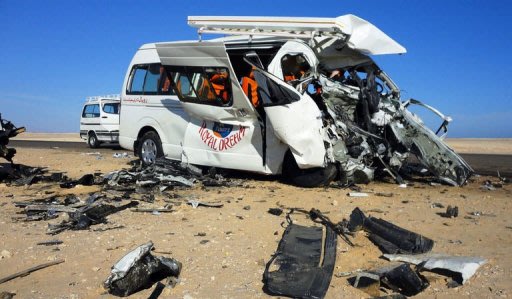
Five Germans killed in Egypt bus crash

Five German tourists and two Egyptians were killed in a bus crash near an Egyptian Red Sea resort on Sunday, police officials said.

Berlin's foreign ministry confirmed that Germans had died in the accident, without specifying the number.

The tourists died when two mini-buses crashed inside a resort near the popular tourist destination Hurghada, officials said.

A number of tourists were also wounded in the crash, they said, without giving further details.

"We unfortunately have to convey that German citizens have been killed and... injured in an accident on the Egyptian coast of the Red Sea," a German foreign ministry spokesman said.

"Foreign Minister (Guido) Westerwelle has activated the foreign ministry's crisis management group. The German ambassador is on the way to the site of the accident," he added.

Road accidents are common in Egypt, largely due to bad road conditions and lax enforcement of traffic laws.

On Friday, two Russian tourists were killed when their bus overturned near the Sinai resort of Nuweiba, police said.

And on November 17, 47 Egyptian school children were killed when a train smashed into their bus in central Egypt.

Sunday 2 December 2012

http://ph.news.yahoo.com/five-german-tourists-killed-egypt-bus-crash-094825467.html
continue reading

Yerevan says Brazzaville crash plane was Armenian

A cargo plan that crashed at Brazzaville airport killing at least 27 people belonged to the Armenian freight specialist airline Rij Airways, the foreign ministry in Yerevan said Saturday.

The plane, carrying seven crew members, crashed as it tried to land in a storm on Friday.

Most of the victims were local people killed when the plane skidded off the runway and ploughed into houses and a bar in the Congolese capital.

"According to initial information, the crew was made up of seven people, of whom five were Armenian," added Armenian civil aviation authority spokeswoman Nelli Tchertchinian.

"They all died," she said.

In Brazzaville, a hospital official told AFP there were 27 bodies. It was not clear if this included the crew.

More than 30 others were injured in the disaster.

The four-engine Ilyushin T76 plane had earlier taken off from the western port city of Pointe Noire.

Sunday 2 December 2012

http://www.google.com/hostednews/afp/article/ALeqM5iRSXFnPLLRa5MoMGQpfBKujkR9og?docId=CNG.1039b89f58178ec8478bc951d0e550c3.6d1

continue reading

13 dead, scores injured in Mbale, Kabale accidents


Cries and screams filled the air on the Mbale-Kampala highway following a grisly accident that claimed the lives of 12 youths participating in the Imbalu circumcision procession on Friday night.

The accident, according to witnesses, occurred at around 9:20pm after a speeding Omni bus tried to dodge an oncoming commuter taxi and instead swerved off the road and rammed into the dancers killing 12 on the spot and injuring several others.

The accident occurred at Kamonkole Trading Centre, five kilometres from Mbale Town.

The deceased

Relatives of the deceased, who rushed to the scene, wailed as they tried to identify the bodies.

The dead were identified as Fatuma Madango, who was pregnant, Michael Oumo, 24, Julius Balamu Wavuna, 21, Richard Podo, 36, Mubage, 25, Ednand Mirifibi, 16 and Caroline Nabwire, 14.

Others are Ismail Kowe,12,Alex Menya,14,Namulumbi,24,Magino,14,Madango,32 and a one Patrick,15. The injured, whose numbers are yet to be known, were rushed to Mbale hospital.

The accident scene later turned chaotic as angry residents set ablaze the two vehicles involved in the accident, forcing their drivers to flee.

The resident blocked the road for close to two hours, forcing the police to fire live bullets in the air to disperse them.

The District Police Commander, Mr Martin Otim, attributed the accident to speeding. The area from Kamonkole to Jami Trading Centre is a black spot that has claimed about 500 lives in the last five years.

Kabale tragedy

Meanwhile, traffic along the Kabale-Mbarara highway came to stand still on Saturday morning when a fuel tanker lost control and overturned before it burst into flames at Kyanamira Trading Centre.

The driver was burnt beyond recognition. The police identified him as Paulo Maina 40, a resident of Nyeru in Kenya.

His tout Patrick Musiri 22, a resident of Embu, Kenya was severely burnt and rushed to Kabale hospital.

“The accident happened at around 10:30am. The tanker was carrying fuel from Nakuru, Kenya to Rwanda. We suspect that the cause of this accident is reckless driving,” Kabale District Police Commander Bosco Arop said.

The district has no fire truck and police commander for Kigezi sub-region Olivia Wawire said they had called the Fire Brigade from Mbarara District to rescue the situation.

Sunday 2 December 2012

http://www.monitor.co.ug/News/National/13-dead--scores-injured-in-Mbale--Kabale-accidents/-/688334/1634518/-/dhq3cd/-/index.html

continue reading

Update: Avalanche death toll reaches 18


Death toll in the deadly landslides at the Sharda Sector in Azad Kashmir climbed to 18 on Saturday as rescuers recovered more dead bodies.

Sixteen bodies, including that of 12 soldiers, have so far been retrieved. A military rescue operation swung into action after heavy snows on Friday triggered two landslides at a remote outpost in the Kel area of Azad Kashmir near the Line of Control (LoC) with India.

The soldiers were on a mission to find three colleagues buried by an earlier avalanche on Friday. The party of rescuers had found two bodies when another avalanche struck in the mountainous Neelum Valley. ISPR has confirmed that bodies of five soldiers including an officer and four civilians buried under the snow were recovered on Saturday. Search was under way for remaining missing persons.

"Three bodies of soldiers were recovered yesterday. The bodies of five soldiers, including a captain, and four civilians have been recovered today (Saturday)," said a statement by the military.

As per police, bodies of the persons retrieved so far were identified as M Anwar, M Khurshid, M Afzal, Gul Hussain Munir Ahmad, Capt Imran, non commissioned officer Dost M, Havaldar Mehmood Alam, Sepoy Matin Ahmad, Sepoy M Khan, Sepoy M Tahir, Sepoy M Sakhawat Hussain, Sepoy M Hussain, Sepoy M Aslam, Sepoy Atta Ullah, Sepoy Farman Hayat and Sepoy Khalid.

Local administration officials said they were searching for more dead bodies as nine people from the rescue party were still missing.

In April, 140 soldiers were buried when a huge wall of snow crashed into the remote Siachen Glacier base high in the mountains in Kashmir. They have all been declared dead, although some of the bodies remain buried.

That tragedy renewed debate about how much sense it made for a country where millions live below the poverty line to maintain outposts in Siachen, dubbed "the world's highest battleground", at immense cost when violence had decreased.

And in February, at least 16 Indian soldiers on duty in the mountains of Held Kashmir were killed when two avalanches swept through army camps.

Sunday 2 December 2012

http://www.nation.com.pk/pakistan-news-newspaper-daily-english-online/national/02-Dec-2012/avalanche-death-toll-reaches-18

continue reading

PIL seeks DNA profile of unidentfied bodies


About 40,000 unidentified bodies are disposed of every year removing every trace of their once earthly existence. During the same period thousands go missing from across the country. Is there a link between the unidentified bodies and the missing persons?

A PIL raised this important question and suggested keeping a DNA profile of the bodies before their disposal could help breaking the news of the death to those families waiting the homecoming of their near and dear ones who have gone missing.

The Supreme Court entertained this PIL by NGO Lokniti Foundation and issued notice to ministry of home affairs, the Central Bureau of Investigation (CBI) and secretary, department of scientific & industrial research seeking their response to the petition.

Petitioner's counsel Ashok Dhamija said the unidentified bodies could be because of a serious crime and "since the bodies cannot be identified using traditional methods, the perpetrators of the possible crime remain untraced and the families, to which the victims belonged, never come to know about the fate of their near and dear ones."

"DNA profiling of unidentified bodies can help match the missing persons. In addition, the DNA profiling of missing persons could help trace them and reunite several who had either been missing or kidnapped as children and forced into prostitution, bonded labour or even those who have turned mentally unstable," Dhamija said.

The petitioner said that though the government had been considering a proposal for DNA profiling of unidentified bodies since 2007, no decision had been taken yet. As per the data compiled by the National Crime Records Bureau, number of unidentified bodies recovered and inquest conducted were 37,282 in 2007, 37,668 (2008), 34,902 (2009), 33,857 (2010) and 37,193 (2011).

In 2011, highest number of unidentified bodies was recovered in Maharashtra (6,313), followed by Tamil Nadu (4,479), Uttar Pradesh (4,084), West Bengal (3,704), Delhi (2,748), Andhra Pradesh (2,639), Karnataka (2,440), Gujarat (2,099), Madhya Pradesh (1,191), Rajasthan (1,170), Haryana (1,159) and Punjab (1,004).

The petitioner said, "One of the main reasons for large number of bodies remaining unidentified is that person freely moves from one part to another in search of work and members of poor families have no means to keep in touch with their near and dear ones. It becomes difficult for the local police to identify persons who have no local connection and who have died without any one complaining of death caused by any mischief."

It said a total of 11,846, 13,586 and 13,268 people went missing in Delhi alone in 2006, 2007 and 2008, respectively. From Andhra Pradesh a total of 47,936 went missing during 2009-12 and in Gujarat another 37,395 were reported missing during 2007-11.

So is there not a link between the missing persons and unidentified bodies which could be unraveled through DNA profiling of the dead yet unidentified? asked the petitioner.

Sunday 2 December 2012

http://timesofindia.indiatimes.com/india/PIL-seeks-DNA-profile-of-unidentfied-bodies/articleshow/17446665.cms

continue reading

Japanese police find charred bodies inside collapsed tunnel; rescue suspended


Japanese rescuers found five charred bodies in a highway tunnel that collapsed on Sunday, crushing cars and triggering a blaze, and sparking fears of another cave-in.

At least seven people were missing inside the nearly five-kilometer (three mile)-long tunnel. Witnesses spoke of terrifying scenes as at least one vehicle burst into flames, sending out clouds of blinding, acrid smoke.

Rescuers were forced to suspend work for several hours in their efforts to reach those believed trapped under thick concrete ceiling panels that crashed from the roof of the tunnel when engineers warned more debris could fall.

Emergency crews who rushed to the Sasago tunnel on the Chuo Expressway, 80 kilometers (50 miles) west of the capital, were hampered by thick smoke billowing from the entrance.

Dozens of people abandoned their vehicles on the Tokyo-bound section of carriageway, and ran for one of the emergency exits or for the mouth, where they huddled in bitter winter weather.

Emergency crews equipped with breathing apparatus battled around a third of the way into the tunnel, where they found up to 70 meters of concrete panels had come crashing down, crushing at least two vehicles.

Hours after the collapse, engineers warned the structure could be unstable, forcing rescuers to halt their work as a team of experts assessed the danger.

It was during this inspection that accompanying police officers confirmed the first deaths.

“What we found resembled bodies inside a vehicle, they were blackened. We have visually confirmed them but have yet to take them out for closer examination,” an official told AFP.

The Fire and Disaster Management Agency later confirmed there were five bodies, adding another vehicle had also been burned.

By late afternoon the operation had resumed. Footage from security cameras showed large concrete panels in a V shape, apparently having collapsed from the middle, with teams of men in protective gear scrambling over them.

One 28-year-old woman who emerged from the smoke-darkened tunnel by herself told rescuers she had been in a rented van with five other people, fire department official Kazuya Tezuka told AFP by telephone.

“I have no idea about what happened to the five others. I don’t know how many vehicles were ahead and behind ours,” she was quoted as saying.

A truck driver who telephoned a colleague from inside the tunnel was also believed to be trapped.

An AFP reporter said two large orange tents had been erected at the tunnel mouth and a helicopter remained nearby, ready to ferry the injured to hospital.

The tunnel, which passes through hills not far from Mount Fuji, is one of the longest in Japan. It sits on a major road connecting Tokyo with the centre and west of the country.

An NHK reporter was passing through the tunnel on his way to Tokyo when it started to disintegrate.

“I managed to drive through the tunnel but vehicles nearby appeared to have been trapped,” he said. “Black smoke was coming and there seemed to be a fire inside the tunnel.”

A man in his 30s, who was just 50 meters ahead of the caved-in spot, recounted details of the terrifying experience

. “A concrete part of the ceiling fell off all of a sudden when I was driving inside. I saw fire coming from a crushed car. I was so frightened I got out of my car right away and walked one hour to get outside,” he told NHK.

Japan has an extensive and well-maintained network of highways with thousands of tunnels, usually several hundred metres long. Millions of cars use the network every day.

Chikaosa Tanimoto, professor emeritus of tunnel engineering at Osaka University told NHK ceilings are made from concrete panels suspended from pillars.

“Speaking only generally, because it is an old tunnel, it is conceivable that the parts connecting the ceiling panels and pillars, or pillars themselves, have deteriorated, affected by vibrations from earthquakes and passing vehicles,” he said.

Sunday 2 December 2012

http://www.thehindu.com/news/international/japanese-police-find-charred-bodies-inside-collapsed-tunnel-rescue-suspended/article4156157.ece

continue reading