Sunday, 2 December 2012

13 dead, scores injured in Mbale, Kabale accidents


Cries and screams filled the air on the Mbale-Kampala highway following a grisly accident that claimed the lives of 12 youths participating in the Imbalu circumcision procession on Friday night.

The accident, according to witnesses, occurred at around 9:20pm after a speeding Omni bus tried to dodge an oncoming commuter taxi and instead swerved off the road and rammed into the dancers killing 12 on the spot and injuring several others.

The accident occurred at Kamonkole Trading Centre, five kilometres from Mbale Town.

The deceased

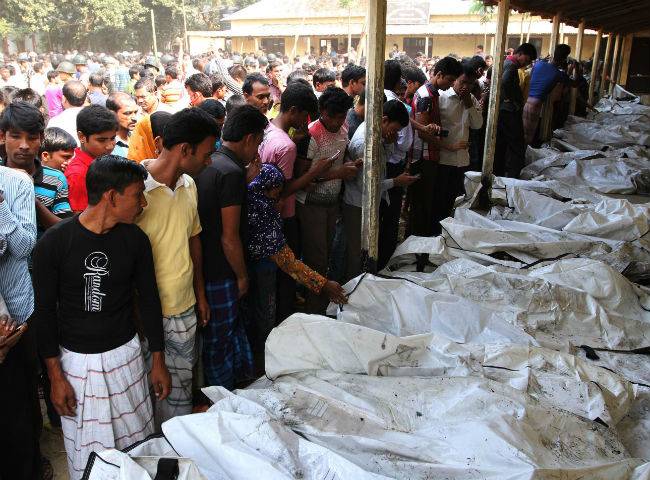
Relatives of the deceased, who rushed to the scene, wailed as they tried to identify the bodies.

The dead were identified as Fatuma Madango, who was pregnant, Michael Oumo, 24, Julius Balamu Wavuna, 21, Richard Podo, 36, Mubage, 25, Ednand Mirifibi, 16 and Caroline Nabwire, 14.

Others are Ismail Kowe,12,Alex Menya,14,Namulumbi,24,Magino,14,Madango,32 and a one Patrick,15. The injured, whose numbers are yet to be known, were rushed to Mbale hospital.

The accident scene later turned chaotic as angry residents set ablaze the two vehicles involved in the accident, forcing their drivers to flee.

The resident blocked the road for close to two hours, forcing the police to fire live bullets in the air to disperse them.

The District Police Commander, Mr Martin Otim, attributed the accident to speeding. The area from Kamonkole to Jami Trading Centre is a black spot that has claimed about 500 lives in the last five years.

Kabale tragedy

Meanwhile, traffic along the Kabale-Mbarara highway came to stand still on Saturday morning when a fuel tanker lost control and overturned before it burst into flames at Kyanamira Trading Centre.

The driver was burnt beyond recognition. The police identified him as Paulo Maina 40, a resident of Nyeru in Kenya.

His tout Patrick Musiri 22, a resident of Embu, Kenya was severely burnt and rushed to Kabale hospital.

“The accident happened at around 10:30am. The tanker was carrying fuel from Nakuru, Kenya to Rwanda. We suspect that the cause of this accident is reckless driving,” Kabale District Police Commander Bosco Arop said.

The district has no fire truck and police commander for Kigezi sub-region Olivia Wawire said they had called the Fire Brigade from Mbarara District to rescue the situation.

Sunday 2 December 2012

http://www.monitor.co.ug/News/National/13-dead--scores-injured-in-Mbale--Kabale-accidents/-/688334/1634518/-/dhq3cd/-/index.html

continue reading

Update: Avalanche death toll reaches 18


Death toll in the deadly landslides at the Sharda Sector in Azad Kashmir climbed to 18 on Saturday as rescuers recovered more dead bodies.

Sixteen bodies, including that of 12 soldiers, have so far been retrieved. A military rescue operation swung into action after heavy snows on Friday triggered two landslides at a remote outpost in the Kel area of Azad Kashmir near the Line of Control (LoC) with India.

The soldiers were on a mission to find three colleagues buried by an earlier avalanche on Friday. The party of rescuers had found two bodies when another avalanche struck in the mountainous Neelum Valley. ISPR has confirmed that bodies of five soldiers including an officer and four civilians buried under the snow were recovered on Saturday. Search was under way for remaining missing persons.

"Three bodies of soldiers were recovered yesterday. The bodies of five soldiers, including a captain, and four civilians have been recovered today (Saturday)," said a statement by the military.

As per police, bodies of the persons retrieved so far were identified as M Anwar, M Khurshid, M Afzal, Gul Hussain Munir Ahmad, Capt Imran, non commissioned officer Dost M, Havaldar Mehmood Alam, Sepoy Matin Ahmad, Sepoy M Khan, Sepoy M Tahir, Sepoy M Sakhawat Hussain, Sepoy M Hussain, Sepoy M Aslam, Sepoy Atta Ullah, Sepoy Farman Hayat and Sepoy Khalid.

Local administration officials said they were searching for more dead bodies as nine people from the rescue party were still missing.

In April, 140 soldiers were buried when a huge wall of snow crashed into the remote Siachen Glacier base high in the mountains in Kashmir. They have all been declared dead, although some of the bodies remain buried.

That tragedy renewed debate about how much sense it made for a country where millions live below the poverty line to maintain outposts in Siachen, dubbed "the world's highest battleground", at immense cost when violence had decreased.

And in February, at least 16 Indian soldiers on duty in the mountains of Held Kashmir were killed when two avalanches swept through army camps.

Sunday 2 December 2012

http://www.nation.com.pk/pakistan-news-newspaper-daily-english-online/national/02-Dec-2012/avalanche-death-toll-reaches-18

continue reading

PIL seeks DNA profile of unidentfied bodies


About 40,000 unidentified bodies are disposed of every year removing every trace of their once earthly existence. During the same period thousands go missing from across the country. Is there a link between the unidentified bodies and the missing persons?

A PIL raised this important question and suggested keeping a DNA profile of the bodies before their disposal could help breaking the news of the death to those families waiting the homecoming of their near and dear ones who have gone missing.

The Supreme Court entertained this PIL by NGO Lokniti Foundation and issued notice to ministry of home affairs, the Central Bureau of Investigation (CBI) and secretary, department of scientific & industrial research seeking their response to the petition.

Petitioner's counsel Ashok Dhamija said the unidentified bodies could be because of a serious crime and "since the bodies cannot be identified using traditional methods, the perpetrators of the possible crime remain untraced and the families, to which the victims belonged, never come to know about the fate of their near and dear ones."

"DNA profiling of unidentified bodies can help match the missing persons. In addition, the DNA profiling of missing persons could help trace them and reunite several who had either been missing or kidnapped as children and forced into prostitution, bonded labour or even those who have turned mentally unstable," Dhamija said.

The petitioner said that though the government had been considering a proposal for DNA profiling of unidentified bodies since 2007, no decision had been taken yet. As per the data compiled by the National Crime Records Bureau, number of unidentified bodies recovered and inquest conducted were 37,282 in 2007, 37,668 (2008), 34,902 (2009), 33,857 (2010) and 37,193 (2011).

In 2011, highest number of unidentified bodies was recovered in Maharashtra (6,313), followed by Tamil Nadu (4,479), Uttar Pradesh (4,084), West Bengal (3,704), Delhi (2,748), Andhra Pradesh (2,639), Karnataka (2,440), Gujarat (2,099), Madhya Pradesh (1,191), Rajasthan (1,170), Haryana (1,159) and Punjab (1,004).

The petitioner said, "One of the main reasons for large number of bodies remaining unidentified is that person freely moves from one part to another in search of work and members of poor families have no means to keep in touch with their near and dear ones. It becomes difficult for the local police to identify persons who have no local connection and who have died without any one complaining of death caused by any mischief."

It said a total of 11,846, 13,586 and 13,268 people went missing in Delhi alone in 2006, 2007 and 2008, respectively. From Andhra Pradesh a total of 47,936 went missing during 2009-12 and in Gujarat another 37,395 were reported missing during 2007-11.

So is there not a link between the missing persons and unidentified bodies which could be unraveled through DNA profiling of the dead yet unidentified? asked the petitioner.

Sunday 2 December 2012

http://timesofindia.indiatimes.com/india/PIL-seeks-DNA-profile-of-unidentfied-bodies/articleshow/17446665.cms

continue reading

Japanese police find charred bodies inside collapsed tunnel; rescue suspended


Japanese rescuers found five charred bodies in a highway tunnel that collapsed on Sunday, crushing cars and triggering a blaze, and sparking fears of another cave-in.

At least seven people were missing inside the nearly five-kilometer (three mile)-long tunnel. Witnesses spoke of terrifying scenes as at least one vehicle burst into flames, sending out clouds of blinding, acrid smoke.

Rescuers were forced to suspend work for several hours in their efforts to reach those believed trapped under thick concrete ceiling panels that crashed from the roof of the tunnel when engineers warned more debris could fall.

Emergency crews who rushed to the Sasago tunnel on the Chuo Expressway, 80 kilometers (50 miles) west of the capital, were hampered by thick smoke billowing from the entrance.

Dozens of people abandoned their vehicles on the Tokyo-bound section of carriageway, and ran for one of the emergency exits or for the mouth, where they huddled in bitter winter weather.

Emergency crews equipped with breathing apparatus battled around a third of the way into the tunnel, where they found up to 70 meters of concrete panels had come crashing down, crushing at least two vehicles.

Hours after the collapse, engineers warned the structure could be unstable, forcing rescuers to halt their work as a team of experts assessed the danger.

It was during this inspection that accompanying police officers confirmed the first deaths.

“What we found resembled bodies inside a vehicle, they were blackened. We have visually confirmed them but have yet to take them out for closer examination,” an official told AFP.

The Fire and Disaster Management Agency later confirmed there were five bodies, adding another vehicle had also been burned.

By late afternoon the operation had resumed. Footage from security cameras showed large concrete panels in a V shape, apparently having collapsed from the middle, with teams of men in protective gear scrambling over them.

One 28-year-old woman who emerged from the smoke-darkened tunnel by herself told rescuers she had been in a rented van with five other people, fire department official Kazuya Tezuka told AFP by telephone.

“I have no idea about what happened to the five others. I don’t know how many vehicles were ahead and behind ours,” she was quoted as saying.

A truck driver who telephoned a colleague from inside the tunnel was also believed to be trapped.

An AFP reporter said two large orange tents had been erected at the tunnel mouth and a helicopter remained nearby, ready to ferry the injured to hospital.

The tunnel, which passes through hills not far from Mount Fuji, is one of the longest in Japan. It sits on a major road connecting Tokyo with the centre and west of the country.

An NHK reporter was passing through the tunnel on his way to Tokyo when it started to disintegrate.

“I managed to drive through the tunnel but vehicles nearby appeared to have been trapped,” he said. “Black smoke was coming and there seemed to be a fire inside the tunnel.”

A man in his 30s, who was just 50 meters ahead of the caved-in spot, recounted details of the terrifying experience

. “A concrete part of the ceiling fell off all of a sudden when I was driving inside. I saw fire coming from a crushed car. I was so frightened I got out of my car right away and walked one hour to get outside,” he told NHK.

Japan has an extensive and well-maintained network of highways with thousands of tunnels, usually several hundred metres long. Millions of cars use the network every day.

Chikaosa Tanimoto, professor emeritus of tunnel engineering at Osaka University told NHK ceilings are made from concrete panels suspended from pillars.

“Speaking only generally, because it is an old tunnel, it is conceivable that the parts connecting the ceiling panels and pillars, or pillars themselves, have deteriorated, affected by vibrations from earthquakes and passing vehicles,” he said.

Sunday 2 December 2012

http://www.thehindu.com/news/international/japanese-police-find-charred-bodies-inside-collapsed-tunnel-rescue-suspended/article4156157.ece

continue reading

Saturday, 1 December 2012

Mexican families carry out their own investigations to find the disappeared

Since her teenage daughter went missing eight years ago, Silvia Ortiz has known that any progress in the case depends on her alone. "I still don't know if Fanny is alive or not. Maybe she is in a mass grave and I will never find her, but I have to keep looking," Ortiz says. "If I don't, who will?"

This was true even in the hours immediately after Fanny's disappearance on her way home from a basketball match in the city of Torreón in northern Mexico. With the police dragging their feet, the family brought in sniffer dogs that followed the 16-year-old's trail until it stopped abruptly at a roadside. Then they found clues linking the abduction to criminals associated with the Zetas drug cartel. When the authorities still did nothing, they discovered that the official heading the investigation was the lover of one of their prime suspects.

In the following years, the pattern was repeated: Ortiz turned up fresh leads, only for the authorities to ignore them. Meanwhile, Mexico's drug war spiralled out of control: tens of thousands were killed – more than 100,000 by some counts – and many others simply vanished. There is no reliable data on the number of people forcibly disappeared during the drug violence, but a document from the Mexican attorney general's office leaked to the Washington Post lists 25,000 adults and children who have gone missing since the start of the Calderón offensive. The documents were reportedly leaked by bureaucrats frustrated with the outgoing government's failure to openly recognise the size of the problem.

For Ortiz, the trauma of her loss was revived in October, when the Zetas' leader, Heriberto Lazcano – known as "El Lazca" – was shot dead by the Mexican navy in an episode shrouded in confusion. Lazcano's body was apparently snatched from a funeral parlour a few hours after his death, but reports soon emerged that a photograph found among his belongings showed the capo sitting beside a young woman who resembled Fanny.

"Of course my heart jumped," Ortiz says. "I would be lying if I said that I didn't believe it was her at first, but my son kept saying: 'No way, forget it, it isn't her, look at the nose.'"

Even in that first flush of false hope there was terror. Whether it was or wasn't Fanny, being so publicly associated with Lazcano was dangerous. If Fanny had ended up in Lazcano's hands, she would now be especially vulnerable to the attentions of rival cartels.

Things only got worse when the Coahuila state attorney general told reporters a recently arrested Zetas commander nicknamed "the Squirrel" had confessed that he abducted Fanny and took her to Lazcano. "It is hard to explain the enormous pain that this generated for us," Ortiz says. "We didn't sleep at all. We jumped up at every tiny noise to see if they were coming for us."

Ortiz soon became convinced that the woman in the photograph was not Fanny. She says she tracked down the real subject of the picture, who told her the man by her side was not even Lazcano. Then she found out from federal officials that neither the story about the photograph being found in his clothes, nor the Squirrel's confession, were true. After a moment in the media spotlight, Ortiz fears Fanny will slip back into anonymity "like all the thousands of other disappeared people".

The attention given to Fanny's case in recent weeks was certainly unusual, but her family's investigative efforts and determination to keep up the pressure in the face of government inaction, incompetence or complicity is not.

Jorge Verástegui found links to local police behind the abduction of his brother and nephew in Coahuila after a religious meeting in 2009. This brought "friendly advice" from officials to tone things down for his own safety, which he ignored: "I don't know at what point I broke the fear barrier but the promise that I have made to myself and my family is much bigger."

Verástegui pins his hopes on collective action. He admits the relatives' group in Coahuila that he helped form, which has registered 258 forced disappearances since 2008, has not won significant improvements in investigations. But, he says, it has provided mutual support and chiselled away at the widely held assumption that those who go missing in drug war hotspots must have some link to organised crime. "We are cleaning the image of the disappeared," he says. "People are beginning to realise that this is something that could happen to anybody."

The dynamics of disappearances vary but Verástegui believes that in Coahuila they are associated with forced recruitment into the cartels, suggesting some of the missing could be packing drugs in safe houses or working as hitmen. "No other explanation fits the fact that ransoms are not demanded in most cases," he says. "It is also a hypothesis that gives us hope of finding them alive."

Fanny's mother will never let go of that hope until she has a fully identified body to bury. "All I want is to see my baby," she says. "All I want is to tell her I love her, and to tell her I want to heal her wounds."

Saturday 1 December 2012

http://www.guardian.co.uk/world/2012/nov/30/mexico-disappeared-drug-war-calderon

continue reading

Missing people, reporting is a duty of all


In Italy, from now on, anyone who becomes aware of the disappearance of someone, can report it to the Police, that will immediately start the research.

A possibility, therefore, which will no longer be due just to the family of the missing person.

This is the main novelty of the law 203/2012, just come into force, which aims to simplify the procedures for the search of those who went away from home for no apparent reason and under circumstances such as to suggest that his/her own life or personal safety is at risk.

The text also provides for the early involvement, by the prefects, of the Special Commissioner for missing persons, so as soon as possible to take all steps within its competence, using the aid of local authorities, the National Body of firefighters and civil protection system, associations of social volunteering all other bodies, public and private, active in the territory.

Finally, the new law establishes the obligation for the person who has denounced the disappearance, to withdraw the report in case there are not anymore the reasons that led him or her to turn to the authorities.

Saturday 1 December 2012

http://www.west-info.eu/missing-people-reporting-is-a-duty-of-all/

continue reading

Mexico: More than 25,000 people disappear in six years


Mexico's Attorney General has compiled a list showing that more than 25,000 adults and children have gone missing in Mexico in the past six years, according to unpublished government documents.

The data sets, submitted by state prosecutors and vetted by the federal government but never released to the public, chronicle the disappearance of tens of thousands of people in the chaos and violence that have enveloped Mexico during its fight against drug mafias and crime gangs.

Families have been left wondering whether their loved ones are alive or among the more than 100,000 victims of homicides recorded during the presidency of Felipe Calderon, who leaves office today. The names on the list – many more than in previous, non-government estimates – are recorded in columns, along with the dates they disappeared, their ages, the clothes they were wearing, their jobs and a few brief, often chilling, details:

"His wife went to buy medicine and disappeared," reads one typical entry. "The son was addicted to drugs." "Her daughter was forced into a car." "The father was arrested by men wearing uniforms and never seen again."

The documents were provided by bureaucrats frustrated by what they describe as a lack of official transparency and the failure of government agencies to investigate the cases.

The leaked list is not complete – or, probably, precise. Some of the missing may have returned to their homes, and some families may never have reported disappearances.

But the list offers a rare glimpse of the running tally the Mexican government has been keeping, and it confirms what human rights activists and families of the missing have been saying: that Mexico has seen an explosion in the number of such cases and that the government appears to be overwhelmed. "What does the government do? Nothing or almost nothing. Why? There is a paralysis," said Juan Lopez Villanueva of the group United Forces for Our Missing in Mexico. "The state has failed us."

According to the National Commission on Human Rights, more than 7,000 people killed in Mexico in the past six years lie unidentified in morgue freezers or common graves. The commission's numbers suggest the government count might be accurate.

From 2006 to mid-2011, the commission notes that more than 18,000 Mexicans were reported missing.

Mr Calderon's spokesman declined to offer a reason why the numbers have not been made public during his tenure, and the Attorney General's office did not respond to questions.

Critics say the outgoing government is burying the numbers because their publication would highlight Mexico's failure to investigate the cases, and undermine efforts by Mr Calderon to show his fight against organised crime is working.

"Releasing the data would add to the already deteriorating forecast about growing insecurity, and publishing such a very large number just reinforces the idea that the country is violent," said Edna Jaime Trevino, director of the think tank Mexico Evalua.

The task of tracking the missing now falls to the incoming President Enrique Pena Nieto's new government. There is no statute of limitations for missing-person cases, and Mexico has heard withering criticism from both the Inter-American Court of Human Rights and the United Nations about its handling of them.

In December 2011, Mr Calderon pledged to create a national database including lists of the people who had disappeared and of unidentified bodies, and he promised it would be ready in early 2012.

Then in March, the Mexican Congress passed a law that required the government to establish Mr Calderon's database, which medical examiners, law enforcement officials and families could use to help track cases. Since then, politicians have failed to publish the regulations that would allow the law to be implemented.

State prosecutors agreed to provide data from their missing-person cases to the Attorney General, but their reports appear uneven. For example, prosecutors in the northern border states of Chihuahua and Coahuila report only a few hundred cases, even as the governors of those states have stated that there were many more.

It remains to be seen if this will change with incoming president Enrique Peña Nieto.

The list of more than 200 pledges from his new administration does not mention the victims of the violence, and he has given little indication of what steps he will take to improve their situation.

The list of necessities is a long one.

The majority of Mexico's states don't have the technology to do DNA testing and crime scenes are regularly tainted by untrained investigators.

Many relatives of those disappeared think twice before going to local police forces, often fearing local officials may be in the pay of those who murdered their loved ones.

Peña Nieto has talked of reforming and retraining police, just as his predecessor did. But rooting out corruption among badly paid and frequently uneducated local police has proved to be easier said than done.

Saturday 1 December 2012

http://www.independent.co.uk/news/world/americas/mexico-more-than-25000-people-disappear-in-six-years-8372482.html http://www.aljazeera.com/indepth/features/2012/11/20121130182316164681.html

continue reading

Tijuana site may contain up to 100 dissolved bodies

Authorities searching a vacant property in eastern Tijuana may have found the remains of dozens of drug-war victims gone missing after they were dissolved in lye by a man known as El Pozolero — the stew maker.

“We believe that there could be more than 100 bodies dissolved there,” said Abel Galván Gallardo, head of Baja California’s organized-crime unit. “There is the total possibility of being able to tell families that their loved one is here.”

The search began Tuesday and is likely to last at least into next week, Galván said Thursday.

By Friday afternoon, federal investigators had discovered 80 human bones and 25 teeth, said Fernando Ocegueda, leader of the group United for the Disappeared of Baja California, which has been collaborating closely with authorities in the excavation effort. The organization represents family members of 280 people, many of whom disappeared at the height of drug violence in Baja California — from 2007 to 2010.

Human-rights activists believe scores of people have disappeared amid fighting among rival drug-trafficking groups and between law enforcement and organized crime. Mexico’s National Commission for Human Rights has said more than 18,000 Mexicans were reported missing between 2006 and mid-2011. The Washington Post, citing unpublished government documents, reported Friday that the number is closer to 25,000.

In eastern Tijuana, investigators are combing through what Galván and Ocegueda described as “organic mass” found in a pit dug four feet underground. Their goal is to unearth as many bones and teeth as possible, then match the DNA from that evidence with DNA samples provided by victims’ family members.

Ocegueda said a second pit was discovered on the property Friday, but that investigators were still combing through the first one. He also said each pit is connected by a duct to a small room “where they would cook the bodies.” A spigot would be opened after the corpses were dissolved, allowing the remains to fall by gravity into the pit.

The bodies were likely dissolved by Santiago Meza López, nicknamed El Pozolero, who confessed to liquefying the corpses of about 300 organized-crime victims by the time Mexican troops captured him outside Ensenada in January 2009. Meza reported to Teodoro García Simental, a member of the Arellano Félix cartel who broke from that organization and formed an alliance with the Sinaloa cartel. Known for his brutality, García was arrested in February 2010.

Ocegueda said his group led investigators to the eastern Tijuana site in the struggling neighborhood of Maclovio Rojas, located off the free road to Tecate. He was able to locate it after being leaked a report of Meza’s confession, which said he had disposed of bodies in a cockfighting ranch.

“There’s something like 80 cockfighting ranches in that area,” Ocegueda said, and it took two years to pinpoint the correct spot.

The site is one of five where Meza said he had disposed the corpses of García’s victims, according to Ocequeda. United for the Disappeared of Baja California said it has looked at nearly three dozen sites in the past two years, including 13 that involved federal investigators.

Two of those sites yielded remains, Ocegueda said, but this week’s excavation seems the most promising to date. Remains at the previous loations were too decomposed to make any positive identifications, Ocegueda said.

“This shows that when you set a goal, you can reach it,” Ocegueda said. “We had to put a lot of pressure on the authorities.”

He plans to continue searching for the two other locations where Meza reportedly dissolved bodies. “For me, it is a great satisfaction having found this — and perhaps bring peace to some families,” said Ocegueda, whose own son has been missing since he was seized from the family’s residence in 2006.

Saturday 1 December 2012

http://www.nctimes.com/tijuana-site-may-contain-up-to-dissolved-bodies/article_ecc61401-ae99-545b-ae6c-d3f16e1c156a.html

continue reading

Update: Pakistan recovers 12 bodies buried under landslides


At least 12 people have been killed, including eight Pakistani soldiers, and nine people are missing after being hit by landslides in the mountainous Kashmir region, officials said on Saturday.

A military rescue operation swung into action after heavy snows on Friday triggered two landslides at a remote outpost in the Kel area of Pakistan-administered Kashmir near the de facto border with India.

"Three bodies of soldiers were recovered yesterday. The dead bodies of five soldiers including a captain and four civilians have been recovered today (Saturday)," said a statement by the military.

Local administration officials said they were searching for more dead bodies as nine people from the rescue party were still missing.

"Eight soldiers and 10 civilians went to rescue the soldiers at the post, all of the rescuers were buried in the second landslide, so we are searching for the rest of the bodies," local administration official Raja Saqib Muneer told AFP.

Disputed Kashmir has caused two of the three wars between India and Pakistan since their independence from Britain in 1947.

But with separatist violence having dropped sharply since a peace process began in 2004, the greatest dangers facing soldiers stationed at remote outposts are often landslides and extreme weather conditions.

In April, 140 Pakistani soldiers were buried when a huge wall of snow crashed into the remote Siachen Glacier base high in the mountains in Kashmir. They have all been declared dead, although some of the bodies remain buried.

That tragedy renewed debate about how much sense it made for a country where millions live below the poverty line to maintain outposts in Siachen, dubbed "the world's highest battleground", at immense cost when violence had decreased.

And in February, at least 16 Indian soldiers on duty in the mountains of Kashmir were killed when two avalanches swept through army camps.

In Friday's accident, a wall of mud and snow hit the outpost in the early hours, said Muneer, deputy commissioner of Neelam district, of which Kel is part.

The 18-strong team was quickly dispatched to search for the soldiers at the outpost, which is 130 kilometres (80 miles) from Pakistan-administered Kashmir's main town of Muzaffarabad, he said.

Separatist violence has fallen in Muslim-majority, heavily militarised Kashmir, but occasional gunfights still erupt between militants and security forces.

Saturday 1 December 2012

http://www.google.com/hostednews/afp/article/ALeqM5i_wcaMiVzSMe2B3Rvc1fStJG-ERw?docId=CNG.0aa0fa5f64f9275cd7425e38b7275970.371

continue reading

Update: At least 32 killed as plane hits houses in Congo

A cargo plane crashed into houses near Brazzaville Maya-Maya airport while attempting to land in a thunderstorm on Friday, killing at least 32 people, a Congolese Red Cross official said on Saturday.

"We have already pulled 32 bodies from the crash site, but there could be more victims," the official said, asking not to be named. The official said the dead included six crew members.

The Soviet-made Ilyushin-76 cargo plane, operated by local carrier Trans Air Congo was travelling from Pointe-Noire, the commercial capital of the Central African state. It crashed into more than a dozen houses near the airport.

Congo Republic, like its neighbour the Democratic Republic of Congo and many countries in the region, has one of the world's poorest aviation safety records due to poor maintenance and the use of old planes banned from other skies.

In March 2011, another Soviet-made Antonov cargo plane, operated by the same company, crashed into houses in Pointe-Noire while attempting to land, killing 23.

Saturday 1 December 2012

http://uk.reuters.com/article/2012/12/01/uk-congo-republic-crash-idUKBRE8B006520121201

continue reading

31 bodies exhumed at Sibenik cemetery

Remains of 31 persons were exhumed at the city cemetery in Sibenik, Croatia, on Friday, and samples were taken for DNA analysis, the Serbian government's Commission on Missing Persons has said.

The exhumation, which was carried out by competent bodies of the Republic of Croatia, lasted for three days.

It was determined that 13 persons, who lost their lives in the same circumstances, were exhumed at the location earlier on individual requests of families.

The exhumation at the Sibenik cemetery is a continuation of the process of investigation of graves in north Dalmatia, where the victims of Croatian Operation Storm were buried.

The process was launched in 2001 at the city cemetery in Knin, where 301 bodies have been exhumed so far, and 250 identified and handed over to the families that have been searching for their beloved ones for years.

The exhumation was attended by President of Commission on Missing Persons Veljko Odalovic and Serbian Ambassador in Zagreb Stanimir Vukcevic.

Saturday 1 December 2012

http://www.tanjug.rs/news/67956/31-bodies-exhumed-at-sibenik-cemetery.htm?utm_source=twitterfeed&utm_medium=twitter

continue reading

Landslide kills three troops; 18 rescuers missing

A landslide killed three Pakistani soldiers in the high mountains of Kashmir on Friday and 18 people sent to rescue them were missing after being hit by a second landslip, officials said.

A military rescue operation swung into action after heavy snows triggered the accident at a remote outpost in the Kel area of Azad Kashmir near the Line of Control.

The bodies of the three soldiers had been recovered but rescuers were still searching for the eight soldiers and 10 civilians from the search party caught in the second landslide, local official Raja Saqib Majeed said.

“We hope that rescue workers will find some of them alive. Let’s hope for the best,” he said, but added that efforts were being hampered by continued bad weather.

In April, about 140 soldiers were buried when a huge wall of snow crashed into the Siachen Glacier base. They have all been declared dead, although some of the bodies remain buried.

In Friday’s accident, the first landslide hit in the early hours, said Mr Majeed, deputy commissioner of Neelam district, of which Kel is part.

The 18-strong team was quickly dispatched to search for them at the site, which is 130km from Muzaffarabad, he said. But he added that “another landslide hit this rescue party and they were buried under it”

Saturday 1 December 2012

http://dawn.com/2012/12/01/landslide-kills-three-troops-18-rescuers-missing/

continue reading

Friday, 30 November 2012

Cargo plane crashes in the Republic of Congo; number of people killed still unclear

A cargo plane owned by a private company crashed Friday near the airport in Brazzaville, the capital of the Republic of Congo, killing at least three people, officials said.

There are conflicting reports as to the number of people killed ranging from at least 3 up to 30.

The Soviet-made Ilyushin-76 belonged to Trans Air Congo and appeared to be transporting merchandise, not people, said an aviation official who requested anonymity because he was not authorized to speak to the media.

The plane was coming from Congo's second-largest city, Pointe Noire, and tried to land during heavy rain, he said.

Ambulances rushed to the scene in the Makazou neighbourhood, located near the airport, but emergency workers were hampered by the lack of light in this capital, which like so many in Africa has a chronic shortage of electricity.

"At the moment, my team is having a hard time searching for survivors in order to find the victims of the crash because there is no light and also because of the rain," Congolese Red Cross head Albert Mberi said.

He said that realistically, they will only be able to launch a proper search Saturday, when the sun comes up.

Reporters at the scene fought through a wall of smoke. Despite the darkness, they could make out the smouldering remains of the plane, including what looked like the left wing of the aircraft. A little bit further on, emergency workers identified the body of the plane's Ukrainian pilot, and covered the corpse in a blanket.

Firefighters were trying to extinguish the blaze of a part of the plane that had fallen into a ravine. They were using their truck lights to try to illuminate the scene of the crash. Although the plane was carrying merchandise, emergency workers fear that there could be more people on board.

Because of the state of the road connecting Pointe Noire to Brazzaville, many traders prefer to fly the roughly 400 kilometres (250 miles).

Witnesses said rain was coming down hard at the time of the accident, according to news site G1. The plane appeared to be unable to brake and ran off the runway, destroying around 15 houses and a bar before hitting a ravine and catching on fire. Firefighters continued to search for victims two hours after the crash.

Africa has one of the worst air safety records in the world, note the AP. In June, a Boeing 727 cargo plane in Ghana slammed into a bus while attempting to land, killing all 10 people inside. A commercial jetliner crashed in Lagos, Nigeria, only days later, killing 153 people.

Friday 30 November 2012

http://www.edmontonjournal.com/news/Official+Sovietmade+cargo+plane+crashes+Republic+Congo/7634350/story.html

continue reading

The whole valley smells of death

For the inhabitants of the Ejido Jesus Carranza, the discovery of 20 skeletal remains buried in clandestine graves on private property came as no surprise. Years back, they witnessed suspicious activities, but for them denunciation (reporting to authorities) was never an option because they feared retaliation.

"Here, we would see new cars...we also saw a lot of military and police in that place," said several neighbors when they were interviewed, asking for their identities not to be revealed and for them not to be photographed.

From the start, the ejidatarios (local communal landowners) dismiss the idea that there are any townspeople among the victims; they affirm that there are no disappeared persons. At least, not there.

"We don't have anybody missing here. We were born here and we've known each other all our lives. Up there (he points towards the ranch) is where people from the outside bought (properties)," said one of the ejidatarios.

All the structures adjacent to the clandestine cemetery are abandoned. It was quiet last week for the residents of the Ejido Jesus Carranza.

"Everything was very peaceful, nothing ever happens here, the truth is that the the village had been peaceful for several months," they assured us, although they did not dismiss the idea that the relative tranquility was due to the fact that the people who were using at least two properties for safe houses and illegal graveyards had left the town.

"The military also left. We only see them on the highway," they said.

It was only last weekend that a helicopter flying over and dozens of municipal prosecutor's vehicles arriving broke the peace and told them something bad was happening.

"Then (the investigators) told us that they were looking for bodies," they stated.

The official report from state authorities states that "investigation and intelligence (work) developed during the past year" led to the discovery of the skeletal remains, all belonging to males.

Prosecutor Jorge Gonzalez Nicolas specified in a press conference that it was thanks to support of U.S. authorities that the exact location where the cadavers were buried.

Unofficial sources say that the support came from the anti-narcotics section of the U.S. Consulate General in Mexico, the same (unit) that provided information on the exact location of Jose Antonio Acosta Hernandez, "El Diego", which allowed them to make a "clean" arrest.

The information from U.S. authorities led the investigators to Ejido Jesus Carranza. On the Juarez-Porvenir highway, at kilometer marker 35, you take a right turn on an unpaved street that goes to the ranch.

Two kilometers (1.2 miles) ahead, one can see several uninhabited structures on the desert terrain. And there, among the sand dunes and the brush, can be seen the open pits dug by personnel from the office of the medical examiner (SEMEFO; Servicio Medico Forense).

A foul odor is everywhere, and also enormous piles of trash left behind by employees from the State Attorney General's Office during their three-day stay, which is how long the search and the excavations took.

This ranch, located east of Ciudad Juarez and adjacent to the San Agustin Ejido, also part of the municipality, is less than three miles from the metal fence that divides Mexico and the United States.

The excavations were conducted in a 100 yard radius, and there were graves side by side. The closest one was less than 30 yards from the swimming pool built in front of the main house.

As of yesterday, the investigating authorities had not yet fully identified the owner of the ranch.

Arturo Sandoval, spokesman for State Prosecutor's Office (FGE; Fiscalia General del Estado) , explains that they were working on identifying the owner through the Public Property Register.

The house was still under construction. There's broken ceiling material and insulation on the floor, and also a bar that takes up a large part of the room.

Notably, the property is situated less than nine miles from the military checkpoint that the Mexican Army operated in San Agustin for several years, and it is also near the surveillance cameras installed by the Federal Police on the Juarez-Porvenir highway.

"Here, the ones who have circulated freely are the criminals, the police, the military; for us, who live here, they would ask us for identification just to go in and out of the town," say the ejidatarios.

The FGE states that are no identified bodies at this time. There is a very extensive data bank developed by the office of medical examiner. The last time a similar project was undertaken was in 2010, when 20 skeletal remains were locates in the town of Palomas de Villa, also very close to a military base.

Friday 30 november 2012

http://www.borderlandbeat.com/2012/11/the-whole-valley-smells-of-death.html?showComment=1354228182675

continue reading

Identifying bodies only consolation now

Mohammad Raju has been racked with guilt at losing the grip on her mother's hand while trying to escape Saturday night's blaze at Tazreen Fashions in Ashulia.

They were walking downstairs from the fifth floor of the eight-storey building. At one stage the two got separated.

A sewing operator, Raju managed to escape the inferno, but his mother Rehana Begum could not.

He had thought his mother would be able to escape. "But that was my biggest mistake,” he told The Daily Star. “I at least want to see my mother's grave. If it is identified, I will go there occasionally to offer prayers and do penance."

From the burnt factory to hospitals in Ashulia, Savar and Dhaka, Raju made a long search for his mother.

He finally went to National Forensic DNA Profiling Laboratory at Dhaka Medical College yesterday to give his blood sample in the hope that his mother's grave will be found at Jurain where 53 unidentified victims of the fire were buried.

Also, a class-II schoolgirl Rumi gave her blood at the lab to check if her DNA profiles matched that of any unidentified victims. Her mother Nazma Begum has been missing since Saturday.

"She is the only child of Nazma," said Rumi's aunt Beauty Begum. "If her mother's grave can be identified, she can get compensation from the authorities."

The number of people who gave blood at the laboratory stands at three. Bakul Miah, a Kishoreganj farmer whose daughter worked at the factory, went to the lab on Wednesday.

An officer at the laboratory said it would take at least two to three months to get results of DNA tests on samples collected from the 53 bodies.

The Tazreen incident left at least 111 workers dead and more than hundred injured.

Friday 30 november 2012

http://www.thedailystar.net/newDesign/news-details.php?nid=259407

continue reading

Death Toll in China Fishing Boat Accident Climbs to 11

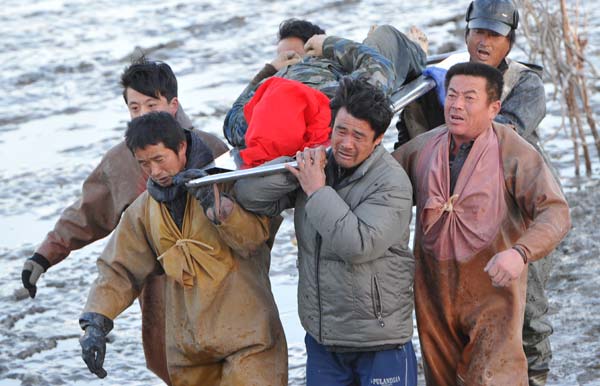
Eleven people have died and five remain missing after a fishing boat sank off the coast of the northeastern Chinese seaport of Dalian, maritime authorities said Thursday.

Following the latest rescue efforts, the number of people reported dead in the accident rose from nine to 11. Their identities have already been confirmed but have not been released by the authorities.

The boat with 17 people on board sank in the wee hours of Wednesday amid strong waves during an attempt to hook the boat to a larger vessel.

The bodies of nine of the fishermen were recovered Wednesday afternoon, while the other two were found Thursday.

The only survivor rescued from the boat is listed is good condition at a hospital in Liaoning province, where Dalian is located.

Authorities said the rescue operation involving a helicopter, seven maritime patrol vessels and 120 other boats was still ongoing.

Friday 30 november 2012

http://www.laht.com/article.asp?ArticleId=652268&CategoryId=12395

continue reading

'Voodoo link' as graves desecrated in Porto-Novo

More than 100 graves have been desecrated in a cemetery near Benin's capital, Porto-Novo, police say.

The grave robbers cut the heads off the bodies and also stole some internal organs.

The BBC's Vincent Nnanna in Benin says there is a suspicion the crime is linked to extreme Voodoo practices of using body parts in charms.

It is the first such incident in the West African nation, where Voodoo is an official religion, he says.

Our reporter says the desecrated graves were discovered by a mason who had forgotten his tools at the 20-acre (eight-hectare) cemetery in Dangbo near Porto-Novo.

The mason alerted the police who found that up to 100 graves had been tampered with overnight.

Relatives have been traumatised by the mutilations as most people believe in reincarnation, our reporter says. They fear their loved ones will be reincarnated with body parts missing.

Crowds who gathered outside the cemetery believe the body parts were taken by people planning to sell them for use as lucky charms, our correspondent says.

A high priest told the BBC such practices were not recognised by the mainstream Voodoo religion - and condemned the grave desecrations.

Voodoo followers - who make up some 40% of Benin's population - believe that all life is driven by spiritual forces of natural phenomena such as water, fire, earth and air, and that these should be honoured through rituals like animal sacrifices.

Friday 30 November 2012

http://www.bbc.co.uk/news/world-africa-20550303

continue reading

Giving new life to vultures to restore a human ritual of death

Fifteen years after vultures disappeared from Mumbai's skies, the Parsi community here intends to build two aviaries at one of its most sacred sites so that the giant scavengers can once again devour human corpses.

Construction is scheduled to begin as soon as April, said Dinshaw Rus Mehta, chairman of the Bombay Parsi Punchayet. If all goes as planned, he said, vultures may again consume the Parsi dead by January 2014.

"Without the vultures, more and more Parsis are choosing to be cremated," Mr. Mehta said. "I have to bring back the vultures so the system is working again, especially during the monsoon."

The plan is the result of six years of negotiations between Parsi leaders and the Indian government to revive a centuries-old practice that seeks to protect the ancient elements — air, earth, fire and water — from being polluted by either burial or cremation. And along the way, both sides hope the effort will contribute to the revival of two species of vulture that are nearing extinction. The government would provide the initial population of birds.

The cost of building the aviaries and maintaining the vultures is estimated at $5 million spread over 15 years, much less expensive than it would have been without the ready supply of food.

"Most vulture aviaries have to spend huge sums to buy meat, but for us that's free because the vultures will be feeding on human bodies — on us," Mr. Mehta said.

Like the vultures on which they once relied, Parsis are disappearing. Their religion, Zoroastrianism, once dominated Iran but was largely displaced by Islam. In the 10th century, a large group of Zoroastrians fled persecution in Iran and settled in India. Fewer than 70,000 remain, most of them concentrated in Mumbai, formerly known as Bombay, where they collectively own prime real estate that was purchased centuries ago.

Among the most valuable of these holdings are 54 acres of trees and winding pathways on Malabar Hill, one of Mumbai's most exclusive neighborhoods. Tucked into these acres are three Towers of Silence where Parsis have for centuries disposed of their dead.

The stone towers are open-air auditoriums containing three concentric rings of marble slabs — an outer ring for dead men, middle ring for deceased women and inner ring for dead children. For centuries, bodies left on the slabs were consumed within hours by neighborhood vultures, with the bones left in a central catchment to leach into the soil.

Modernity has impinged on this ancient practice in many ways. That includes the construction of nearby skyscrapers where non-Parsis could watch the grisly scenes unfold. But by far the greatest threat has been the ecological disaster visited in recent years on vultures.

India once had as many as 400 million vultures, a vast population that thrived because the nation has one of the largest livestock populations in the world but forbids cattle slaughter. When cows died, they were immediately set upon by flocks of vultures that left behind skin for leather merchants and bones for bone collectors. As recently as the 1980s, even the smallest villages often had thousands of vulture residents.

But then came diclofenac, a common painkiller widely used in hospitals to lessen the pain of the dying. Marketed under names like Voltaren, it is similar to the medicines found in Advil and Aleve; in 1993 its use in India was approved in cattle. Soon after, vultures began dying in huge numbers because the drug causes them to suffer irreversible kidney failure.

Diclofenac's veterinarian use has since been banned, which may finally be having an effect. A recent study found that for the first time since the drug's introduction, India's vulture population did not decline over the past year.

Still, the numbers for three species have shrunk to only a few thousand, a tiny fraction of their former levels. With so few vultures left, the Parsi community set up mirrors around the Towers of Silence to create something akin to solar ovens to accelerate decomposition. But the mirrors are ineffective during monsoon months. So an increasing number of Parsis are opting for cremation, a practice many Parsi priests believe is an abomination since fire is sacred and corpses unclean.

Desperate to maintain one of their most important rituals, Parsi leaders have created detailed plans to build the aviaries near the Towers of Silence, each housing 76 vultures. Parsi leaders say they are waiting for formal approval from community members, doctors and priests before beginning construction, approvals they expect to receive over the next several weeks.

But Homi B. Dhalla, president of the World Zarathushti Cultural Foundation, has promised to fight the plans. He helped to develop the tower solar collectors and said they were working well. And he is worried that once the government provides vultures for Parsi aviaries, bureaucrats will try to seize the land.

"Why endanger our property?" Dr. Dhalla asked. "Who is going to fight the government?"

Another concern is whether Parsis can be persuaded to stop using diclofenac. Nearly all of the roughly 800 bodies brought annually to the towers come from two Parsi hospitals, and doctors and family would have to certify that the deceased had not been given diclofenac in the three days before death. There is no simple test to detect the drug, and if vultures in the aviaries die from diclofenac poisoning after eating Parsi corpses the government has promised to end the effort.

Parsi medical leaders were cautious in their comments about the vulture program. "As a hospital," said Dr. SK Dhingra, superintendent of BD Petit Parsee General Hospital, "we cannot tell our patients, 'You can do this, or you can do that.'"

Khurshed Dastoor, one of five Parsi high priests, said that he was not sure members would adhere to a diclofenac ban.

"For 10 years, I have been trying to educate the community to turn off their cellphones before they go inside our most sacred fire temples, and I have failed," he said. "And now we think the community will give up diclofenac in a couple of months?"

Other Parsi leaders, however, said they were pushing ahead because of the importance of restoring the tradition.

"We must hope for the best," Mr. Mehta said.

Friday 30 November 2012

http://timesofindia.indiatimes.com/home/environment/flora-fauna/Giving-new-life-to-vultures-to-restore-a-human-ritual-of-death/articleshow/17430441.cms

continue reading

Thursday, 29 November 2012

11 dead, 5 missing in boat tragedy

At least 11 people are dead and five remain missing after a fishing boat sank in coastal waters early on Wednesday near Dalian, Liaoning province, Xinhua News Agency reported.

The boat with 17 fishermen and women on board, was overturned by huge waves at about 2 am and sank 2 nautical miles from the Houershi village port at the Jinzhou New Area in Dalian.

One person was rescued and the bodies of 11 people were recovered on Wednesday afternoon, Xinhua reported.

Rescuers were still searching for the five missing people on Wednesday afternoon.

The only person rescued was in stable condition and being held for observation at a local hospital.

The boat set out from Houershi Port at around 1 am and those aboard were about to transfer to a bigger fishing vessel before huge waves overturned it.

One fisherman used his satellite mobile phone to call for help.

Ten of the fishermen and women were migrant workers, and seven people, including the owner of the boat, were from the local fishing village.

The wooden boat was 10 meters long and powered by a 10 horsepower engine.

Sun Caihui, a local fishing boat owner who took part in the rescue, said that strong winds and rough seas made the rescue effort very difficult.

"We received a call from the village head at around 5 am and started our boat immediately.

But their boat had sunk beneath the water and the fishermen cannot be found in muddy seawater," he said.

The rescue was made easier in the afternoon when the tide was low.

"Nothing like this has ever happened in our village," said Sun, who knew some of the people aboard the boat personally.

Sun said that hiring non-local fishing workers is common practice in the village because of a labor shortage.

Gale winds as strong as force 8 on the Beaufort scale swept the coastal waters near Dalian city early on Wednesday, China News Service reported.

The search and rescue operation involved a helicopter, seven maritime patrol ships and 120 other boats.

An investigation into the cause of the accident is under way.

Thursday 29 november 2012

http://www.chinadaily.com.cn/china/2012-11/29/content_15969372.htm

continue reading

Wreckage of missing MI-8 discovered; 8 crew members found dead

All 8 members of MI-8 crew that has been discovered several hours ago today, November 29, in Almaty oblast were found dead near the wreckage of the missing helicopter, Tengrinews.kz reports citing the press-service of Almaty oblast administration Ilyas Biyakhmetov.

“Head of Almaty oblast Emergency Situations Department Sabit Bitayev has confirmed that all 8 people who were onboard of the helicopter have been found dead. The helicopter had significant damages with only the aft remaining intact. All bodies were outside of the helicopter,” he said.

The helicopter that went missing in Kazakhstan on November 24 in the area of Koktuma-Dostyk next to Kazakhstan-Chinese border has been discovered only today, November 29. According to Kazakhstan Emergency Situations Ministry, the wreckage of the helicopter was found in the area of the 16th railroad junction.

“The wreckage of the missing helicopter was found 90-95 km from Usharal in Almaty oblast towards Dostyk station, 5-7km east of Dostyk-Usharal road, 15-20 km from Alakol lake. During the fall the helicopter was significantly damaged and only its aft was intact. According to the preliminary information, all the crew members have died as a result of the accident. Two bodies were lifted from under the wreckage. Investigators are working on site. The situation is under control. An investigation has been initiated,” the Ministry said. Law-enforcement authorities and personnel of Druzhbinskaya transport prosecutor’s office has left for the accident site.

"At 6:30 p.m. 6 dead bodies were found at the accident site. The search is being continued," the Department said.

According to the Transport Prosecutors of Kazakhstan, the chronology is as follows:

- The wreckage of the helicopter were discovered at 4.03 p.m.
- A response force of Almaty oblast Emergency Situations Department arrived to the site at 5:15 p.m.
- Six bodies were discovered at 6:30 p.m.
- Two more bodies were discovered a little later.
The MI-8 helicopter with board number 823 owned by Kazakhstan's Euro-Asia Air went missing on November 24 while making a routine flyover of Atassu-Alashankow oil pipeline. The following crew members were onboard:

Captain – Raul Khabibullin;
Pilot – Nurlan Yessenaliyev
Flight mechanic – Vladimir Kim
Engineers – Konstantin Maksayev and Viktor Radomskiy
Accompanying persons - T. Shokparov, A. Sarsembayev, K. Sabirov.

Thursday 29 November 2012

For more information see: http://en.tengrinews.kz/emergencies/Wreckage-of-missing-MI-8-discovered-8-crew-members-found-dead-14914/

continue reading

There Are Over 200 Bodies on Mount Everest, And They’re Used as Landmarks

More than 200 people have died in their attempt to scale Mount Everest. The mountain offers seemingly endless options for kicking the bucket, from falling into the abyss to suffocating from lack of oxygen to being smashed by raining boulders. Yet climbers continue to try their skills – and luck – in tackling Everest, despite the obvious dangers. Indeed, the living pass the frozen, preserved dead along Everest’s routes so often that many bodies have earned nicknames and serve as trail markers. Here are a few of the more colofrul tales, adapted from Altered Dimensions:

The body of “Green Boots,” an Indian climber who died in 1996 and is believed to be Tsewang Paljor, lies near a cave that all climbers must pass on their way to the peak. Green Boots now serves as a waypoint marker that climbers use to gauge how near they are to the summit. Green Boots met his end after becoming separated from his party. He sought refuge in a mountain overhang, but to no avail. He sat there shivering in the cold until he died.

In 2006, English climber David Sharp joined Green Boots. He stopped in the now-infamous cave to rest. His body eventually froze in place, rendering him unable to move but still alive. Over 40 climbers passed by him as he sat freezing to death. His plight might have been overlooked as passers-by assumed Sharp was the already-dead Green Boots. Eventually, some heard faint moans, realized he was still alive, and, too late, attempted to give him oxygen or help him stand.

Francys Arsentiev was the first American woman to reach Everest’s summit without the aid of bottled oxygen, in 1998. But climbers do not recognize this as a successful ascent since she never made it down the mountain. Following a rough night time trek to camp, her husband, a fellow climber, noticed she was missing. Despite the dangers, he chose to turn back to find his wife anyway. On his way back, he encountered a team of Uzbek climbers, who said they had tried to help Francys but had to abandon her when their own oxygen became depleted. The next day, two other climbers found Francys, who was still alive but in too poor of a condition to be moved. Her husband’s ice axe and rope were nearby, but he was nowhere to be found. Francys died where the two climbers left her, and climbers solved her husband’s disappearance the following year when they found his body lower down on the mountain face where he fell to his death.

Thursday 29 November 2012

http://blogs.smithsonianmag.com/smartnews/2012/11/there-are-over-200-bodies-on-mount-everest-and-theyre-used-as-landmarks/

continue reading

Six killed as three wheeler crashes into Yal Devi train

Six persons including two children were killed when an overloaded three wheeler they were travelling in collided with the Yal Devi Express train bound for Vavuniya from Colombo, at an unprotected railway crossing in Ambanpola, Kirimetiyawa yesterday morning.

There were seven persons in the vehicle, three males and four females.

A woman who was in a serious condition was admitted to the Kurunegala hospital. She succumbed to her injuries.

Eye witnesses said that the bodies of the victims were beyond recognition. The driver’s identity was established after tracing his identity card. He was identified as Udaya Asiri Wijeratne.

The victims were returning after visiting a relative and were on their way to a ‘Devalaya’

Thursday 29 november 2012

http://www.island.lk/index.php?page_cat=article-details&page=article-details&code_title=67108

continue reading

Trial over junta's `death flights' starts in Argentina

A major trial for crimes, including the so-called "death flights," during Argentina's 1976-83 dictatorship started Wednesday in Buenos Aires.

Several pilots involved in the death flights - in which illegal detainees were thrown alive from planes to their death in the sea - are among the 68 people standing trial for crimes committed in the Navy Officers School of Mechanics, or ESMA, which is believed to have held about 5,000 illegal detainees during the junta.

The regime is believed to have killed about 30,000 people, although they technically are still regarded as "desaparecidos" (missing), because most of the bodies have never been found.

In this case, the courts are dealing with 789 crimes against humanity and are set to hear 900 witnesses. Most of the defendants were Navy officers and petty officers during the dictatorship, although there are also civilians, including former finance secretary Juan Alemann. Some of these people are already serving sentences for other crimes committed in the ESMA.

The opening of the trial was broadcast live at an auditorium in the Room for Memory Institute, which has been created at the facilities of the former ESMA in the Buenos Aires neighborhood of Nunez.

The existence of the death flights has been reported by survivors of the ESMA illegal detention camp and also by former Capt. Adolfo Scilingo, who is serving a jail sentence in Spain after confessing to courts there that he had thrown into the sea 30 detainees who were anesthetized at the time.

The Argentine Forensic Anthropology Team identified in 2005 several bodies found in the country's Atlantic coast in 1977. It also certified that they showed fractures that probably were caused by a fall from great altitude and the subsequent impact on the water.

Thursday 29 November 2012

Read more here: http://www.bellinghamherald.com/2012/11/28/2783134/trial-over-juntas-death-flights.html#storylink=cpy

continue reading

Kishoreganj farmer first to try DNA test

A farmer from Kishoreganj, who lost his daughter in the Tazreen Fashions disaster, went to the National DNA Profiling Laboratory at Dhaka Medical College yesterday to give his blood sample in the hope of locating her grave.

Suma Akhter, 16, daughter of Bakul Miah, 38, was on duty at Tazreen Fashions in Nischintapur of Ashulia on the outskirts of the capital when the fire broke out on Saturday night.

She is missing and presumed dead.

Bakul Miah, the father, yesterday filled up a form with his contact information at the lab.

Bakul told The Daily Star his only wish was to find the grave of his daughter so that he could visit it occasionally and pray for the eternal peace of her soul.

Work on DNA profiling from samples collected from the bodies of 59 unidentified victims started yesterday.

Fifty-three of the unidentified victims were buried at Jurain Graveyard on Tuesday. The bodies of six victims were handed over to their relatives after they identified their dear ones at the DMC morgue.

The DNA samples from all 59 bodies were collected on Monday and kept at the National Forensic DNA Profiling Laboratory.

Ahmad Ferdous, scientific officer at the laboratory, told The Daily Star that the lab had collected samples and had tagged the bodies with numbers before they were buried in tagged graves.

He said the laboratory would make a database of DNA samples collected and match those with the parents or children of the victims.

He said teeth, tissues and bones of the victims had been collected as samples for DNA profiling.

However, one to three months could be required to make DNA profiling of the samples collected. DNA profiling of relatives of the victims would take less time, he said.

Ferdous added that the lab authorities were keeping contact information of the victims' relatives. If their DNA profiles matched with that of a body, they would inform the authorities concerned and the relatives of the matter.

Relatives of many Tazreen employees, who are missing and are believed to be dead, are at a loss as to how and where to go for DNA sampling.

Nilufar Begum, who lost her parents, brother and brother's wife in the blaze, was trying to get to the laboratory yesterday but could not as she did not have proper information.

Thursday 29 November 2012

http://www.thedailystar.net/newDesign/news-details.php?nid=259217

continue reading

Update: Five women, four children among 15 drown in Kirthar Canal

As many as 15 people, including five women and four children, were drowned in Kirthar Canal near Amrote Shareef after a passenger van fell into canal on Wednesday.

According to detail, the passenger van was on its way to Golo Daro from Gharhi Yasin in District Khairpur, when reached at Kirthar Canal its fell into it, subsequently at least 16 people were drowned.

According to witnesses, around 30 passengers were in the van.

On receiving information, the administration reached on the spot and started rescue and recovered 15 bodies including of six women and four children while nine people were fished out alive and shifted them to Gharihi Yasin and Shikarpur hospitals.

Some among the dead identified as Bachul Manganhar, Sangaar Jaffery, Umedan Jaffery, child Arshad Jafery (6), Wahid Ali, Jafery (5) and Rashid Ali (9). The Shikarpur deputy commissioner confirmed death of 15 people.

Sindh Minister for Local Government Agha Siraj Durrani confirmed the death of 14 people and told that as many as seven other people are still missing and district administration is searching their bodies and he was directed the administration for help and EDO health, DC, and other officials are present on the spot.

Thursday 29 November 2012 http://www.dailytimes.com.pk/default.asp?page=2012%5C11%5C29%5Cstory_29-11-2012_pg7_12

continue reading

Workplaces that are death traps

One of the most disposable items in our country is human life. Abroad we read about loss of hundreds of lives from sinking of overloaded motor launches in rivers, from runaway buses driven by half-trained operators that fall into ditches and, as added measures, deaths from fires in factories in premises that never have been inspected for safety. We are used to watching on TV horrific and heart-rending video images of bodies being recovered from sunken vehicles, scorched buildings, and road side ditches.

We have seen and read about righteous indignation of our public officials at these incidents, dire threats of punishment to those responsible for such disasters that are never carried out, and empty promises that the nation will never face such disasters again.

But while the families of the countless victims wail and lament their losses, the people who are primarily responsible for these deaths and disasters, and their facilitators such as our public officials, are quick to point fingers elsewhere and try to absolve themselves of any wrongdoing. It is as though the people who perished in these disasters ended their lives voluntarily.

When will we learn to take ownership for these completely avoidable disasters? When will we learn to treat each human life as an asset that is more valuable than the product it makes? The recent Ashulia disaster is just another addition to the countless incidents of total callousness that prevails in the country over safety and protection of workers from workplace hazards.

We have had fires in garment factories several times before where workers lost their lives. Only a few days ago we had fires in a low income housing area surrounded by unsafe factories where lives were lost.

Close on the heels of the recent Ashulia fire we also had this lightning-like accident where girders fell off a fly over construction project that killed eleven people in Chittagong.

After none of these accidents or disasters in the past did we hear the people who owned the factories or the buildings come out and take ownership for the tragedies or take measures that would prevent repetition of such incidents. We also did not hear of any punitive action against the defaulting owners by the government. Instead, if I recall correctly, there was plenty of talk of deep conspiracies against the garment industry by persons unknown that were labelled as the causes of frequent fires. No one talked about setting up standards of safety for the factories and workers, or their rigid implementation and monitoring by government. Each incident was allowed to pass into oblivion until another happened.

As in all disasters or accidents in the past a host of reasons has been cited in the press for the Ashulia and Bahaddar Hat misfortunes.

These include failure to operate fire extinguishers in the building, blocking of exit routes of workers and, in the case of the Chittagong incident, a faulty crane that lifted the girders.

Absent from these reports is any indication or statement whether the factory owner or the flyover construction company had any mechanism in place that would ensure safety of workers or equipment.

It is also not clear what role the owners played during and after the incident besides announcing some gratuities to the victims after the fact.

The Ashulia incident and the incident in Bahaddar Hat in Chittagong would not have happened if we had taken lessons from the past. These would not have not happened had we employed a minimum standard of workplace safety, and held the people who engage workers in factories and construction projects, responsible for providing safe workplace.

The garment factories in Bangladesh today are situated on opposite ends of the safety spectrum.

On one end are those modern facilities that are located in different export processing zones and have rather rigid safety standards.

On the other end we have a series of garment factories that line up the Airport Road, Uttara, and other roads, all with cage-like appearances where it seems accidents are waiting to happen.

Workplace safety is a prime consideration for a government before a business is allowed to operate. In western countries a small departure from the safety codes and standards is cause for suspension of the business. Along with strict building codes and safety standards a practice that is regularly in vogue in most industrial countries is training workers in handling emergencies such as fire through drills.

No amount of fire extinguishers will be of use if the people who work in these buildings do not know how to operate them. Along with that also essential is training in emergency response through mock drills. Many of the buildings that I have seen on the Airport Road and Uttara were perhaps not originally intended to be factories, yet we have hundreds of people sweating their way in these accident prone buildings day after day, without a care either from the owners or from the government.

The accidents of this week would not have happened if the employers and our public officials had learnt to take preventive measures from the beginning. The accidents would not have happened if our public officials had strictly enforced the safety rules and taken punitive action against the offenders instead of smelling conspiracies in disasters.

The lives that have been lost at Ashulia or in Chittagong cannot be brought back; nor can the livelihood the victims provided to their families be restored. What can be done is to ensure that such incidents are not repeated.

This can be done by regular inspection of the buildings and the equipment that are used, ensuring that they all meet the minimum standards for safety and operation.

Finding scapegoats for these accidents and finger-pointing will do us no good. I hope and pray that we will not watch and read about such avoidable disasters in the future. I hope and pray that we all learn that human lives are not disposable items.

Wednesday 29 November 2012

http://www.thedailystar.net/newDesign/news-details.php?nid=259150

continue reading

Wednesday, 28 November 2012

Migrant deaths highlight rural tension in Italy

Even dead migrant workers are exploitable. Or so it would seem from the hardly edifying scenes that followed the deaths last Saturday of six Romanian farm workers killed in a horrific train accident near Rossano in Calabria, southern Italy.

The workers were killed when the Fiat Multipla car in which they were travelling home was struck by a train at a countryside level crossing, late in the afternoon.

The impact of the crash reduced the car to mangled steel, instantly killing the six passengers, three men and three women. It took rescue workers and firemen hours to extract the bodies.

The pain and distress of the Romanian workers’ families did not end there. When relatives arrived at the scene late on Saturday night, they were horrified to find rival undertaker companies arguing about who had the right to collect the bodies. As the undertakers squabbled, one of the bodies was knocked off the rescue service stretcher and onto the ground.

In a short clip ( today.it/citta/rossano) that has been frequently viewed, relatives of the dead workers are heard to shout angrily at the undertakers: “Shame on you. Shame on the Italian people.” In the clip, the police appear to stand back, unsure what to do.

The tragedy once again serves to highlight the precarious working conditions of seasonal farm workers in southern Italy. The six dead had been harvesting clementines, probably for a daily wage packet of €20 euro.

In a homily on Sunday, the bishop of Rossano, Santo Marciano, called on local farmers to reject the “logic of dishonesty and exploitation which reduces human beings to conditions of modern slavery”.

Two years ago, police had to bus 1,300 mainly African seasonal farm workers out of another Calabrian town, Rosarno, following three days of riots and scuffles involving the workers and local people. The riots started after shots were fired, almost certainly by ’Ndrangheta Mafiosi, at some of the Africans in an attempt to enforce territorial control.

The level crossing at which the six died is one which the Italian state train authority (FSI) leases to private citizens, most often farmers. They are usually closed off by a padlocked gate.

Investigators have yet to establish the full dynamics of the tragedy, although it is known that two Romanian workers survived the crash because they had got out of the car to open the crossing gate.

Wednesday 28 november 2012

http://www.irishtimes.com/newspaper/world/2012/1128/1224327207594.html

continue reading

9 Dead, 7 missing after fishing boat sinks off northeast China

Nine people have died and seven remain missing after a fishing boat sank off the coast of the northeastern Chinese seaport of Dalian, maritime authorities said.

The boat with 17 people on board sank in the wee hours of Wednesday amid strong waves during an attempt to hook the boat to a larger vessel, the authorities said.

The bodies of nine of the fishermen were recovered at around 3:30 p.m., while another seven people are still missing.

The only person rescued from the sinking boat is listed is good condition at a hospital in Liaoning province, where Dalian is located.

Authorities said a rescue operation involving a helicopter, seven maritime patrol vessels and 120 other boats was still ongoing.

Wednesday 28 november 2012

Read more: http://latino.foxnews.com/latino/news/2012/11/28/dead-7-missing-after-fishing-boat-sinks-off-northeast-china/#ixzz2DXMIgEBj

continue reading

15 killed as van falls into canal in S. Pakistan

At least 15 people were killed and eight others went missing on Wednesday evening when a passenger van fell into a canal in Pakistan’s southern province of Sindh, local media reported.

According to local Urdu TV channel ARY News, the passenger vehicle carrying 23 people plunged into the Kair Thar canal in the Shikarpur district due to overspeed and brake failure.

Majority of the killed included women and children who drowned in the water after the van fell into the canal.

Deputy Commissioner of the district Azhar Shah confirmed the death of the 15 people, adding that the death toll could rise as at least eight people were still missing.

Initially, local people retrieved bodies of four women and two children from the canal before the rescue teams arrived at the site. Rescue workers were searching the missing people with the help of heavy machinery.

The ill-fated passenger van was heading towards Shikarpur district from Dadu city of the same province when the accident occurred.

All the dead bodies were shifted to civil hospital Shikarpur as rescue teams continued their efforts to recover more bodies.

Wednesday 28 November 2012

http://www.nzweek.com/world/15-killed-as-van-falls-into-canal-in-s-pakistan-30391/

continue reading

52 unclaimed fire victims buried after DNA tests

No-one showed up over the past two days to claim them. Their bodies charred beyond recognition.

And so, unidentified bodies of 53 workers who had died from the fire at Tazreeen Fashions Ltd were buried at the Jurain Graveyard in the capital on Tuesday afternoon.

Anjuman-e-Mufidul Islam, a charity, received the bodies and conducted the burial as the nation observed a day of mourning on Tuesday.

After concluding the DNA tests at Dhaka Medical College Hospital (DMCH), the district administration handed over the bodies to the voluntary organisation.

The graves were prepared on Monday night and the serial numbers of the DNA were tagged with the coffins as well as on the boards erected there in the hope that, some day, their families can identify them.

Bangladesh's deadliest factory fire in the multi-storied Tazreen Fashions Limited of Tuba Group burned alive at least 110 workers, according to government estimates.

Sixty bodies were initially handed over to the Anjuman for burial. Later, the district administration decided to wait until Tuesday for relatives of the dead to claim them.

They claimed seven more bodies and the administration handed over the rest around 11:30am on on Tuesday.

Additional Deputy Commissioner (ADC) of Dhaka Abul Fazal Meer told reporters that they had 55 bodies last night. Husbands of 'Jaheda' and 'Mariam' identified their bodies in the morning. "We've handed over 53 bodies to Anjuman-e-Mafidul Islam for burial."

The Additional District Commissioner of Dhaka Abul Fazal could not say how many of the dead were female.

"The bodies are burnt so badly that identifying them was almost impossible," he said.

After the first Namaz-e-Janaza at the DMCH, the bodies were taken to Jurain graveyard and buried after a second Janaza there.

Mohammad Abdul Halim, Assistant Director of Anjuman-e-Mafidul Islam, said that all the bodies were buried as per Islamic rituals.

Four vehicles carried the bodies to the graveyard. Those who did not find their loved ones yet thronged the graveyard to give it a last try — all in vain.

The tombstone of the dead will carry the number waiting to be identified by their families, said Assistant Director of Anjumane Mofidul Islam Halim.

Wednesday 28 November 2012

http://www.bdnews24.com/details.php?id=237087&cid=2

continue reading

Decomposing bodies of five men found in Korean-marked boat off Japan’s coast

Police revealed Wednesday that a boat with Korean (Hangul) language writing on the side washed ashore on Sado Island with five rotting bodies inside. The island is located just off Niigata Prefecture on Japan’s western coast, and while police say nationalities are still unknown, they confirm all the bodies were adult males. The only other things in the 13 meter (43 feet) long boat were small belongings and garbage.

Five bodies were found on Wednesday morning in the boat washed up on rocks by a beach on the island, roughly over 10 meters (32.8 feet) long and weighing about 5 tons, on Sado island, northern Japan, Kyodo news reported.

It is still unknown how the passengers died, likewise the Korean writing on the boat is said to be unreadable. Police have said the only thing that is clear is that boat was adrift at sea for a long period of time. In the last few years, there have been several cases of North Koreans turning up in that area off Japan’s coast after fleeing the isolated communist country. Nine refugees, consisting of three men, three women, and three children, were found by the Japan Coast Guard in September 2011 after being at sea for 5 days. The group later resettled in South Korea.

The police and the Japan Coast Guard are seeking to identify the bodies of what appear to be adults and are probing how the boat drifted onto the beach.

In January of this year, three more North Koreans were found at sea, along with the body of another passenger who had died of hypothermia. They were also thought to be defectors trying to escape North Korea’s food shortages and poverty, but they turned out to be fishermen whose boat engine died and drifted out to sea. They were eventually repatriated at their own request.

Monday 28 November 2012

http://japandailypress.com/decomposing-bodies-of-five-men-found-in-korean-marked-boat-off-japans-coast-2819036

continue reading

Unclaimed bodies buried

There was none to claim them.

Fifty-three unidentified bodies from the fire at Tazreeen Fashions Ltd were buried at the Jurain Graveyard in the capital on Tuesday afternoon after two days of wait for their families, reports bdnews24.com

But the bodies were beyond recognition.

Anjuman-e-Mafidul Islam, a charity, received the bodies and conducted the burials when the nation observed a day of mourning on Tuesday.

After concluding the DNA tests at Dhaka Medical College Hospital (DMCH), the district administration handed over the bodies to the welfare body.

The graves were prepared on Monday night and the serial numbers of the DNA were tagged with the coffins as well as on the boards erected there so that their families can identify the dead bodies later.

The deadliest factory fire broke out on the ground floor of the multi-storey Tazreen Fashions Limited of Tuba Group killing at least 110 workers, according to government estimates.

Sixty bodies were initially handed over to the Anjuman-e-Mafidul Islam for burial. Later, the district administration decided to wait until Tuesday for relatives of the dead to claim them.

As relatives claimed seven more bodies, the administration handed over the rest around 11:30am on Tuesday.

Additional Deputy Commissioner (ADC) of Dhaka Abul Fazal Meer told reporters that they had 55 bodies last night. Husbands of 'Zaheda' and 'Mariam' identified their bodies in the morning. "We've handed over 53 bodies to Anjuman-e-Mafidul Islam for burial."

The ADC, however, could not say how many of the bodies were male and female.

"The bodies are burnt so badly that identifying them was almost impossible," he said. After the first namaz-e-janaza at the DMCH, the bodies were taken to Jurain graveyard and buried after a second Janaza there.

Mohammad Abdul Halim, Assistant Director of Anjuman-e-Mafidul Islam, said that all the bodies were buried as per Islamic rituals.

Wednesday 28 November 2012

http://www.newstoday.com.bd/index.php?option=details&news_id=2330083&date=2012-11-28

continue reading

Tuesday, 27 November 2012

5 killed in expressway crash near Slim River

Five people were killed and six injured in a crash involving an MPV and a lorry at the Km372 of the North-South Expressway near Slim River early today.

The dead and injured in the 7.30am incident have not been identified yet, according to a report in The Star Online today. The injured have been sent to the Slim River Hospital.

A 12-year-old girl was among the five who died. They were travelling from Nibong Tebal to Muar when accident occurred.

The victims were trapped in the wreck and firemen had to extricate their bodies, a Fire and Rescue Department spokesman said.

According to the report, the accident was believed to have been caused by a punctured tyre to the MPV, causing it to go out of control and crashing into the lorry.

Tuesday 27 November 2012

http://www.themalaysianinsider.com/malaysia/article/5-killed-in-expressway-crash-near-slim-river

continue reading

An agonising wait outside

“I am going to die… Please pray for me!”

These are Lipi's last words to her husband from the burning factory in Ashulia, where fire killed at least 111 workers Saturday night.

As far as Akram, 30-year-old husband of Lipi, got from the phone conversation that evening, she was trapped on the 5th floor of eight-storey Tazreen Fashions Ltd. Since the call, Akram ceaselessly tried Lipi on her mobile phone until it went dead around 9:00am.

He also ran to the factory soon as he could, but only to find horrible screams and clouds of smoke coming out of the burning building.

Started on the ground floor, which was used for storing goods, the flame lasted till dawn.

The whole night Akram ran from one hospital to another with a hope to find his wife among the wounded and rescued. But Lipi was nowhere.

Akram finally got to get into the factory Sunday afternoon. He found ashes, charred flesh, broken tiles, burnt sewing machines, electric wires and unused fire extinguishers, but no trace of his wife.

Still determined to find her, he looked for his wife among scattered sandals, scarves, shirts and lunch boxes uttering, “Oh God, where do I look for her now.”

Akram, however, found an attendance card of one Ms Zaida near a broken window on the third floor. Panicked workers had broken the grills of the window trying to escape the fire.

A total of 59 bodies, which could not be identified and remained unclaimed, were handed over to voluntary organisation Anjuman-E-Mafiudul Islam for funeral.

Meanwhile, Bangladesh Garment Manufacturers and Exporters Association (BGMEA) announced Tk 1 lakh as compensation for each deceased's family.

But that was no news to Akram. “It is not possible for me to claim a random body as my wife only for money. What good is money if I don't get her back,” he said.

Like Akram, Saidur Rahman, Mohammad Hanif and many others returned home disappointed after a bitter search in the burnt facility.

“There is no dead body, no one's here,” Mohammad Hanif told the waiting crowd at the main entrance of the factory. He had also come looking for his two relatives who used to work there.

Hanif's wife is one of the fortunate workers who had escaped the inferno by jumping from the third floor window and survived. She broke a leg and a few ribs, and injured the head. She is now resting at home after medical attention.

Another worker Mamata escaped the fire with the help of one male colleague. “When the fire alarm went crazy, our manager told that nothing had happened,” she said.

Although the building had three staircases inside, it had no fire or emergency exit. So rushing down the stairs had not helped the panicked workers as flame was dancing up from the ground floor, added Mamata.

The workers on the first four floors were the worst victims of the fire, said Md Obaidul, a survivor who escaped through a window.

Soon as the fire alarm rang the power went off, said Shiria, another survivor of the fire. “In no time the room got filled with hot smoke and we started scrambling to find a way in the dark,” she said, adding that most of the victims died of suffocation.

Shiria is now worried if the workers would get their salary this month. Like many she had also joined the factory for a wage of around $ 40 per month.

“How about those who lost their identity cards in the incident, would they be paid?” she asked on Sunday evening standing in front of the burnt building.

Meanwhile, expressing solidarity with Tazreen employees workers of other factories in Ashulia and Savar areas brought out a procession in Nischintapur village. The procession ended at the gate of Tazreen Fashions.

Wednesday 29 November 2012

http://www.thedailystar.net/newDesign/news-details.php?nid=258933

continue reading