Tuesday, 21 January 2014

Longboat capsize: Death toll now 10


The death toll in the boat mishap here last Saturday rose to 10 today with the recovery of another body from the Lassa River.

The body of a 60-year-old woman, Ibong Rais, was found in Tanjung Bubus, Seberang Daro, at about 9 am by villagers helping the search team.

The search team, led by Matu Daro police chief DSP Wagner Lisa Libut, is now looking for a 55-year-old man, the only person still missing.

Tuesday 21 January 2014

http://www.themalaymailonline.com/malaysia/article/longboat-capsize-death-toll-now-10

continue reading

Monday, 20 January 2014

19 dead in Upper Egypt road crash


Nineteen people have died in a collision involving a truck and a minibus on a rural highway in southern Egypt, a local health ministry official has said.

State news agency MENA said the accident took place late on Sunday near the city of Edfu, north of Aswan. The bus was en route to Cairo.

Five children were among the dead, and at least one was injured, health ministry official Mohamed Azmy confirmed.

In mourning for the dead, the provincial governor has cancelled Aswan's National Day festivities, which fall on the week starting 15 January.

The celebrations mark the inauguration anniversary of the Aswan High Dam, one of the biggest projects in Egypt's modern history.

Largely blamed on lax enforcement of traffic laws and poorly developed roads, traffic accidents are very common in Egypt.

Five people died last week in a road accident in the southern governorate of Qena.

Around 12,000 people die annually on Egypt's roads, according to a 2012 World Health Organisation (WHO) report.

Egypt is one of ten countries listed in the WHO Road Safety project to be conducted over five years by a consortium of six international partners.

Monday 20 January 2014

http://english.ahram.org.eg/NewsContent/1/64/92002/Egypt/Politics-/-dead-in-Upper-Egypt-road-crash.aspx

continue reading

Aviation safety: 2013 in numbers


The Aviation Safety Network (ASN), an independent body that provides an online database of aviation accidents and incidents, reported that the number of fatalities were at a record low in 2013.

Its database shows a total of 265 airliner accident fatalities, which resulted from 29 fatal airliner accidents, were recorded around the world.

According to ASN, it was the safest year by number of fatalities and the second safest year by number of accidents. The ten-year average is at 720 fatalities and 32 accidents a year (see graph below for stats since 1946).

ASN credits international aviation organisations such the International Civil Aviation Organisation (ICAO), the International Air Transport Association (IATA‎) and government bodies (such as the Civil Aviation Safety Authority in Australia) for the drop in flight fatalities. Commercial aviation remains one of the safest forms of travel per distance travelled.

The big crashes of 2013

According to ASN records, the worst plane crash last year happened on November 17 when a Tatarstan Airlines Boeing 737 crashed while attempting to land at Kazan in Russia, killing 50 people.

The plane was battling strong winds on approach, hit the runway and exploded in flames. The Russian carrier had in fact only received a four-star rating from Airline Ratings. It had also failed to complete the International Air Transport Association Operational Safety Audit which is an internationally accepted evaluation system for airlines.

Other tragic accidents include a fatal crash on October 17 where 49 people died when a Lao Airlines ATR72 crashed while on approach to Pakse in Laos due to severe rain caused by a nearby tropical storm.

Lao Airlines was also only rated as a four-star airline by Airline Ratings in part because it also had not completed the International Air Transport Association Operational Safety Audit.

Below is a map showing accident locations around the world in 2013.


The Asiana Boeing 777 crash in July received a lot of press when the plane hit a runway sea wall and flipped over at San Francisco International Airport. Amazingly, 304 passengers and crew walked away and only three passengers died.

ASN considered the Asiana Boeing 777 crash to be the “most miraculous escape” of the year.

Monday 20 January 2014

http://theconversation.com/and-the-award-for-the-safest-airline-in-2013-goes-to-21973

continue reading

Namibia: Air crash victims identification finalised


The National Forensic Science Institute (NFSI), which has been conducting tests to identify the victims of the Mozambican plane crash that killed all 33 people on board in Namibia last year, says it is now dealing with "fragmented remains" to identify the remaining 17 passengers.

NFSI director Paul Ludik said this at a press briefing on Friday in Windhoek, where it was revealed that forensic experts had identified seven more bodies this month, bringing the total number of identified bodies to 16.

The tests, on more than 600 body parts, have been conducted since last month, and Ludik, who believes they are in the final stages, however, declined to name the nationalities of identified passengers.

Ludik only said some family members were initially against the repatriation of the bodies, but later changed their minds, with some preferring full recovery of the bodies.

The wreckage recovery assessment team, sent to Bwabwata Park in Kavango East to survey the crash site, has returned to Windhoek.

Captain Ericksson Nengola, director of aircraft accidents investigations in the Ministry of Works and Transport confirmed yesterday that they arrived in the capital and will go back [to Bwabwata] since the recovery process takes between 36 and 40 weeks.

Once the survey is completed, a plan to remove the wreckage will be worked out, and this will likely occur in February.

Police spokesman Major General James Tjivikua announced on Friday at a media briefing that the latest identification was completed on 3 January 2014.

"It is also important to note that the people who have been identified to date were booked into seats in the front, middle and rear of the aircraft," he said. He said the identifications were based on fingerprint comparisons, and those identified comprise citizens of five or six countries.

According to Tjivikua, nine families of the 16 identified victims have asked for their loved ones to be repatriated before the end of the process and the repatriations are under way. He added that the remains of five others have already been sent to their countries of origin.

The plane, en route from Mozambique to Angola, went down in the deserted terrain of the Bwabwata park, where Namibia turns into a narrow strip of land sandwiched between Botswana and Angola. It was one of the worst air accidents on record in Namibia and in Mozambique's civil aviation history.

The crash made headlines in December last year when investigators found that the pilot of the Mozambican plane deliberately brought it down.

Monday 20 January 2014

http://allafrica.com/stories/201401202257.html

continue reading

Sarawak boat tragedy death toll increases


A search team recovered four bodies from the Lassa River here today, raising to eight the number of people who drowned after a longboat capsized in the river near here last Saturday.

Sarawak police chief Muhammad Sabtu Osman said the search was going on for three more missing people.

He said the bodies recovered today were those of a woman and three men.

Twenty-seven people from Kampung Tekajong were returning to their village when the longboat they were travelling in capsized after it was hit by a huge wave at about 1 pm last Saturday.

Sixteen people swam to safety, three were found drowned and eight went missing.

Muhammad Sabtu said the area of the search was to be extended as two of the bodies were recovered far from the place where the boat capsized.

He said some villagers were also helping in the search in 17 boats while others were helping with the cooking of meals and tending to other logistical needs.

Muhammad Sabtu said the police had ruled out foul play in the tragedy, adding that it was an accident caused by rough river conditions and worsened by the presence of the seasonal king tide.

“The victims, especially the men, are seasoned sea farers. The high number of casualties is perhaps due to the number of elderly women. We hope no quarters will exploit the mishap,” he said.

He also said that the longboat skipper was related to most of the villagers he had been ferrying.

“The villagers are not angry with him as the families of those who perished and the others consider this as a pure accident,” he said.

Muhammad Sabtu said he would leave it to the villagers concerned to determine how to bring back the bodies to Kampung Tekajong, whether by boat or road.

He advised the people, including civil servants, travelling by river to always use life jackets for their own safety.

“I would particularly like all those returning home by river for the coming Chinese New Year (Jan 31 and Feb 1) celebration to heed this advice,” he said.

Monday 20 January 2014

http://www.freemalaysiatoday.com/category/nation/2014/01/20/swak-boat-tragedy-death-toll-increases/

continue reading

Sunday, 19 January 2014

1919 Baltimore tunnel mine explosion


At 6:45 a.m. on Thursday morning, June 5, 1919, Jacob Milz, an elderly tracklayer employed by the Delaware & Hudson Coal Company, arrived for work at the Baltimore Tunnel No. 2 Mine in Wilkes-Barre's East End. It was a modern operation, equipped with electricity and a motor engine that transported the miners below ground via a train of cars connected to a trolley wire.

Milz was one of 150 men who descended into the mine in 14 coal cars that spring morning. Riding in the first car immediately behind the engine, he noted that "all the men were in good spirits, as they talked, laughed and joked with each other."

Shortly after, John McGroarty, the motorman, began driving the engine into the mine, he was informed that the trolley wire, which conducted electricity for the engine, had fallen from its bracket and needed repair. To avoid certain disaster, McGroarty

and his brakeman, James Kehoe, uncoupled the engine from the 14 cars forcing the train to a halt just 200 feet away from the mine entrance. Now the men would have to complete their journey on foot.

As they began to climb out of the coal cars, a smoky haze descended upon the miners. The only sound to be heard was the sizzling of the trolley wire as sparks flickered toward the rear car carrying 12 canisters of dynamite.

Suddenly there was an explosion. McGroarty and Kehoe, who were about to turn off the electricity so they could repair the fallen bracket, saw a sheet of flame flash behind them followed by an ear-piercing blast. In that instant, every man and boy on the train was either dead - having been burned to a crisp by the explosion - or dying a slow, excruciatingly painful death by suffocation and severe burning.

Somehow Milz escaped injury by jumping out of the first car and crawling into the G vein, a clear area with good air circulation. After clearing his throat and lungs of coal dust, he joined others in an effort to rescue those who were still alive.

Although the fire did not last long it resulted in 92 deaths and 44 injuries, making the Baltimore Tunnel explosion one of the worst disasters in Pennsylvania's industrial history.

This Wednesday the Pennsylvania Historical and Museum Commission will unveil a blue and gold historical marker dedicated to the Baltimore Tunnel Mine Disaster as part of this year's "Mining History Week." The ceremony will be held on Spring Street behind Home Depot in Wilkes-Barre.

There will also be a panel discussion on the disaster at 3 p.m. Thursday in the Fitz Room, Sheehey-Farmer Campus Center at King's College. Members of the panel will include professors Thomas Mackaman and Dan Clasby; Katie Lavery, who lost two uncles in the explosion, and King's students who worked with Lavery and the two professors to secure the PHMC marker.

The origins of the Baltimore Tunnel disaster can be traced to August 1918 when the United Mine Workers union won the right for workers to be transported into the coal mines. Prior to that time, miners were forced to walk miles underground before arriving at their place of work. Constantly exposed to the dangers of toxic gasses, cave-ins, and rock slides, they filed a grievance to end the treacherous practice.

The Delaware & Hudson responded to the complaint by providing one trip of cars for the miners each morning with the stipulation that the black blasting power used in the mines was to be transported in the last unoccupied car.

The use of electricity to transport miners to their workplace on the same train of cars as the blasting powder was not only a violation of the Department of the Mines' safety regulations, but an inevitable recipe for disaster. Naturally, the miners riding the cars were acutely aware of the danger presented by the black powder, but they were powerless to do anything about it.

Although the exact cause of the explosion was never determined, a subsequent investigation conducted by national mine experts and local mine inspectors identified three possibilities: (1) the ignition of the black powder by a short-circuited wire; (2) a miner's crowbar making contact with an overhead wire and (3) that a draft of 186,000 cubic feet of air per minute in the tunnel pulled in the flames from the black powder causing the explosion.

The horrific scene that followed became seared into the memories of those who observed it. Miner Thomas Dougherty, one of the fortunate survivors, was thrown out of a car by the blast and saved himself by jumping into a ditch.

"Bodies were all about," he recalled. "Some I know were dead, others were dying. The flames were terrific. They were all about. We were in a veritable hell. No man could possibly hope to escape with his life unless he got into the water, buried his face and rolled over and over as I did."

Brakeman Jim Kehoe related an even more gruesome experience. Working his way to the area closest to the dynamite car, he found men "being roasted alive" as they "shrieked for help." When he tried to pull one of the victims to safety, Kehoe ended up with "a hand full of skin and clothes" which he'd inadvertently "torn from the man's body."

Rescue crews instantly rushed to the scene in the hope of saving those who were still alive, while firefighters worked frantically to put out the flames. Many of the bodies were burned to a crisp. Others who were burned and tried to reach safety died of suffocation due to the sulfur fumes that filled the tunnel.

In a sad twist of fate, some of the victims had recently returned from World War I only to die in the anthracite pits of their hometown. Other victims were the fathers of soldiers from the 311th Field Artillery, which had been welcomed home just 12 hours earlier.

After the rescue effort was disbanded and the hospitals, filled to overflowing, the gruesome work of preparing the dead for burial began. Most of the victims were Polish, Lithuanian, Slovak and Russian and were burned beyond recognition. There must have been few, if any, viewings.

Perhaps the most poignant scene came on June 8 at a common funeral Mass at St. Mary's Polish Catholic Church on Parkland Avenue, where rows of caskets filled the aisles. The dead were later buried in a common grave at the parish cemetery in the Georgetown section of Wilkes-Barre Township.

If there was a silver lining, it came in the form of workmen's compensation paid to the widows and children of the deceased miners and some additional financial relief from the Commonwealth of Pennsylvania. And still the survivors were left to wonder: "What price the life of a coal miner?"

William Kashatus teaches history at Luzerne County Community College. Email him at Bkashatus@luzerne.edu.Photos courtesy of Luzerne County Historical Society

Sunday 19 January 2014

http://citizensvoice.com/arts-living/phmc-to-unveil-marker-on-1919-baltimore-tunnel-mine-explosion-1.1617983

continue reading

Sri Lanka mass grave count hits 36


Forensic experts have discovered more bodies in an unmarked mass grave in Sri Lanka’s former war zone, raising the total to 36, an official said on Friday.

A team led by judicial medical officer Dhananjaya Waidyaratne found four more skeletons on Thursday in the first mass grave uncovered since troops defeated Tamil rebels nearly five years ago.

“The bodies have been buried in several layers,” Waidyaratne told the BBC’s Sinhala Service at the northern district of Mannar, where the grave was found.

A local magistrate ordered further digging after road construction workers stumbled on a skeleton while laying a water pipeline on December 21. Ten skeletons were found initially.

“It is difficult to place a time of death or a cause of death without further scientific tests,” he said, adding 36 skeletons had been found in the mass grave. Women and children were among those buried, he added. Police have not yet been able to identify the remains.

But the Roman Catholic Bishop of Mannar, Rayappu Joseph, said the victims could be members of the minority ethnic Tamil community in the area, 312-km north of the capital Colombo.

Mannar has a large concentration of Tamils, and was the scene of many battles between troops and Tamil rebels during the island’s 37-year-old separatist war, which ended in May 2009.

Sunday 19 January 2014

http://www.thenews.com.pk/Todays-News-1-227365-Sri-Lanka-mass-grave-count-hits-36

continue reading

Search resumes for 8 people missing after boat capsize in Sarawak


The search resumed Sunday for the eight villagers missing after a longboat carrying 27 people capsized in Daro, about 150 km southwest of here, on Saturday, resulting in the drowning of three women.

Wet weather is slowing down the search and rescue for the eight passengers still missing after their boat capsized in rural Sarawak.

Sarawak Police Commissioner Datuk Wira Muhammad Sabtu Osman said Sunday the morning rain prevented a helicopter from being dispatched from Kuching to the accident site, about 500km away.

He said operations presently involved the police, marine police, Fire and Rescue Department and People's Volunteer Corps aided by 14 boats from nearby villages.

According to the operations centre, 81 personnel are participating in the search.

On a related matter, Sabtu told reporters in Kuching today that media reports of six bodies found was wrong.

"The situation has not changed: It is three bodies recovered, all females.

“Sixteen were rescued - nine females and seven males.

“The eight missing are five males and three females," Sabtu said after a meet-and-greet session at a market here.

He said reports that included the names of the dead of missing passengers were also inaccurate.

"All efforts are on the search. Investigation will come later. We cannot say how it happened other than the weather could have been in bad shape at the time.

“It has been suggested the boat was overloaded but the police are not going to confirm this now. Let us search first."

The search operations resumed at 7.30am Sunday.

The three bodies recovered so far have been retrieved by their family members.

Personnel from the Department of Civil Defence, the Police, People's Volunteer Corps (Rela), Sarawak Rivers Board and nearby villagers are also helping in the search.

The longboat capsized at about 1 pm after being hit by a huge wave as it was cruising in the Batang Lassa near Kampung Kut, carrying 27 villagers from Kampung Tekajong on their way home after attending a wedding in Kampung Saai.

Sunday 19 January 2014

http://www.thestar.com.my/News/Nation/2014/01/19/Search-resumes-for-8-people-missing-after-boat-capsize-in-Sarwak/

http://www.thestar.com.my/News/Nation/2014/01/19/Sarawak-boat-capsize-Wet-weather-slows-search/

continue reading

Three drown, eight missing in Malaysia boat capsize


Three people drowned on Saturday and eight others remained missing after a motorboat capsized in a river in eastern Malaysia, a police official said.

Sixteen others were rescued after the accident near a village in the town of Mukah in the state of Sarawak, 1,155 km east of Kuala Lumpur, according to state police chief Muhammad Sabtu Othman.

Muhammad said the victims were on their way back home after attending a wedding reception in a nearby village when the accident occurred.

Search and rescue operations were continuing for the missing victims.

Sunday 19 January 2014

http://www.thehindu.com/news/international/world/three-drown-eight-missing-in-malaysia-boat-capsize/article5590370.ece

continue reading

Brazil flooding deaths reach 22


The death toll from a flood in southern Brazil a week ago rose to 22 Saturday with the discovery of two more bodies.

Five people are still missing in the town of Itaoca and one remained hospitalized, the Sao Paulo state's Civil Defense department said.

Some 332 people -- or about 10 percent of the town's population -- were left homeless by flooding of the Palmital River following torrential downpours in the area 340 kilometers (210 miles) southwest of Sao Paulo.

Sunday 19 January 2014

http://www.globalpost.com/dispatch/news/afp/140118/brazil-flooding-deaths-reach-22

continue reading

Saturday, 18 January 2014

India: At least 18 dead in Mumbai stampede


A stampede killed at least 18 people in India's financial hub Mumbai on Saturday when a large crowd gathered to pay their last respects to a Muslim spiritual leader, police said.

More than 40 people were injured in the chaos that erupted shortly after midnight local time (1830 GMT) when the gates were shut to the residence of Syedna Mohammed Burhanuddin, who died aged 102 Friday.

"Organisers had closed the gates. The crowd was so huge that people started suffocating, some fainted and then people began running and falling on each other in a panic," Mumbai police chief Satyapal Singh told reporters.

In reply to a question, Singh confirmed that 18 people died and admitted there was a lapse in crowd control as police and organisers had failed to anticipate the huge turnout of devotees.

Singh added that he had ordered a thorough investigation into what led to the pre-dawn disorder.

Burhanuddin, who was due to celebrate his 103rd birthday in a few weeks, died of a heart attack at his home, a spokesman said.

He was a leader of the Dawoodi Bohra community, a sect of Shiite Islam.

Stampedes at public events in India are common as large numbers of people pack into congested areas.

Panic can spread quickly and, with few safety regulations in place, the result is often lethal.

Home Minister Sushilkumar Shinde told reporters: "I feel very sorry about the tragic incident", and expressed his condolences for the 18 deaths.

Thousands adorned in white scarves and skullcaps had gathered Saturday on the streets of Mumbai for the funeral procession of Burhanuddin, TV footage showed.

Narendra Modi, leader of the opposition Bharatiya Janata Party who has been vilified for deadly anti-Muslim riots in his Gujarat state in 2002, called the incident "unfortunate" on Twitter.

"Stampede near Syedna Sahib's residence is very unfortunate. Condolences to families of those who lost their lives & prayers with the injured," Modi tweeted.

The spiritual leader, succeeded by his 70-year-old son Syedna Mufaddal Saifuddin, led the Dawoodi Bohra community for nearly five decades.

Burhanuddin had succeeded his father Syedna Taher Saifuddin in 1965.

He was honoured with civilian titles such as the Star of Jordan and Order of the Nile by the governments of Jordan and Egypt.

The latest disaster comes just months after some 115 devotees were crushed to death or drowned on a bridge near a Hindu temple in October, when crowds panicked after rumours that the bridge was going to collapse in the central state of Madhya Pradesh.

In 2006, another stampede outside the same temple killed 50 people as they crossed a river, prompting authorities to build the bridge.

India has a long history of deadly stampedes at religious festivals, with at least 36 people trampled to death last February as pilgrims headed home from the Kumbh Mela religious festival on the banks of the river Ganges.

Some 102 Hindu devotees were killed in a stampede in January 2011 in the state of Kerala, while 224 pilgrims died in September 2008 as thousands of worshippers rushed to reach a 15th-century hill-top temple in Jodhpur.

Saturday 18 January 2014

http://www.google.com/hostednews/afp/article/ALeqM5g8i-B2Z-36-1chX8lLV77rycOxKw?docId=8bd16116-6ee2-40da-8075-0035c99ac2c5

continue reading

Mass grave fuels fear of thousands buried in Sri Lanka war zone


The discovery of a mass grave containing more than 30 skulls in northern Sri Lanka has fuelled speculation that there may be many more like it containing the remains of thousands who went missing during the island nation's nearly three-decade war.

The police have suggested that the Tamil Tiger rebels it defeated five years ago could be responsible for the burial, uncovered near a historic Hindu temple in the district of Mannar. Sri Lanka is already under international pressure to address alleged wartime human rights violations.

A failure to probe the discovery could fuel the anger of Western nations demanding an independent international investigation into suspected abuses. The remains, which workers stumbled on as they dug up roadside paving for a water project, are yet to be identified.

The first mass grave to be found in the former war zone, it is spread over an area measuring about 400 square feet (37 square metres) and is 5 feet (1.5 metres) deep. "The bodies are buried in several layers. Unfortunately, the top layer of the bodies have been destroyed by the road construction work," said Dhanajaya Waidyaratne, the Judicial Medical Officer in charge of the excavation.

More than 100,000 people were killed in the war between the Liberation Tigers of Tamil Eelam (LTTE) and the government military since it started in 1983 and thousands, mainly ethnic- minority Tamils, are still unaccounted for or missing.

A U.N. panel has said around 40,000 mainly Tamil civilians died in the ferocious final months of the conflict, but Sri Lanka has disputed that figure. Both sides committed atrocities, but army shelling killed most victims, it concluded. Police Spokesman Ajith Rohana said initial forensic evidence suggested the bodies may have been buried at least 15 years ago. "This area was controlled by the LTTE for over 20 years and there are reports that hundreds of soldiers went missing in this area. But we don't know for sure. The investigations are continuing," Rohana told Reuters.

THOUSANDS MORE Residents and a religious leader in Mannar say, however, that the area was controlled mainly by the army from 1990. "This grave has grown-up people and children, and there are some holes in the skulls believed to be from gunshots," the Catholic Bishop of Mannar, Rayappu Joseph, who went to inspect the mass grave and the skeletons, told Reuters. "We don't know who killed these people. This is an area that was held by army for a long time. Wherever there has been LTTE or army camps, we must dig."

A top military official denied that the area was under army control during the war. "The area changed hands between the LTTE, the Indian Peacekeeping Force and army over time," he said, declining to be named.

The former political proxy of the Tigers, the Tamil National Alliance (TNA), which was voted to power in northern provincial polls last September, said the mass grave was the tip of an iceberg and there must be many more. "The loss of lives, according to us, is between 75,000 to 150,000.

Where are those remains?" TNA legislator M.A. Sumanthiran told Reuters. "They must be somewhere. If they were put into incinerators and destroyed, we don't know. But we don't think more than 100,000 would have been dealt with like that." Last year, Sri Lanka set up a presidential commission to investigate a mass grave with remains of more than 150 people in a central province.

The evidence was sent to China for forensic investigations and so far there has been no conclusion. Brad Adams, Asia director at Human Rights Watch, said it may be true that the LTTE was responsible for the latest find. "Unless there is real transparency in the forensic investigation, we'll never be sure," he said in an emailed comment. "But we know they won't want to open a Pandora's Box that would incriminate many senior figures."

Saturday 18 January 2014

http://www.firstpost.com/world/mass-grave-fuels-fear-of-thousands-buried-in-sri-lanka-war-zone-1346453.html?utm_source=ref_article

continue reading

Friday, 17 January 2014

Flood deaths hit 33; state of calamity in Jolo


The number of fatalities left by widespread flooding and landslides due to week-long heavy rains in wide areas of Mindanao has increased to 33, regional disaster officials in Caraga and Davao regions reported yesterday.

In the same report, initial damage to infrastructure and agriculture in the two regions has been estimated at P138 million, while a total of 69,718 families or 324,724 people were affected by the widespread flooding and landslides.

Office of Civil Defense (OCD) regional director Liza Mazo said in the Caraga region the floods and landslides claimed 15 lives: Surigao del Sur with three recorded fatalities; Agusan del Sur with six, and the island province of Dinagat with six.

Mazo said the additional dead were the three earlier reported missing whose bodies were recovered in Agusan del Sur.

The victims were swept away by floodwaters when a rescue boat ferrying them capsized in Bunawan River.

“A total of 128 houses are damaged due to flooding and landslides, 51 of which are totally damaged from the provinces of Agusan del Sur and Surigao del Sur, while 77 are partially damaged from Bislig City, Agusan del Norte and municipality of Dinagat, Dinagat Island province,” Mazo said.

Estimated cost of damage to infrastructure in Agusan del Sur and Surigao del Norte was placed at P7 million, and additional P15 million in destroyed agricultural crops in these two provinces.

“As of this reporting, a total of 32,077 families or 142,057 persons in 224 flood and landslide stricken barangays were affected, while 10,970 families or 50,786 individuals of the total number of affected residents were displaced and are now staying at 168 evacuation centers in the five provinces of Caraga and in Butuan City,” Mazo said.

Three other people died from drowning during the flooding last week in Zamboanga del Sur and Zamboanga del Norte in Western Mindanao region.

The National Disaster Risk Reduction and Management Council (NDRRMC), meanwhile, reported one person still missing in Barangay Labrado, Kulanko, Zamboanga del Norte.

In Davao region, the death toll increased to 15 yesterday as NDRRMC also reported that landslides and floods destroyed roads, bridges and hundreds of hectares of banana plantations in Davao del Norte.

OCD Davao regional director Loreto Rirao said that aside from the 15 fatalities, eight persons are still missing – four in a landslide that hit Barangay Mt. Diwata in Monkayo town, two from Compostela town and one from the Typhoon Pablo-devastated Barangay Andap in New Bataan, all in Compostela Valley province.

The 15 dead came from the Barangay Mt. Diwata in Monkayo with three; one from Barangay Babag, Monkayo town; one from Barangay Bango, Compostela town; one from Barangay Andap, New Bataan, one from Barangay Tagbaros, Maco, all in Compostela Valley province.

In Davao Oriental, five people perished in a landslide that occurred in Barangay Bangol, and one from Barangay Tubaon, all in Tarragona town, while two drowned in the flood that inundated Barangay Marayag, Lupon town. The village was totally wiped out in a landslide.

All that is left in the poblacion are mud and huge boulders that rolled into the village at the height of the flooding.

Rirao reported that a total of 145 villages in Davao Oriental, Davao del Norte and Compostela Valley province, including Davao City, were affected by the disastrous flooding and landslides.

He added that 37,641 families or 184,667 individuals from these villages have been affected and most of them are still staying in 104 evacuation centers.

The widespread floods and landslides caused several towns and provinces in Mindanao to declare a state of calamity, some of them as far south as Jolo in Sulu province.

Officials said a storm surge caused by the prevailing low-pressure area in Mindanao struck five villages and damaged close to 300 houses and infrastructure.

Jolo Mayor Hussin Amin said some 15,000 residents were displaced.

He said several big waves battered the coastal villages of Jolo since Saturday and brought serious damage after four days.

According to Amin, even his own house was not spared.

Amin said the five villages hit by the storm surges include Chinese Pier, Takut-Takut, Tulay, Walled City, and Bus-Bus.

Friday 17 January 2014

http://manilatimes.net/enginex/wp-content/uploads/2014/01/140114_flood01.jpg

continue reading

Identifying human remains: Pima County gaining national attention


The Pima County Medical Examiner's office is in the national spotlight for their work in identifying human remains.

The department has received an award for technology they have perfected to get fingerprints off mummified remains. Identifying bodies is always a challenge for staff, but it's one that brings much needed closure to families who are missing loved ones.

Chief Medical Examiner, Dr. Gregory Hess, said the dry desert climate made this prime ground to perfect the technology.

It's a practice they've used for over a decade, but because of the number of human remains found out in the desert, the medical examiner's office has been able to become a leader in the field.

"It's very easy. A simple solution of sodium hydroxide and water. We soak the hand in the solution and keep watch on it, check it every 24 hours for up to 72 hours, until we feel we can get a perfect fingerprint."

The technique uses a chemical solution to re-hydrate a mummified finger, to produce a perfect print. A decomposing mummified hand gets leathery, and produces a print that is very smudged.

Dr. Hess said between 2011 and 2013, his office used this technique on 76 pairs of hands. Positive fingerprint identifications were made in 34 of the cases after successful rehydration.

"This is one tool we can use to increase the chance of identifying families loved ones," said Dr. Hess.

The technology was good news for organizations like Homicide Survivors. Executive Director, Carol Gaxiola, said positive identification helped bring much needed closure to families who in some cases, waited for years to find a missing loved one.

It was also great news for the non-profit Colibri Center for human rights. Executive Director Robin Reinecke had an office inside the medical examiner's building, and worked side by side with them to relay the news to migrant families, once an identification was made.

Last year, Dr. Hess said 169 migrant remains were found in the Southern Arizona desert. Of the 150 remains in the morgue right now, Hess said almost 100 bodies were unidentified, and tagged as "John Doe".

Their work was helping give these "John Doe's" a name and a face.

"We're on the phone with families every single day. Usually the last time they heard from their loved one was right before they were getting ready to cross the border," said Reinecke.

The organization had 1600 cases active.

"It's medicinal for families. I think that's the easiest way to think about it. For those of us that don't know what it's like to have a missing person, it's like a trauma that happens every single day. Identification, when we can achieve it, it's like medicine for the family."

Dr. Hess said their office was already getting calls from other states who had pending cases in which this technology would be useful.

The technique is set to be published in the 2014 edition of the "Academic Forensic Pathology Journal," said Hess.

Friday 17 January 2014

http://www.tucsonnewsnow.com/story/24476610/identifying-human-remains-pima-county-gaining-national-attention

continue reading

Thursday, 16 January 2014

The 1963 Coliseum explosion


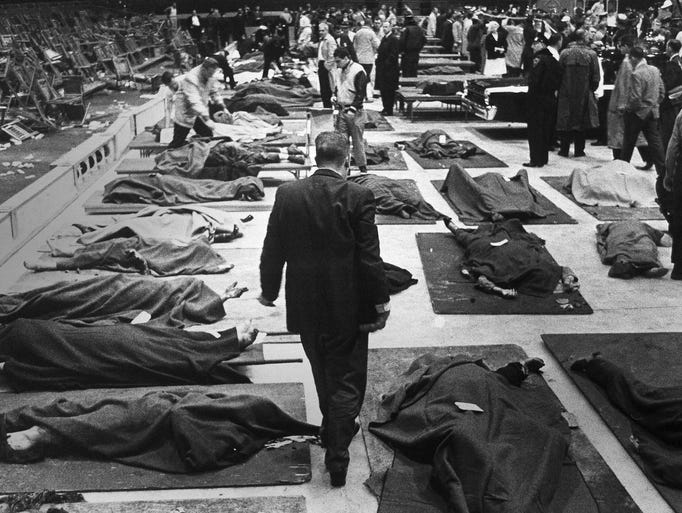
On Halloween night, 1963, during a "Holiday on Ice" skating exhibition at the Indiana State Fairgrounds Coliseum, a propane gas explosion killed 74 people and injured nearly 400.

It was just after 11 p.m. and the skaters were finishing a medley called "Mardi Gras." No one realized that propane gas was leaking from a rusty tank in the concession area, slowly filling the unventilated room.

As the skaters began gliding into a pinwheel formation for the finale the gas came in contact with an electric popcorn machine. When the gas ignited, a blast of orange flame shot 40 feet up through the south side seats, catapulting people and chairs though the air. Concrete chunks and body parts rained down.

Fifty-four people were killed on the scene and another 20 later died of their injuries.


Rescuers used the nearby cattle barn as a temporary hospital and the coroner's office set up a temporary morgue on the ice floor. The dead were placed on plywood and lined up on the ice according to gender and age. Family members who came to identify loved ones had to register at the administration building before being led to the Coliseum.

A Marion County grand jury indicted the state fire marshal, the Indianapolis fire chief, the general manager and the concessions manager of the Coliseum, as well as officers of the company that supplied the gas. But there was only one conviction, the president of the gas supplier, and that verdict was later overturned by the Indiana Supreme Court. According to the Encyclopedia of Indianapolis, victims and survivors ultimately received about $4.6 million in settlements.

In 1991, the Coliseum acquired a sponsorship and was renamed Pepsi Coliseum, however that sponsorship was not renewed in 2012.

In Oct. 2012, a $63 million renovation to the coliseum began. Construction of an adjoining 20,000-square-foot arena should be completed by 2014.

The new arena will allow the State Fair to hold events like public skating, youth hockey games and horse shows at the same time a concert or a circus is going on in the Coliseum. Inside the Coliseum, fair officials plan to build double-tiered seating that will increase the building's seating capacity to 9,000 from the current 8,000.

Thursday 16 January 2014

http://www.indystar.com/story/news/history/retroindy/2014/01/15/coliseum-explosion/4495037/

continue reading

Five bodies recovered from plane crash in Idaho mountains


Authorities in Valley County say they have recovered five bodies from the wreckage of a plane that crashed in the central Idaho mountains last month.

Lt. Dan Smith with the Valley County Sheriff's Office says deputies were assisted Wednesday afternoon by a Blackhawk helicopter from the Idaho Army National Guard. He says it took two days to get into the remote, snow-covered mountainside, then dig out and remove the bodies.

It appears all five people on board the single engine Beech Bonanza died on impact. Smith says there is not much left of the plane. However, they were able to find the serial number to confirm it is the plane they have been looking for since it went missing on Dec. 1.

The wreckage was located last Friday by Dellon Smith, who is the brother of the pilot, Dale Smith, of San Jose, Calif.

Smith was flying from Baker City, Oregon to Butte, Montana when he lost contact with air traffic controllers while near the Johnson Creek airstrip in Yellow Pine, Idaho.

Smith's son Daniel, his wife Sheree, along with his daughter Amber and her fiance Jonathan Norton were also on the plane.

Lt. Smith said deputies did recover wallets from one of the passengers and the pilot to identify them. The other bodies will have to undergo DNA testing to confirm their identities.

It will now be up to the NTSB to recover the wreckage. They have not be up there yet. Smith says Valley County officials have been sending them photos and talking with them on the phone. No word on when that will take place.

A series of photos sent to KTVB by the Idaho National Guard document the rough, steep terrain surrounding the crash site.

Colonel Tim Marsano said the slope of the landing zone required helicopters crews to do a running onload / offload, meaning the helicopter could not land.

Thursday 16 January 2014

http://www.ktvb.com/news/Five-bodies-recovered-from-plane-crash-in-Idaho-mountains-240372751.html

continue reading

Floods, landslide kill 13 in Indonesia; 2 missing


Days of torrential rain triggered a landslide and flash floods on Indonesia's Sulawesi island, killing at least 13 people and sending tens of thousands fleeing for safe ground, disaster officials said Thursday.

Residents and rescuers in Sangihe district of North Sulawesi province dug through debris with their bare hands and shovels. Two bodies were pulled from the mud, and eleven others were found in the water late Wednesday, said National Disaster Mitigation Agency's spokesman Sutopo Purwo Nugroho.

More than 1,000 houses were flooded by overflowing rivers in five other districts of the province, he said.

About 40,000 people fled to temporary shelters, and rescuers were still searching Thursday for at least two more villagers.

Police and soldiers struggled to reach about 1,000 people who were isolated in three hamlets after floods destroyed the only bridge, said the agency's provincial chief Noldy Liow.

He said that rivers bloated by days of rain burst their banks and washed away dozens of houses and vehicles, including in the provincial capital of Manado. Floodwaters reached a meter (3.28 feet) in some places.

"Many people drowned or were buried by mud ... they didn't have time to save themselves," Liow said.

Millions of people live in mountainous regions and near fertile plains that are close to rivers. Seasonal rains and high tides in recent days have caused widespread flooding across much of Indonesia, an archipelago of more than 17,000 islands that's home to 240 million people.

Thursday 16 January 2014

http://www.thejakartapost.com/news/2014/01/16/floods-landslide-kill-13-indonesia-2-missing.html

continue reading

Wednesday, 15 January 2014

19 children killed in bus crash on school trip in Pakistan


At least 21 people, including 19 children, were killed when a school bus smashed head-on into a truck in Pakistan.

The bus collided with the loaded dump-truck near the town of Nawabshah, around 270 kilometres north of Karachi in the southern province of Sindh.

The children, who were students of the Bright Future School from the nearby town of Daulatpur, had come to Nawabshah for a school trip.

Their bus was on its way back to Daulatpur when the accident happened.

Doctor Hashim Langa, chief of the government-run Civil Hospital in Nawabshah, said the hospital had received 21 dead bodies, of which 19 were children.

"Their ages range from five or six to 16," he said.

There were also between 15 and 20 people injured and they were brought to the hospital, he added.

Police said reckless driving might have caused the tragic accident.

They said they were trying to locate the truck driver, who fled the scene.

"We are investigating the reasons, but apparently it must have been irresponsible driving by one of the drivers," senior police officer Asif Ali Pechuho said.

The driver of the bus was among the dead, he added.

He said the bus was so badly wrecked that rescue workers had to use tools to extract bodies.

Pakistan has one of the world's worst records for fatal traffic accidents, blamed on poor roads, badly maintained vehicles and reckless driving.

Multiple-casualty accidents are common.

Wednesday 15 January 2014

http://www.abc.net.au/news/2014-01-15/19-children-killed-in-bus-crash-on-school-trip-in-pakistan/5202282

continue reading

Goa Collapse: Death toll rises to 31


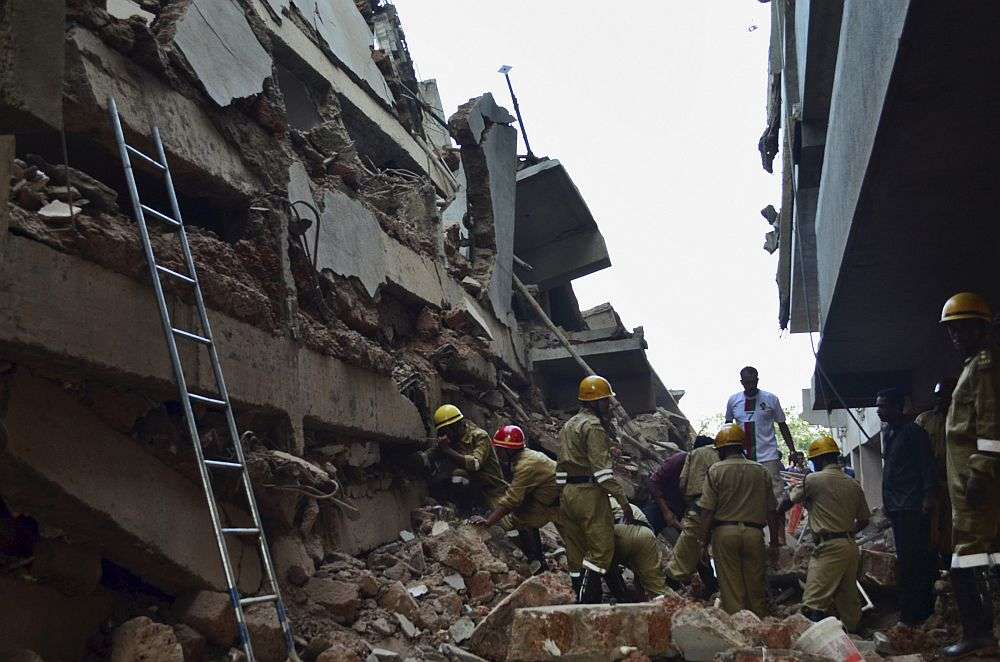
The death toll in Canacona building collapse has reached 31 with rescuers today pulling out the last body from under the rubble before finally calling off the operations as police arrested a deputy collector in connection with the case.

Director of Fire and Emergency Services Ashok Menon said the rescue operations stood withdrawn from 3 pm onwards.

"The total number of casualties in the building collapse has gone up to 31," he said.

The operation was stopped after authorities certified there are no more dead bodies under the debris of the five-storey under construction building that had caved in on January 4.

Over 40 workers were present at the site when the mishap occurred.

The rescue teams which pulled out 16 people alive had suspended their operation earlier after two adjacent buildings near the spot tilted.

Wednesday 15 January 2014

http://news.outlookindia.com/items.aspx?artid=824712

continue reading

Melting glaciers in northern Italy reveal corpses of WW1 soldiers


At first glance Peio is a small alpine ski resort like many others in northern Italy. In winter it is popular with middle-class Italians as well as, increasingly, Russian tourists. In summer there’s good hiking in the Stelvio National Park. It has a spa, shops that sell a dozen different kinds of grappa, and, perhaps, aspirations to be the next Cortina. A cable car was inaugurated three years ago, and a multi-storey car park is under construction.

But in Peio, reminders of the region’s past are never far away. Stroll up through the village and, passing the tiny First World War museum on your left, you come to the 15th-century San Rocco church with its Austro-Hungarian cemetery and sign requesting massimo rispetto. Here, one sunny day last September, 500 people attended the funeral of two soldiers who fell in battle in May 1918.

In Peio, you feel, the First World War never quite ended. And in one very real sense, it lives on, thanks to the preserving properties of ice. For Peio was once the highest village in the Austro-Hungarian empire, and had a ringside seat to a little-known but spectacular episode of that conflict called the White War.

In 1914 both Trentino – the province in which Peio lies – and the neighbouring South Tyrol were Hapsburg domains. Italy, recently unified and eager to settle her frontiers permanently, looked on the two provinces, along with Trieste, as ‘unredeemed lands’. In May 1915, with the aim of reclaiming them, she entered the war on the side of the Allies. Conflict was already raging on the western and eastern fronts; now a third front opened up. It stretched from the Julian Alps, which Italy now shares with Slovenia in the east, to the Ortler massif near the Swiss border further west – some 250 miles.

As much of the front was at altitudes of over 6,500ft, a new kind of war had to be developed. The Italians already had specialist mountain troops – the Alpini with their famous feathered caps – but the Austrians had to create the equivalent: the Kaiserschรผtzen. They were supported by artillery and engineers who constructed an entire infrastructure of war at altitude, including trenches carved out of the ice and rudimentary cableways for transporting men and munitions to the peaks.

In the decades that followed the armistice, the world warmed up and the glaciers began to retreat, revealing the debris of the White War. The material that, beginning in the 1990s, began to flood out of the mountains was remarkably well preserved. It included a love letter, addressed to Maria and never sent, and an ode to a louse, ‘friend of my long days’, scribbled on a page of an Austrian soldier’s diary.

The bodies, when they came, were often mummified. The two soldiers interred last September were blond, blue-eyed Austrians aged 17 and 18 years old, who died on the Presena glacier and were buried by their comrades, top-to-toe, in a crevasse. Both had bulletholes in their skulls. One still had a spoon tucked into his puttees — common practice among soldiers who travelled from trench to trench and ate out of communal pots. When Franco Nicolis of the Archaeological Heritage Office in the provincial capital, Trento, saw them, he says, his first thought was for their mothers. ‘They feel contemporary. They come out of the ice just as they went in,’ he says. In all likelihood the soldiers’ mothers never discovered their sons’ fate.


One of the oddities of the White War was that both the Alpini and the Kaiserschรผtzen recruited local men who knew the mountains, which meant that they often knew each other too. Sometimes family loyalties were split. ‘There are many stories of people hearing the voice of a brother or a cousin in the thick of battle,’ Nicolis says.

For both sides the worst enemy was the weather, which killed more men than the fighting. At those altitudes, the temperature could fall to -30C, and the ‘white death’ — death by avalanche — claimed thousands of lives.

The people of Peio lived these stories because unlike the inhabitants of other frontline villages, they stayed put. ‘The Emperor decreed that this village should not be evacuated,’ Angelo Dalpez, Peio’s mayor, says. ‘As the highest village in the empire, it was symbolic — a message to the rest.’ They worked as porters and suppliers of food. They tended the injured, buried the dead, and witnessed the remodelling of their ancestral landscape (shelling lowered the summit of one mountain, San Matteo, by 20ft).

In 1919 the Treaty of Saint-Germain-en-Laye awarded Trentino to Italy. ‘There was never any clash,’ Nicolis says. ‘No revolution. It was an entirely smooth transition.’ People here had always felt autonomous, in their mountainous border region, and under the new arrangement the Italian government granted them a degree of autonomy. They carried on drinking grappa, eating knรถdel and speaking Italian (which had been one of the 12 official languages of the empire), but they never forgot their history. Many of their relations had fought on the Hapsburg side, and when the soldiers started melting out of the ice, they looked on them as their grand-fathers or great-grandfathers.

This became clear in 2004, when Maurizio Vicenzi, a local mountain guide and the director of Peio’s war museum, whose own family fought for the Austrians, stumbled on the mummified remains of three Hapsburg soldiers hanging upside down out of an ice wall near San Matteo — at 12,000ft, scene of some of the highest battles in history. The three were unarmed and had bandages in their pockets, suggesting they may have been stretcher-bearers who died in the last battle for the mountain, on September 3 1918. When a pathologist was granted permission to study one of the bodies, to try to understand the mummification process, there was an outcry among local people who felt that the dead were being profaned.

The three now lie in the cemetery at San Rocco next to the two from the Presena glacier, in five unmarked graves. All have passed through the lab of the forensic anthropologist Daniel Gaudio and his team, in Vicenza. His priority is to name the mummified soldiers if he can. It is rare that he succeeds for although he can almost always extract DNA, contextual information about the circumstances of their deaths tends to be lacking, meaning that he can’t locate potential living relations to find a match.


In 2005 Vicenzi started exploring a site called Punta Linke, almost 6,500ft above Peio. He found a natural cave in the ice and material scattered over the surface — steel helmets, straw overshoes, boxes of ammunition — and realised there was a structure beneath. With friends from Peio, Great War enthusiasts all, he investigated. Nicolis’s team arrived on the scene two summers later, and together they excavated a wooden cabin — a station on one of the cableways that provided vital supplies to the troops.

The cabin is built against the rocky peak of Punta Linke, and behind it a tunnel runs for 100ft through that peak. When the team first found the tunnel, which is the height of a man, it was filled with ice that they cleared with the help of giant fans. During the war wooden crates brought up on the cableway were pushed through the tunnel before being launched on the final stage of their journey – an impressive 4,000ft leap – using an unsupported cableway, across the glacier to the front line. Beside the tunnel’s exit is a window through which a lookout watched the crates go.

Inside the cabin is a Sendling engine, made in Munich, dismantled by the departing Austrians and now restored. The archaeologists have left in place three documents they found pinned to the wall: handwritten instructions for operating the engine, a page from an illustrated newspaper, Wiener Bilder, showing Viennese people queuing to buy food, which by 1916 was in short supply in the crumbling empire, and a postcard addressed to a surgeon in the engineering corps, Georg Kristof, from his wife in Bohemia. The card shows a woman sleeping peacefully and is signed, in Czech, ‘Your abandoned lover’.

In their lab in Trento, Nicolis and his colleague Nicola Cappellozza show me the love letter written to Maria, which was found in a box of letters ready to be posted, on Punta Cadini (11,500ft), and dated late in 1918. (The archaeologists do not want to reveal the contents of the letter until they can trace Maria’s family.) ‘Perhaps hostilities ended before they could be sent,’ Nicolis says. Other finds include fragments of newspaper printed in Cyrillic. The Russian tourists who visit Peio today may not know it, but other Russians were there before them — prisoners brought from the eastern front and used as pack mules, or put to work weaving the straw overshoes that protected the Austrians’ feet from frostbite.

Peio’s war museum fills out the picture. Inside its display cases are primitive-looking surgical instruments of the kind Kristof might have used, rosaries, porcelain pipes that resemble small saxophones, decorated in the Tyrolian style, and ‘trench art’ carved out of fragments of shells or shell casings. In the hungry period following the armistice, the villagers roamed the mountains looking to salvage material they could reuse or sell. Some pieces they kept as souvenirs, donating them to the museum when it opened 10 years ago. ‘They consider the museum their collective property,’ Dalpez says. ‘They’re proud of it.’

More than 80 soldiers who fell in the White War have come to light in recent decades. There are certainly more to come, but one body continues to elude the rescuers – that of Arnaldo Berni, the 24-year-old captain who led the Italians to their conquest of San Matteo on August 13 1918. Berni’s story illustrates the tragedy of a war where, as the British historian Mark Thompson explained in his 2008 book, The White War, Herculean feats produced trivial territorial gains, and no one down below took much notice.


After his victory, in a letter that must have slipped past the censors, Berni complained to relations about the press coverage. ‘There is a short and confused description of our battle, which was in fact brilliant and incurred very little loss of life… The journalists don’t come to us at such high altitudes, so the prodigious efforts of our men are not known.’ He died three weeks later, when the Austrians — on their way to recapturing San Matteo — dropped a shell on the crevasse in which he was sheltering. Two months later, the Italians dealt a shattering blow to the Austro-Hungarian war effort at Vittorio Veneto, on the Venetian plain, and the war was over.

There have been many attempts to find Berni over the years, first by his own men, then by his devoted half-sister, Margherita — the once skinny little girl he nicknamed Ossicino, or ‘Little Bone’ — who for long after the war made annual pilgrimages to the mountains, and finally by Vicenzi, Cappellozza and others, who in 2009 climbed down into the crevasse where the hero almost certainly met his death. They found no trace of him, but Cappellozza hasn’t forgotten the experience. ‘We were able to walk horizontally a long way. I remember the colours in the ice — the blues, the violets.’

In the summer of 2013, just before the snow came, Nicolis’s team put the finishing touches to the restoration of the way-station at Punta Linke. From next summer, intrepid hikers will be able to visit this simple monument and, as he puts it, ‘smell the war’. Sometimes, Nicolis says, he looks through the window at Punta Linke and tries to see the mountains as the soldiers did. Those, like Kristof, who came from distant corners of the empire, must have been mystified by the struggle for this inhospitable wilderness. For others, local highlanders, the mountains were the prize and the Emperor the abstraction, but one for whom they were expected to fight men they had climbed with all their lives.

In both cases, he believes, the mountains signified death before they signified beauty. ‘Snow is truly a sign of mourning,’ Giuseppe Ungaretti, the Italian war poet, wrote in 1917. Peio’s mayor has a different take on things. At the funeral of the Presena pair, three anthems were played — the Italian, the Austrian and the Ode to Joy. ‘The people who fought here,’ he says, ‘were Europeans before their time.’

Wednesday 15 January 2014

http://www.telegraph.co.uk/history/world-war-one/10562017/Melting-glaciers-in-northern-Italy-reveal-corpses-of-WW1-soldiers.html

continue reading