Sunday, 27 January 2013

Update hospital: 61 killed in Venezuela prison riot


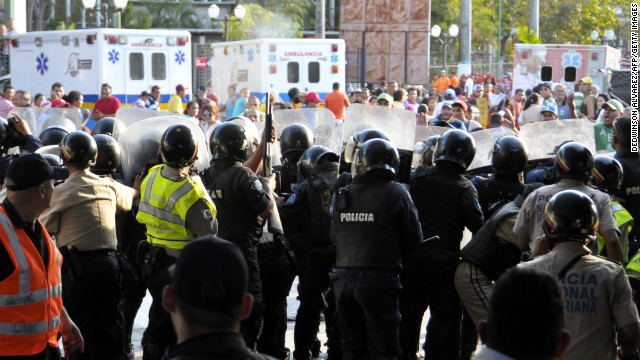
The death toll has risen to 61 following fierce gunbattles between inmates and National Guard troops at a Venezuelan prison, a hospital director said Saturday. About 120 more people were wounded in one of the deadliest prison riots in the nation's history.

Penitentiary Service Minister Iris Varela said Saturday that officials had begun evacuating inmates from the Uribana prison in Barquisimeto and transferring them to other facilities, but she did not provide an official death toll.

However, Dr. Ruy Medina, director of Central Hospital in the city of Barquisimeto, told The Associated Press that the number of dead had risen to 61. He initially told Venezuelan news media after the Friday uprising that about 50 were killed.

Medina said that nearly all of the injuries were from gunshots and that 45 of the estimated 120 people who were wounded remained hospitalized. Some underwent surgeries for their wounds.

Relatives wept outside the prison during the violence, and cried at the morgue Saturday as they waited to identify bodies.

The riot was the latest in a series of deadly clashes in Venezuela's overcrowded and often anarchical prisons, where inmates typically obtain weapons and drugs with the help of corrupt guards. Critics called it proof that the government is failing to get a grip on a worsening national crisis in its penitentiaries.

The gunbattles seized attention amid uncertainty about President Hugo Chavez's future, while he remained in Cuba recovering and undergoing treatment more than six weeks after his latest cancer surgery.

Government officials pledged a thorough investigation, while some critics said there should have been ways for the authorities to prevent such bloodshed.

Nayibe Mendez, the mother of a 22-year-old inmate in the prison, told the AP that she was able to talk by phone with her son and he was uninjured.

"What they say is that there were shots all over the place, and they don't know where they came from," Mendez said. "It was a massacre. A full list hasn't come out of the dead and injured."

Mendez spoke by telephone from the morgue, where she said she went out of solidarity. "We're all hurt. No matter what, a prisoner has a right to live," she said, demanding that the authorities fully investigate what happened.

Varela said during a news conference that officials decided to evacuate all inmates from the prison in order to "close this chapter of violence." She said victims had wounds from guns, explosives and knives or other sharp weapons made by the inmates.

Varela did not provide any estimates of the numbers killed and injured, and instead criticized Venezuelan news media at length for their coverage of the violence.

Vice President Nicolas Maduro called the bloodshed tragic and said Prosecutor General Luisa Ortega Diaz and National Assembly President Diosdado Cabello would lead the investigation.

"The prisons have to be governed by law," Maduro said on television early Saturday.

The riot was the deadliest in nearly two decades. In 1994, more than 100 inmates died in the country's bloodiest prison on record, at a prison in the western city of Maracaibo. In 1994, about 60 inmates were killed in a riot in a Caracas prison.

Varela said that the violence erupted on Friday when groups of inmates attacked National Guard troops who were attempting to carry out an inspection. She said the government decided to send troops to search the prison after reports of clashes between groups of inmates during the past two days.

Douglas Briceno said his nephew, an inmate, was wounded in the foot during the shooting. "I think he's out of danger," Briceno told the AP. "I haven't been able to communicate with him because they don't let me pass to the prison."

Opposition leader Henrique Capriles condemned the government's handling of what he and many other critics call a growing crisis in the country's prisons.

"Our country's prisons are an example of the incapacity of this government and its leaders. They never solved the problem," Capriles said on his Twitter account. "How many more deaths do there have to be in the prisons for the government to acknowledge its failure and make changes?"

Venezuela currently has 33 prisons built to hold about 12,000 inmates, but officials have said the prisons' population is about 47,000.

The Venezuelan Prisons Observatory, a watchdog group, said in a statement that in 2007 the Costa Rica-based Inter-American Court of Human Rights had ordered the government to seize weapons that inmates had in their possession at Uribana prison and to take measures to avoid deaths in the facility. The group called for the government to release a list with the names of the dead and wounded in Friday's violence, as well as details about weapons seized in the search.

"No one doubts that inspections are necessary procedures to guarantee prison conditions in line with international standards, but they can't be carried out with the warlike attitude as (authorities) have done it," said Humberto Prado, an activist who leads the prison watchdog group.

"It's clear that the inspection wasn't coordinated or put into practice as it should have been. It was evidently a disproportionate use of force," Prado told the AP.

His group says Uribana prison was built to hold up to 850 inmates but currently has about 1,400.

Similar though less deadly clashes have flared repeatedly during the past few years.

In April and May, a prison uprising in La Planta prison in Caracas blocked authorities from going inside for nearly three weeks. One prisoner was killed and five people were wounded, including two National Guard soldiers and three inmates.

Two months later, another riot broke out at a penitentiary in Merida, and the Venezuelan Prisons Observatory reported 30 killed.

In August, 25 people were killed and 43 wounded when two groups of inmates fought a gunbattle inside Yare I prison south of Caracas.

Chavez's government previously pledged improvements to the prison system, but opponents and activists say the government hasn't made progress.

Varela, the prisons minister, said news media including Globovision and a local newspaper had run reports on the inspection by authorities, which she said had in fact been a "trigger for the violence."

Prado denied that, saying: "The problem isn't the work of the media. The problem is that the government hasn't disarmed the prison population."

Sunday 27 January 2013

http://world.time.com/2013/01/27/hospital-61-killed-in-venezuela-prison-riot/

continue reading

'Secret Gypsy graves'; exhumations may be needed


A cemetery boss fears for her life because she exposed a racket that may have allowed gypsies to bury their dead on the cheap.

It could mean that up to 30 bodies will have to be exhumed. Some families may even have spent years tending the wrong graves.

Debbie Mowatt, the supervisor, says children have been threatened and an insider says someone scrawled graffiti on her van with a message “along the lines that she was going to die”.

Now she has had to have a panic alarm installed linking her home directly to a police station and the house is monitored by CCTV.

The insider added: “This lady has had a terrible time since this all blew up.” Mrs Mowatt has already been knocked unconscious and thrown into a 6ft freshly dug grave.

She told police it was still dark when she woke up. She was only able to escape because she called her boss on her mobile phone and he brought a ladder to help her out.

Two gravediggers were arrested over the attack but all charges against them were dropped five months later for lack of evidence.

Mrs Mowatt suspected cemetery workers had been taking money from gypsies and travellers to bury their relatives without proper records being kept.

Northumberland County Council staff have been touring graveyards in Tweedmouth and Berwick-upon-Tweed looking for “unofficial” coffins by ramming metal rods into the ground and by electronically scanning the graves.

Last November, the council issued an apology for the distress it anticipates will be caused to families because it has discovered “serious errors” at the two cemeteries.

Chris Gregory, 52, and Malcolm Purvis, 49, the gravediggers at the centre of the allegations, claim they are victims of a “witch hunt”.

Although the police charges over the assault were dropped, both were suspended from their £20,000-a-year jobs and sacked 13 months ago for gross misconduct. There is no suggestion that the men are behind the more recent threats.

At home in Scremerston, Mr Gregory, who runs a landscape gardening business, said all the claims against them were “never proved” He said both had been quizzed about taking cash, which they deny.

He explained the large number of unmarked graves by saying: “There are loads of pauper’s graves. You can’t put a headstone on a pauper’s grave. I know 120 per cent that nobody was buried in the wrong grave.”

Sunday 27 January 2013

http://www.express.co.uk/posts/view/373566/-Secret-gypsy-graves-terror

continue reading

North Korean cannibalism fears amid claims starving people 'eat children and corpses'


Reports from inside the secretive famine-hit pariah state, North Korea, claim a man has been executed after murdering his two children for food.

Shocking reports claim North Koreans are turning to cannibalism with reports including details of one man who dug up his grandchild's corpse to eat and another who boiled his child and ate the flesh.

Details of the incidents were reported by the Asia Press, and published in the Sunday Times.

They claim a 'hidden famine' in the farming provinces of North and South Hwanghae has killed 10,000 people are there are fears that cannibalism is spreading throughout the country.

The reports come as sanctions against the country are tightened against the backdrop of angry rhetoric over missile testing.

The litany of horrors were documented by Asia Press, a specialist news agency based in Osaka, Japan, which claims to have recruited a network of "citizen journalists" inside North Korea.

The reports are considered credible.

Interviews have led Asia Press to conclude that probably more than 10,000 people have died in North and South Hwanghae provinces, south of Pyongyang, the capital.

North Korea has not confirmed or denied any reports of the deaths.

One informant, based in South Hwanghae, said: "In my village in May, a man who killed his own two children and tried to eat them was executed by a firing squad.

"While his wife was away on business he killed his eldest daughter and, because his son saw what he had done, he killed his son as well. When the wife came home, he offered her food, saying: 'We have meat.'

"But his wife, suspicious, notified the Ministry of Public Security, which led to the discovery of part of their children's bodies under the eaves."

Jiro Ishimaru, from Asia Press said: 'Particularly shocking were the numerous testimonies that hit us about cannibalism.'

Another of the citizen journalists, Gu Gwang-ho, said: "There was an incident when a man was arrested for digging up the grave of his grandchild and eating the remains."

A middle ranking official of the ruling Korean Workers Party said: "In a village in Chongdan county, a man who went mad with hunger boiled his own child, ate his flesh and was arrested"

A new UN agreement, passed on Tuesday, extended sanctions already imposed on North Korea after it held nuclear tests in 2006 and 2009.

The current rise in tensions and extension of sanctions follows Pyonyang's defiant decision to push ahead with a long-range rocket launch on December 12 - insisting it was a peaceful mission to place a satellite in orbit.

Despite the insistence of the regime that the test was peaceful the rest of the world saw it as a banned ballistic missile test.

The United States, supported by Japan and South Korea, spearheaded the new UN resolution.

This week North Korea once again raised the level of rhetoric over sanctions, threatening war with its neighbours in the south saying: "If the South Korean puppet regime of traitors directly participates in the so-called UN 'sanctions', strong physical countermeasures would be taken," the North's Committee for Peaceful Reunification of Fatherland said.

Sunday 27 January 2013

http://www.independent.co.uk/news/world/asia/north-korean-cannibalism-fears-amid-claims-starving-people-eat-children-and-corpses-8468781.html

continue reading

11 killed, 32 hurt in Portugal bus accident


A bus crashed and fell into a ravine near the eastern Portuguese town of Serta, killing 11 people and injuring 32, officials said Sunday.

National Civil Protection authority spokesman Carlos Guerra said the injured were flown and driven to hospitals in nearby cities. One injured person died in the hospital.

The bus, run by a Spanish company from Badajoz, fell into a ravine in the town of Carvalhal on a tourist trip from the Spanish city of Badajoz to Portuguese city Santa Maria da Feira, said a National Civil Protection Authority source.

According to a spokesperson for the National Civil Protection Authority, the passengers have been removed from the vehicle and were taken to the University Hospital of Coimbra, Castelo Branco District Hospital and the Pediatric Hospital of Coimbra. One person in critical condition was airlifted to St. Joseph Hospital in Lisbon.

Civil Protection spokesman Rui Esteves said all the occupant of the bus, including the driver, were Portuguese citizens.

Television images showed a large rescue operation mounted on the rain-soaked approach road, including more than 260 firefighters and at least one rescue helicopter.


Some of the passengers were trapped inside and images showed firefighters cutting sections of the bus to rescue them.

At least 200 firefighters and 80 operational vehicles remain at the scene to assist in the rescue efforts. The police have installed a safety lane on the IC8 highway to facilitate the passage of ambulances coming from the districts of Leiria, Castelo Branco and Santarem.

Police confirmed that the 11 killed are all of Portuguese nationality.

The road was wet and there was poor visibility due to bad weather conditions when the deadly accident took place.

Sunday 27 January 2013

http://www.huffingtonpost.com/huff-wires/20130127/eu-portugal-bus-crash/?utm_hp_ref=homepage&ir=homepage

http://news.xinhuanet.com/english/world/2013-01/27/c_132131629.htm

continue reading

Ezu River bodies: water scarcity, epidemic loom

As the mystery behind corpses found afloat in Ezu River in Amansea, Anambra State border town to Enugu State remained unraveled more than a week after the horror, water scarcity, epidemic and fear have continued to reign supreme among the residents of the communities around the river and indeed, South East geo-political zone, Ngwuja Ugwoke reports.

For a very long time from now residents of villages around the Ezu River in Amansea and Ugwuoba communities of Anambra and Enugu States respectively will certainly have to contend with acute water scarcity and epidemics as a result of the dead bodies recently dumped in the river which serves as a major source of water for them.

An outbreak of epidemic has already been reported in Amansea area. Several residents of the area were said to have suddenly taken ill and were hospitalized just few days after the discovery of several corpses floating on the river. Mr. Boniface Okonkwo, a former member of the Anambra State Assembly and indigene of the town broke the sad news to journalists who visited the area following the sighting of corpses floating on the river.

The ex-lawmaker who looked thoroughly worried told newsmen that some members of his community who drank water from the river after the dead bodies were sighted in the river were later rushed to the hospital because they suddenly took ill.

Even the Anambra State governor, Mr. Peter Obi had on arrival at the scene where the dead bodies were afloat on the river anticipated that outbreak of epidemic was imminent in the area. Consequently he had during the visit warned people to desist from fetching water from the river for any domestic use, warning that the river had been polluted.

The former lawmaker stated that those who took ill were basically people who didn’t hear about the sad news of the dumping of dead bodies in the river. According to the ex-lawmaker, “I am coming out from a hospital now because some people in my community have suddenly fallen sick after drinking water from Ezu River. They are some old villagers who didn’t hear about these corpses thrown into our river.

I went there to see them and I am still going to another hospital there because they told me that some of them were taken to other hospitals. You know, in this my town people don’t make use of any other water except the one they fetch from Ezu River, that is the only water they take and their body will become cool; they don’t use pure water, and that is why you can’t find (water) borehole in this town. The dead body they dumped into our river has polluted the water. So I am now calling on the Government to come and provide water boreholes for my people because they are now facing the problem of water scarcity”.

Interestingly, in order to ensure that the people do not go to fetch water from the Ezu River, both the Anambra State government and Awka – North local government have been sponsoring water tanker operators to supply water to the residents of the villages around the river.

For about three days from Saturday, January 19, when the dead bodies started floating on the river many residents of the villages around the river fled their homes because the stench of decomposing human flesh enveloped the entire area. Some locals claimed they counted between 35 to 40 corpses afloat the river.

But the Anambra State police command on Monday, January 21 said they have recovered 18 dead bodies. Mr. Emeka Chukwuemeka, spokesman of the police command disclosed the number of the dead bodies to newsmen. Incidentally, three more corpses were again seen afloat somewhere in the river on Wednesday, January 24, meaning that more of the dead bodies were still in the belly of the river.

Since the discovery of those dead bodies in the river there has been serious apprehension among the residents of the communities around the area and indeed in the entire South East geo-political zone of Nigeria. This is basically because both the identity of people whose corpses were dumped in the river, the circumstances that led to their death, and those who brought them and dumped them in the river have remained a mystery.

The commissioner of police, Anambra State, Mr. Bala Nasarawa and his Enugu State counterpart, Mr. Musa Daura had promptly visited the scene where the dead bodies were afloat the river and promised to join forces to unravel the mystery surrounding the corpses, but, have not come up with any clue, at least to the members of the public as at the time of filing this report.

And determined to ensure that the mystery behind the sad development was unraveled, the Anambra State governor, Mr. Peter Obi has announced a N5 million reward to any person who could come up with useful information that would lead to the arrest of those behind the matter.

Governor Obi said, “Human life is sacred and people should respect the sanctity of human life, and such barbaric action as we have seen concerning these corpses we have seen here should not be condoned in a decent society in this time and age”. He was in London taking part in the 80th birthday celebration of the former Commonwealth Secretary-General, Chief Emeka Anyaoku when the sad news broke out and he had to abandon the event and return to the State.

Not only are a few people worried over the discovery. The questions people are asking which no answers have been provided for include, what lead to the death of those people whose corpses were seen afloat the Ezu River, who are they, who killed them, why were they killed, why were their corpses thrown into the river and who are those who brought them and dumped them into the river?

Even as any clue is yet to be given by the security on any of the above puzzles, those corpses recovered by the police were said to have been given mass burial by officials of the Anambra State Ministry of Health assisted by the police. According to the Police, all the corpses were male adults and there were no gunshot injuries or any mark of violence found on them.

Some of the villagers maintained that some of the recovered corpses from the river were buried in a mass grave. They are even more worried that the corses were buried very close to the bank of the river meaning that the river would remain polluted for a long time as the bodies continue to decay.

But the Commissioner of Police, Anambra State, Mr. Balla Nasarawa had on Sunday, January 20, 2013, said the Police Patholoigists from Benin and government doctors in Anambra State will commence autopsy on the corpses on Monday, January 21, 2013.

It is submitted that, since it is evident that some of the corpses had been buried, it is therefore not possible to perform autopsy on all the recovered corpses.

In another related development, the Leadership Sunday of January 13, 2013, had reported that the Police in Delta State recovered scores of unidentified corpses of women at a hideout/ operational base of suspected ritualists. The Delta State Police Public Relations Officer(PPRO) Famous Ajieh, in confirming the incident said Police swooped on the suspects at their operational base in Okpanam village and arrested four of them. The Police Public Relations Officer (PPRO) also stated that the Police found scores of mutilated bodies of women at the hideout.

The South East zonal Director of the Civil liberties Organisation, Olu Omotayo has viewed the Ezu River incident as an indication that security in Anambra State was porous. But any one who is familiar with the geography of Ezu River which situates as the boundary of Anambra to Enugu State would certainly not share Omotayo’s conclusion.

According to a statement by him, “The incident in Delta State is somehow straightforward and better handled by the Delta State Police Command, due to the arrest of some of the culprits, but we advised that the Police should further conduct a thorough investigation into the matter and ensure that those arrested are promptly arraign before a court of competent jurisdiction.

Moreover the incident in Anambra State clearly shows that security/ security network in the state is very porous and bad, or how do one explain how 20 corpses are transported and dumped in a community without the perpetrators being apprehended in the course of their operation by any security agent. We submit that performance of autopsy on the remaining corpses should not be the end of the case.

There should be a thorough investigation of how the corpses reached the Amansea Community, and who the perpetrators of this heinous act are. We call on the Inspector General of Police, to ensure that both cases in Anambra and Delta States are properly investigated and the perpetrators arraign before a Court of Law”.

Interestingly, the people of Amansea have already embarked on a traditional approach to unravel the mystery behind the dumping of the corpses in their river. Some of the villagers said that the goddess of the river is angry. But basically people see it as a challenge to the police to tell members of the public what happened.

Sunday 27 January 2013

http://leadership.ng/nga/articles/46161/2013/01/27/ezu_river_killings_water_scarcity_epidemic_loom.html

continue reading

Over 100 Skeletons Unearthed In Matale mass grave


In Matale, the body count grows ever higher as more and more skeletons emerge out of the red earth near the Matale hospital, with over a hundred recovered, according to a judicial medical officer.

But at present, how this mass gravesite came to be is still a mystery.

It all started when in November last year workers began digging near the hospital in order to lay a new biogas unit. They received a grisly surprise when they uncovered what appeared to be pieces of a human skull, a police report said.

Having reported the find, further excavation found not just one, but 10 skulls. The site was handed over to the Matale police, who, on the instructions of Matale Magistrate Chathurika de Silva, began an investigation, together with Consultant Judicial Medical Officer of the nearby Matale Hospital, Ajith Jayasena. The CID too began investigations on December 2.

As of Friday (25) the official police report said that 92 skeletons, complete with skulls, and 13 shards of bone were recovered.

However, Jayasena on speaking to The Sunday Leader said that the excavation was continuing, and more skeletons were being uncovered. Although 92 had been collected in front of the Magistrate, the recovered skeletons already numbered more than 100.

The number of people buried could well have been higher- this was the third biogas unit the workers had been intending to place on the site. As Jayasena said, it was entirely possible that even more buried remains were lost when the earlier construction was taking place in 2010.

Meanwhile, the excavating continued. “It is only after we recover the skeletons that we can examine them closely and give the final report to court,” Jayasena said. Jayasena said that what had been discovered when the skeletons were unearthed could not yet be divulged, as he was working according to a court order.

He added that it was too soon to conclusively date the bones uncovered. The reason for this, Jayasena said, was that the rate of bone decay tended to vary from place to place and country to country. Other factors could change the rate of bone decay, from the manner in which the skeletons were buried to the chemical composition of the soil. As a result, this method of dating the skeletons, based purely on how badly the bones had decayed, was not accurate, Jayasena said.

On the other hand, the best way to date the bones would be to take a sample and send it to a foreign country for analysis. “I know we don’t have such facilities in Sri Lanka,” Jayasena explained, adding that the best course of action was to send the bone samples overseas for carbon dating.

“I can’t say that it’s right or wrong that the bones uncovered date to 1971 or some other time. As a forensic expert, until the investigation report is released, it is not possible to give evidence,” Jayasena said, adding that it was up to the police to investigate from their end as well.

However, Jayasena added that the opinion of the Archaeological Department had been sought to see if the bones were more than 100 years old, in which case it would fall under their purview. The Director of Excavation, Nimal Perera had come to the site to examine the remains and was to provide a certificate stating that the remains had no archaeological value, Jayasena said.

He added that it was normal procedure to treat mass graves such as this one as crime scenes. The Matale gravesite was also being considered a crime scene because it was not a seriously established cemetery, nor had hospital records shown that the Matale hospital had buried remains on the site. However, proper investigations still had to be done to ascertain whether the site was, in fact, a scene of crime or not. “This process will take time… that is the nature of investigation,” Jayasena said.

He added that the bones recovered had been buried in a haphazard fashion, such that even a layperson could tell that there was no order to the burials.

Jayasena’s comments come after intense speculation as to where the remains could have come from. When The Sunday Leader visited Matale, it was found that the residents believed various alternative theories. One, an 80 year old hospital attendant called Loku Banda Herath, said he recalled that there had been a smallpox outbreak in the area, so that his own father, also a hospital attendant, had been unable to return home for fear of spreading the disease. When he returned home, Herath learned that those who had succumbed to the disease were buried in a mass grave not far from the hospital grounds. This theory was refuted by Jayasena, who said, “They have been saying that the skeletons are over 40-years-old, and belong to patients who had small pox. It is a lie.” He further said the residents were saying these things to obstruct the investigation.

Others, such as U. R. Muthubanda, a JVP supporter who was connected to the 1971 insurrections, said that the bodies could not have been from that period, as there were only direct conflicts between the Government and the JVP. There have also been reports that the skeletons could date back to 1946, when, police noted, a landslide killed around five hundred people.

However, these rumours are still just that- rumours. As Jayasena revealed, authorities still have no idea how old the skeletons actually are.

One of most persistent theories is that the skeletons date back to the 1989 JVP insurrection. It is for this reason that the JVP have been calling for an independent investigation into the origin of the documents. JVP MP Vijitha Herath said he was aware that the final report had still not been handed over. “Our position is, that we want an actual impartial examination, and for the doctors and other intellectuals to release the report so that we can form an idea of what happened,” Herath said. He added that the party wanted “immediate action” on the matter.

Herath said that the party did think the remains could be of JVP activists, but added that they had no real evidence to support this belief, having not received any reports from the gravesite.

However, he added, there were mass graves full of JVP activists scattered throughout the island. Herath said that the Government (at the time, the UNP was in power) committed massacres by way of illegal gangs. “They were called the Green Tigers,” Herath said, adding that they had carried out many killings and kidnapping of JVP activists. He alleged that such mass graves could be found in Achchuvely, Matara, Eliyakanda, Diyagama, Batalanda, Divulapitiya and the Kurunegala jungle, most of which dated back to 1989.

Sunday 27 January 2013

http://www.thesundayleader.lk/2013/01/27/over-100-skeletons-unearthed-in-matale/

continue reading

Bangladesh probing allegations that emergency exit was locked at garment factory where 7 died


Bangladesh's government has ordered an investigation into allegations that the sole emergency exit was locked at a garment factory where a fire killed seven female workers, an official said Sunday.

The fire Saturday at the Smart Export Garment Ltd. factory occurred just two months after a blaze killed 112 workers in another factory near the capital, raising questions about safety in Bangladesh's garment industry, which exports clothes to leading Western retailers. The gates of that factory were locked.

Government official Jahangir Kabir Nanak said an investigation has been ordered into the cause of Saturday's fire and allegations that the emergency exit was locked.

Altaf Hossain, father of a garment worker killed in the latest fire, has filed a police case against three directors of the factory, accusing them of negligence involving the fire, Dhaka Metropolitan Police Sub-inspector Shamsul Hoque told The Associated Press on Sunday.

He said police had begun an investigation.

Doctors said most of the victims died from asphyxiation.

"When I tried to escape through the emergency exit I found the gate locked," Raushan Ara, a worker at the factory, was quoted as saying by Dhaka's Prothom Alo newspaper.

The newspaper said at least 50 people were injured in a stampede triggered by the fire. Six were hospitalized, while others received first aid treatment on their own.

Some of the injured jumped out of the windows of the two-story factory, survivors said.

Dhaka Metropolitan Police Deputy Commissioner Monzurul Kabir said the bodies of seven women were recovered from the top floor of the factoryt. He said the factory was making pants and shirts, but could not provide further details.

Fire official Abdul Halim said it took firefighters about two hours to bring the blaze under control.

Volunteers joined firefighters in battling the fire as a large crowd gathered outside the factory awaiting word on the fate of relatives. Family members were seen crying near the body of a female worker named Josna, who was 16.

About 250 workers were working at the time of the fire, newspapers said.


It was not immediately known if the factory produced garments for any international companies. The owner was not available for comment, and the Bangladesh Garment Manufacturers and Exporters Association said the factory was not a member so it had no details.

Earlier this month, Wal-Mart Stores Inc. alerted its global suppliers that it will immediately drop them if they subcontract their work to factories that haven't been authorized by the discounter. The stricter contracting rule, along with other changes to its policy, come amid increasing calls for better safety oversight after the deadly fire in late November at a factory owned by Tazreen Fashions Ltd. that supplied clothing to Wal-Mart and other retailers. Wal-Mart has said the factory wasn't authorized to make its clothes.

Wal-Mart ranks second behind Swedish fast fashion retailer H&M in the number of clothing orders it places in Bangladesh.

Fires have led to more than 600 deaths of garment workers in Bangladesh since 2005, according to research by the advocacy group International Labor Rights Forum.

Sunday 27 January 2013

Read more: http://www.ottawacitizen.com/news/Garment+factory+fire+kills+injures+another+Bangladesh/7877206/story.html#ixzz2JBn27v5r

continue reading

Remaining bodies of missing Kemerovo miners recovered


Four miners missing since a methane blast in a coal mine in Russia's Kemerovo region last week were found dead in a shaft on Sunday, taking the death toll to eight.

“Four miners whose fate was unknown until today have been found without signs of life” in the mine, the regional emergency situations ministry said, adding their bodies would be retrieved later Sunday.

The explosion at Mine No 7 in the Kuzbass coal basin occurred on January 20. The workers were inspecting the mine, which had halted production after a collapsing wall killed one miner earlier this month.

The Kuzbass coal basin in West Siberia is Russia's biggest. Accidents there are relatively common due to ageing infrastructure, violations of ventilation safety requirements and tampering with gas-level monitoring equipment.

Sunday 27 January 2013

http://www.iol.co.za/news/world/four-missing-in-mine-blast-found-dead-1.1459274#.UQVBmEH3TUI

continue reading

A look at notable deadly nightclub fires


A fire that swept through a crowded nightclub in southern Brazil early Sunday appears to be the deadliest in a decade. Here is a look at some other recent big nightclub fires:

- A blaze at the Lame Horse nightclub in Perm, Russia, broke out in December 2009, when an indoor fireworks display ignited a plastic ceiling decorated with branches, killing 152.

- A fire at the Santika nightclub in Bangkok killed 67 people on New Year's Day in 2009. An indoor fireworks display set off after the countdown to the new year ignited the blaze.

-Fireworks sparked a blaze and stampede that killed at least 43 people at a Shenzhen, China nightclub in September 2008.

- A December 2004 fire killed 194 people at an overcrowded working-class nightclub in Buenos Aires, Argentina, after a flare ignited ceiling foam.

- A nightclub fire in the U.S. state of Rhode Island in 2003 killed 100 people after pyrotechnics used as a stage prop by the 1980s rock band Great White set ablaze cheap soundproofing foam on the walls and ceiling.

-Flames engulfed the tiny La Gojira discotheque in Caracas, Venezuela, in November 2002, leaving 50 people dead.

-A welding accident reportedly set off a Dec. 25, 2000, fire at a club in Luoyang, China, killing 309.

Sunday 27 January 2013

http://www.myfoxphoenix.com/story/20716482/a-look-at-notable-deadly-nightclub-fires

continue reading

Unidentified immigrant body count remains grave issue in Brooks County


Lawmen and “angels” are among those focused on the 129 people found dead in Brooks County’s remote and rugged terrain last year.

Last month, a new unit formed to strengthen the prosecution of human smugglers who led illegal immigrants to their deaths through the area, Brooks County Chief Deputy Urbino “Benny” Martinez said Friday.

However, the California-based non-profit Angeles Del Desierto has raised additional concerns in regard to the often unidentified bodies. The group claims DNA samples, crucial in identifying the remains which are often skeletal, aren’t being collected as they should in the Deep South Texas counties that act as throughways for immigrants headed north.

“There is a crime being committed here,” Martinez said of the immigrants left behind to die as smugglers take groups of 20 to 25 past the Falfurrias checkpoint.

He said the new unit targeting human smugglers is headed by U.S. Immigration and Customs Enforcement, with Border Patrol agents and state- and county-level officers participating.

The 129 bodies found in Brooks County last year is a high number, he said, and more than half remain unidentified after succumbing to the elements or dehydration.

“Sixty-eight unknowns, my God,” Martinez said. “There needs to be closure.”

Most who were identified came from Mexico; others were from El Salvador, Honduras, Guatemala, the Dominican Republic, Costa Rica and Ecuador, he said.

Six bodies have been found already this year.

Recent reports from Border Patrol and a Washington D.C.-based non-profit point to a dramatic increase in immigrant deaths in the South Texas area. In December, Border Patrol said the number of dead in the Rio Grande Valley sector doubled compared to the past fiscal year.

Angeles Del Desierto director Rafael Hernandez said authorities only have photographs to rely on once the bodies are buried and the lack of a database proves problematic when trying to locate the remains. Additionally, he said some private ranch owners have expressed significant resistance when his organization has asked for permission to search for the dead on their land.

“This is our principle problem: first, we don’t have access to ranches to conduct searches. Second: we don’t have opportunities to know who the people buried are,” he said.

There are more than 200 missing on his own list and families continue to contact him, he said.

Joe Martin, a lawyer with the South Texas Civil Rights Project working with the Angeles Del Desierto, said there are concerns samples aren’t being collected every time an unidentified body is found.

“It’s absolutely possible that in most of these cases DNA samples could be taken,” he said.

Brooks County Judge Raul Ramirez said the procedures to process the bodies are governed by the Texas Health and Safety Code. He said while the county does not have its own licensed medical examiner to collect samples, an examiner works out of the Mission funeral home in an effort to help identify the bodies.

“All of them, we try to take a sample,” Ramirez said, adding later that they are prohibited from cremation.

However, the STCRP said the collection of samples from an unidentified body is required, rather than elective. The organization cites a portion of the Texas Code of Criminal Procedure that states a physician must collect samples from unidentified bodies which are then sent for inclusion in a state database.

When bodies are identified, authorities work with consulates to return them home to their families and organizations like Angeles Del Desierto lend their help too. But, this leads to the funeral home being inundated with bodies as well, Hernandez said, explaining that if they remain unknown they are buried after two weeks.

The STCRP has requested a number of records from various South Texas counties, which often don’t have their own medical examiner, to understand how the unidentified bodies are processed, Martin said.

“It seems like it’s hit or miss,” he said of the different practices in different counties.

There are volunteers working with Angeles Del Desierto willing to scientifically test the samples without cost, but they must be released by the county’s justices of the peace, he said. Ramirez said forensic students at Baylor University have expressed interest in doing the same, but transporting the samples (and its associated costs) might be problematic.

Both Ramirez and Hernandez are able to cite a grim mathematical equation off the top of their heads.

For impoverished Brooks County it costs $750 per body — a total of $96,750 in 2012 — to pick them up, Ramirez said. There’s an additional $1,500 to $2,500 for an autopsy and even a body bag costs $150, he said. Other expenditures include a deputy’s time away from his post and the vehicle repairs sometimes needed after venturing into the brutal terrain, he said.

Meanwhile, Hernandez said families must pay $300 to collect a sample and the DNA test itself costs $3,000. Then, there’s the wait for the results — anywhere from two to three months — while the body is kept at the funeral home for $100 per day. That adds up to a bill of more than $9,000 at least. There’s also a price to pay to exhume the body and eventually send it home.

“What person from Central America or Mexico or someplace has the money just to know whether that’s their family or not?” he said.

Martin said he hopes a South Texas coalition focused solely on the push to collect samples for body identification might be formed. He said the militarization of the border has made immigrants who choose to risk their own lives to circumvent Border Patrol checkpoints “collateral damage.”

“This is not politics,” he said. “This is a humanitarian crisis and we’re hoping people see that and respond to that. We’re not going to let go of this. This is an unimaginable horror.”

Brooks County authorities have expressed the gravity of the situation as well.

“It’s not only the right thing to do, it’s the law,” Ramirez said of gathering the bodies. “This is a story I’m very passionate about.”

The Sheriff’s Office is often second, usually after Border Patrol, to encounter the bodies. They gather any bit of information that could be used to identify, such as clothing or bits of paper with phone numbers.

Still, 43 unknown people buried in Falfurrias and more waiting to found by their loved ones, Martinez said.

Those who die in rural Brooks County are spouses, parents, siblings, children and grandchildren — making their identification all the more pressing, he said.

“They have dignity. They belong to someone.”

Sunday 27 January 2013

http://www.valleymorningstar.com/news/local_news/article_54e7dd4c-6834-11e2-98f1-0019bb30f31a.html

continue reading

'At least 245 killed' in Brazil nightclub blaze 'after musician set fireworks off on stage'


At least 245 people have been reportedly killed in a nightclub fire in southern Brazil.

According to reports at least 200 others have also been treated in hospital after the blaze ripped through the Kiss Nightclub in the city of Santa Maria in Rio Grande do Sul.

Estimates in local media claim that up to five hundred people were in the club at the time.

The fire reportedly began when the singer of a band performing let off fireworks.

According to some reports the sound proofing of the building caught fire and the victims died from smoke inhalation. Thick toxic smoke is said to have quickly filled the club.

A local governor tweeted today, “Sad Sunday. We are taking appropriate action and possible. I'll Be in Santa Maria in the late morning.”

Firefighters confirmed all the deaths were due to smoke inhalation.

"We have just taken the fire under control," Colonel Silvia Fuchs of the local fire department was quoted by Reuters as saying.

"Now we are removing the bodies."

The building reportedly only had one emergency exit, and firefighters had to make a hole in the wall to help people escape.

The total number of victims is also still unknown and there may be hundreds injured, Civil Police and regional government spokesman Marcelo Arigoni told Radio Gaucha.

He told the radio a truck carrying 70 bodies had arrived at the Municipal Sports Centre, which was being used as an improvised morgue. Police believe there are about 20 bodies still inside the club.

The fire appeared to be among the deadliest in a nightclub since a 2004 fire killed 194 people at an overcrowded working-class nightclub in Buenos Aires, Argentina.

A blaze at the Lame Horse nightclub in Perm, Russia, broke out on Dec. 5, 2009, when an indoor fireworks display ignited a plastic ceiling decorated with branches, killing 152

A nightclub fire in the U.S. state of Rhode Island in 2003 killed 100 people after pyrotechnics used as a stage prop by the 1980s rock band Great White set ablaze cheap soundproofing foam on the walls and ceiling.

A welding accident reportedly set off a Dec. 25, 2000, fire at a club in Luoyang, China, killing 309.

Sunday 27 January 2013

http://www.independent.co.uk/news/world/americas/at-least-245-killed-in-brazil-nightclub-blaze-after-musician-set-fireworks-off-on-stage-8468600.html

continue reading

Landslides leave 16 people dead, 9 missing in western Indonesia


Rescuers found four more bodies Sunday, bringing the death toll to 16 in two separate landslides triggered by torrential rain in western Indonesia, including five geothermal workers, officials said.

The worst landslides happened in Tanjung Sani of Agam district in West Sumatra province, where 20 houses were buried when mud and rocks fell from surrounding hills at dawn on Sunday, killing 11 villagers, said disaster official Ade Edward.

He said six injured villagers were being treated at a hospital, including one in critical condition. The bodies of the dead, including three children aged 8 and 9, have been evacuated and rescuers using heavy digging equipment are searching for nine people who reportedly were buried under the mud and feared dead.

Hundreds of terrified survivors fled their hillside homes for tents on safer ground, fearing more of the mountainside would collapse under continuing rain, Edward said.

In the neighboring province of Jambi, days of heavy rains triggered a landslide in a drilling field owned by PT. Pertamina Geothermal Energy, a state-run company, late Saturday. The death toll there rose to five after searchers pulled out the body of another worker from the mud on Sunday, said Sutopo Purwo Nugroho from the National Disaster Mitigation Agency.

Company official Adiatma Sardjito said 60 workers survived Saturday’s landslide.

“The workers were having dinner when the landslide suddenly occurred,” Sardjito said, adding the disaster left five others hurt.

He said the landslide did not impact their production.

Seasonal downpours cause frequent landslides and flashfloods each year in Indonesia, a chain of 17,000 islands where millions of people live in mountainous areas or near fertile flood plains.

Company official Adiatma Sardjito said 60 workers survived Saturday's landslide.

Sunday 27 January 2013

http://www.washingtonpost.com/world/asia_pacific/landslide-buries-houses-leaves-4-villagers-dead-and-18-missing-in-western-indonesia/2013/01/27/5fedf08a-6840-11e2-83c7-38d5fac94235_story.html

continue reading

Tenth body recovered after Mazaruni boat crash


Mechanic Ricky Bobb was yesterday confirmed as the tenth fatality of the Mazaruni River boat collision, while police announced that search and recovery efforts were still ongoing for others.

The decomposing body of Bobb, 27, the brother of Keanu Amsterdam, 17, who also died after the collision of small open boats Dube and Mattrani on Tuesday, was discovered just after 10 am yesterday by police ranks from the operation recovery group, about five miles away from the crash site.

“The search for others persons is continuing,” police later said in a statement, indicating a higher death toll than previously believed.

Region Seven Chairman Gordon Bradford said yesterday that the search efforts were ongoing for at least one more person.

The accident, which is still being investigated by the Maritime Administration Department (MARAD), occurred around 12.30 pm in the Crab Falls area, as the operators of the vessels were navigating the point of an island, an official report has said. The Dube, which was transporting 10 persons and cargo, was travelling from Parika to Puruni, while the Mattrani, was leaving Puruni and was destined for Parika through Bartica. There have been conflicting accounts about the passenger load aboard the Mattrani, with the captain and bowman giving the number as 12, including themselves, and a survivor giving the number as 14.

The other fatalities are Deon Moses, 33, of Lot 6 Norton Street, Wortmanville; Kevon Ambrose, 25, of Vergenoegen, East Bank Essequibo and Brazilian national Francisco Olivera Alves, 48, whose bodies were recovered on Friday. The bodies of Christopher Ramnarine, 21, of Parika, East Bank Essequibo; Zahir Baksh, 34, of Kaneville, East Bank Demerara, and Jewan Seeram of Tuschen, East Bank Essequibo were found on Thursday. Ulrick Grimes, 39, of Salem, East Bank Essequibo was found on Wednesday and Jermaine Calistro, 27, of Boodhoo Housing Scheme, East Bank Essequibo was found hours after the collision on Tuesday.

Ambrose’s brother-in-law, Trevis Hinds, told Stabroek News yesterday that about 3 pm on Friday he received a call from one his associates who was part of a search team at Bartica confirming the man’s death.

Hinds explained that the family had previously been contacted on the day of the accident and told that the boat Ambrose had boarded had been involved in accident with another boat. However, he noted that this information was unconfirmed because Ambrose, a miner, had left for the interior about two weeks prior and he was scheduled to be back home in about two months.

He learnt from one of Ambrose’s workmates yesterday that he was travelling out of the interior because he had contracted malaria and typhoid and had decided to seek medical assistance.

Hinds added that after he received the news of the discovery from Bartica on Friday, he and other family members travelled to Parika, where they saw Ambrose’s decomposing body being removed from a boat.

Hinds said they identified him by his face, which was not disfigured like some of the other dead people, as well as tattoos about his body. Given the position they were told his body was found in, Hinds suggested that Ambrose may have swum to a nearby tree and clung on to it.

The dead man’s mother, Joan Ambrose, who resides in Barbados, was said to have received the news of her son’s death yesterday. She had not been notified of the accident.

She is to return to Guyana today to make arrangements for burial.

Meanwhile, the funeral service for Grimes was held on Friday.

His widow, Penny Grimes, said that after receiving the news on Wednesday, she and the couple’s seven children, along with relatives, went to the Parika Stelling where they identified the body of Grimes.

She added that Friday’s funeral service was well attended by friends and other villagers in the Salem Area. There was no appearance by any government official or regional representatives, she said.

Sunday 27 January 2013

http://www.stabroeknews.com/2013/news/stories/01/27/tenth-body-recovered-after-mazaruni-boat-crash/?utm_source=feedburner&utm_medium=feed&utm_campaign=Feed%3A+stabroeknewsguyana+%28Stabroek+News%29

continue reading

Saturday, 26 January 2013

Cypriots Digging for Graves of Missing


Nearly 39 years after the Turkish invasion of Cyprus, the Committee on Missing Persons (CMP) has begun digging for possible burial sites of victims within a fenced Turkish military area in the occupied areas, said Aristos Aristotelous, the Greek Cypriot member of the CMP.

Speaking to the Cyprus News Agency, Aristotelous said the Turkish authorities recently gave their consent for excavations to take place, following a request from the CMP. The former AKEL MP said he hoped the committee would also be able to carry out excavations in other Turkish military areas which have long been linked to possible burial sites.

Until now, Turkey has resisted requests to open up military areas where many of the missing are believed to have been buried in mass graves, based on witness accounts given to the CMP.

Aristotelous said digging for the remains of missing persons began in a fenced military area southwest of the Kyrenia district, based on information given long ago to the CMP.

As a result of fighting between Greeks and Turks in the 1960′s and the Turkish invasion of 1974, some 1,464 Greek Cypriots and 494 Turkish Cypriots were reported missing and both sides blamed the other for atrocities and murders. According to the CMP, to date, human remains of more than 900 people have been exhumed from burial sites located across the island.

The CMP team of scientists has visited and opened more than 600 potential burial sites so far, the majority in the north of the island. Officials said that 373 did not contain any human remains. As of August 2012, a total of 330 missing persons (264 Greek Cypriots and 66 Turkish Cypriots) were identified and returned to their families for burial.

Exhumations are carried out on both sides of the buffer zone by bi-communal teams (six teams in the north and two teams in the south) made of over 55 Cypriot archaeologists and anthropologists. The teams are now autonomous after having been trained by international experts from the Argentine Forensic Anthropology Team (EAAF) during the first 18 months of the project.

Saturday 26 January 2013

http://greece.greekreporter.com/2013/01/26/cypriots-digging-for-graves-of-missing/#!lightbox/0/

continue reading

Anti-tank mine may have caused Chitungwiza blast


An anti-tank landmine is believed to have caused the Chitungwiza blast that killed five people on Monday. Sources close to the investigations revealed that the “the nature of the damage was consistent with a landmine”.

Burial papers for the victims indicated “suspected bomb” as the cause of the death. However, police spokesperson Asst Comm Charity Charamba said investigations were continuing.

“We are still investigating. We cannot confirm it was a landmine as of now. We want to exhaust all leads,” she said.

She said no arrests had been made yet.

Landmines do not end with the personal, physical, or even mental trauma of an individual. They inflict societal trauma, through infrastructure and economic damage.

Sources close to investigations believe the other two dead were a soldier and a police detective.

The two are believed to have brought the deadly weapon to Sekuru Shumba — Speakmore Mandere — the traditional healer who also perished in the blast.

It is believed they wanted to extract red mercury, which has an attractive market in Johannesburg.

According to online sources, red mercury is a 19th-century term for protiodide or iodide of mercury.

It was commonly recommended for use as an anti-syphilitic as late as 1913.

Today, it is used in some countries for skin lightening, causing some cases of nephritic syndrome. Red mercuric iodide is a poisonous, scarlet-red, odourless, tasteless powder that is insoluble in water.

According to some world media reports red mercury sells for as high as US$1,8 million per kilogramme.

Remains of the five victims of the explosion were collected for burial yesterday. First to collect the remains were the Mandere family from Centenary, followed by the Chimina family whose daughter, seven-month-old Kelly, also died. She was buried yesterday at the Unit L cemetery.

The remains of commuter omnibus operator Clever Kamudzeya were expected to be collected late afternoon.

Burial is scheduled for today in Chihota.

Relatives of one of the victims, Aleck Shamu, were also making arrangements to collect his body while the remains of the fifth victim were still to be identified.

He would be buried in Masvingo.

A member of the Zimbabwe National Traditional Healers Association, Mr Lovemore Muparadzi, said the blast was most likely the result of a failed attempt to address problems associated with an enrichment medicine (muti) processed using a rare animal called sandawana, which looks like a mouse.

“That explosion was not caused by lightning or goblins. It most likely happened because of a sandawana,” he said.

He said the practice was very dangerous such that it was not recommended to be done in a house.

He said the practice is usually discharged in the bush.

Zinatha spokesman George Kandiyero concurred with Muparadzi.

“Buying such muti can be dangerous because people tend not to get the full manual on how it is used. And if you do not get full details, it can backfire,” he said.

Saturday 26 January 2013

http://www.herald.co.zw/index.php?option=com_content&view=article&id=64771:anti-tank-mine-may-have-caused-chitungwiza-blast&catid=37:top-stories&Itemid=130#.UQP3IkH3TUI

continue reading

11 killed when truck hits people boarding Kenya ferry


At least 11 people were killed Saturday morning when a truck lost control and rammed into passengers boarding a ferry in Kenya’s port city of Mombasa, the Kenya Red Cross said.

“So far we can confirm 11 deaths from the ferry tragedy. Scores are still trapped at the scene and more than 20 people have been evacuated,” Mombasa regional Red Cross chief Mwanaisha Hamisi told AFP.

Hamisi confirmed witness accounts of the event, saying “the lorry rammed into the passengers as they were boarding the ferry.”

“Its brakes failed then it lost control and hurtled down the ferry’s boarding ramp, running over the passengers and trapping people underneath it,” she added.

“Hamisi said that the death toll could rise as “many people are trapped in the wreckage.”

A witness, Hassan Juma, who was on his way to work, told an AFP reporter that he “saw the lorry lose control and ram into a crowd of passengers boarding the ferry.”

The area traffic police boss confirmed the incident but was unsure of the number of dead and injured.

“We have dispatched a team to the scene…We can’t tell the exact number of people because there are a lot of people usually crossing the channel,” regional traffic police chief Joshua Omukata said.

Mombasa, some 400 kilometres (248 miles) southeast of the capital Nairobi is Kenya’s main port city and a key tourist hub famed for its sandy beaches.

Saturday 26 January 2013

http://www.capitalfm.co.ke/news/2013/01/11-people-killed-in-likoni-accident/

continue reading

Arepo And pipeline vandalism; source of many deaths and disasters


Arepo, an otherwise obscure and somnolent community in Ogun State, which is only a few kilometres away from Lagos, has been in the news for the wrong reasons.

The community is important as it has a pipeline which supplies about 9 to 11 million litres of fuel from Lagos to Ibadan, Ilorin and the North.

But since September last year, the community has witnessed pipeline explosions, pipeline vandalism, death of persons in the community and the murder of officials of the Nigerian National Petroleum Corporation (NNPC).

On September 5, a pipeline was vandalised by some scoundrels. Their purpose was to scoop fuel illegally from it, but the fire that ensued was said to have killed at least 30 persons.

Later, the NNPC sent three engineers to fix the damaged pipeline but they were killed by people who were suspected to be enjoying the proceeds of the fuel obtained illegally from the wrecked pipeline.

Four weeks after they were killed, a police special task force recovered the bodies of the three missing NNPC engineers. Their bullet-riddled bodies were buried in a shallow grave.

The head of the Anti-Pipeline Vandalism Special Task Force, Friday Ibadin, an Assistant Commissioner of Police (ACP), explained how the bodies were found.

He said: “We found, in a decomposing state, bullet-ridden bodies of the three victims. We learnt that the body of the local security guard employed by NNPC, Taye, a.k.a Dead Man, was cut into pieces and disposed off.”

Ibadin continued, “Shortly after the incident, the Inspector-General of Police, Mohammed Abubakar, reconstituted the dissolved anti vandal team.

“It became important to get to the root of the incident that led to the death of these NNPC officials. And in the course of the investigation, about six suspects were arrested. We gathered from the confession of one of the suspects, Imerepamu Ijebu Joel, that he knew where the NNPC staffers were buried.

“Initially, he took our team to a spot and after several hours, the bodies were not found.

“At night, the Ijaw boy attempted to dig one spot, but the police who were on guard stopped him. And two days later, he opened up and agreed to take us to the real spot.

“It took six hours of sailing to get to the spot. We had 40 heavily armed men, and we took along a pathologist, a coroner, and the medical team from NNPC that eventually identified the bodies.

“They took us to a place where they buried non-natives. With the assistance of one John Bosco, Peter Opidi, and the suspect, Imerepamu Ijebu Joel, we were shown two shallow graves.

“It was there that we discovered the bodies and they have been deposited at a mortuary.

“I wish to commend the sector commander, DSP Onaghise Osayande, and his team who dared the dangers of the creek to recover the bodies. Meanwhile, we are carrying out further investigations to see if there was more to the killings than what we had gathered.”

However, the people of Arepo absolved themselves of the pipeline vandalism that reportedly claimed not less than 30 lives in the area.

In a statement signed by the secretary of the Arepo Oba-in-council, Victor Olajide, the community claimed that none of its indigenes was involved in the vandalisation of the pipeline.

The statement which described the act as barbaric, claimed that it was Ijaws who lived in the area that perpetrated the act.

The statement said, “Not a single Arepo indigene has been arrested and police records revealed that those arrested are non-indigenes. The name Arepo is synonymous with palm oil and not petroleum products and the people are land merchants, making enough resources from their trade. We will never demean ourselves in the breaking of pipeline or siphoning of fuel, it is criminal and we will not do it.

“Most casualties or arrested youths are usually of the Ijaw extraction. The records are with the police to show those that were arrested recently for the killings of the innocent NNPC engineers are all from the Niger-Delta.”

But there was no let-up in the activities of pipeline vandals in the area as another explosion occurred on January 11 this year.

The consequence of that was that five charred bodies were recovered at the scene by security operatives.

However, early in the morning of last Wednesday, an unspecified number of vandals were reportedly killed when some suspected hoodlums stormed Arepo, and again wreaked havoc on the NNPC Pipeline in the area.

This is barely two weeks that an incident of great magnitude occurred at the same place that claimed several lives.

It was gathered that the Wednesday deaths might not be unconnected with the face-off with the men of the Nigeria Security and Civil Defence Corps (NSCDC) and the Vandals.

The image maker of the NSCDC, Kareem Olanrewaju told LEADERSHIP that the fire outbreak and the deaths were also as a result of “an exchange of fire between them and our men at Magboro area, we cannot say whether it is the same team we had encountered with that went to vandalise at Arepo”.

Olanrewaju said “Officers of NSCDC were stationed to patrol the area since the last incident. We have also carried out a series of operations there successfully with the arrest of some suspected vandals and seizure of exhibit”.

He explained that the NSCDC Commandant was already at the spot “as some of our men were attacked in another operation around Iperu/Ogere area. Some of them were injured and had been taken to the hospital”.

It appears that vandals still have their eyes on illegally siphoning fuel from the pipeline at Arepo, and it would take the vigilance and competence of security agents to stop them.

Saturday 26 January 2013

http://leadership.ng/nga/articles/46084/2013/01/26/arepo_and_pipeline_vandalism.html

continue reading

Riot kills 22 in Egypt after death sentences for football hooligans


At least 22 people have died after a furious crowd rampaged through Egypt's Port Said, adding to a bloody three days for the country.

The protesters were angered by the death sentences handed to 21 men for their involvement in last year's football stadium disaster in the city, which killed 74.

Spectators were crushed in the disaster on 1 February last year after the match between Cairo's al-Ahly and Port Said's local team, al-Masri.

Today's disturbances were sparked when Judge Sobhy Abdel Maguid announced that the men would be "referred to the Mufti," a phrase meaning execution, as in Egypt all death sentences require approval from the country's top religious authority.

Families of victims in the Cairo court cheered and wept for joy at the announcement.

A total of 73 people were standing trial, with more verdicts due on 9 March.

One relative of a victim in the court shouted: "God is greatest." Outside al-Ahly's stadium, supporters also cheered. Fans had threatened fresh violence unless the death penalty was given.

But in Port Said, al-Masry fans protested the decision outside the city's prison, where most of the convicted men are being held. Residents rampaged through the streets and some tried to storm the prison, angry that people from their city had been blamed, with gunshots reported.

At least 11 people are reported dead, two of them policemen.

Armoured vehicles and military police were deployed on the streets, with the state news agency quoting a general saying the aim was to "establish calm and stability in Port Said and to protect public institutions".

Unrest has been growing across Egypt since rallies marking the second anniversary of the protests which ended Hosni Mubarak's dictatorial 30-year reign.

Protesters are unhappy that the revolutionary fervour has since dissipated, alleging continued police brutality. President Mohamed Morsi, elected in June last year, stoked unrest with his decision to fast-track an Islamist-tinged constitution rejected by his opponents.

Morsi's supporters say their critics are ignoring democratic principles, after elections swept the Islamists to office.

Thousands took to the streets of Cairo, Alexandria and other cities yesterday.

Police fired tear gas to disperse protesters who had tried to cross barbed-wire barriers outside the presidential palace in Cairo, state TV reported. Protesters' tents were also dismantled and some burned.

Nine people were killed in yesterday's violence, most in the port city of Suez, where the army has also been deployed.

Security sources said the latest deaths brought to 20 the number killed in three days of violence, and hundreds have been injured.

In Cairo's Tahrir Square, Mahmoud Suleiman, 22, said: "We want to change the president and the government. We are tired of this regime. Nothing has changed."

"The protests will continue until we realise all the demands of the revolution - bread, freedom and social justice," said Ahmed Salama, 28, a protester camped out with dozens of others in Tahrir.

In a statement in response to yesterday's violence, Morsi said the state would not hesitate in "pursuing the criminals and delivering them to justice". He urged Egyptians to respect the principles of the revolution by expressing views peacefully.

The president is due to meet later today with the National Defence Council to discuss the violence.

Saturday 26 January 2013

http://www.independent.co.uk/incoming/riot-kills-22-in-egypt-after-death-sentences-for-football-hooligans-8468099.html

continue reading

Fire guts Bangladesh garment factory, six killed


Fire raced through a small garment factory in the Bangladesh capital on Saturday, killing at least six employees and injuring 10, firefighters and witnesses said, two months after the country's worst factory blaze killed 112 workers.

Fire service officials said the fire at Smart Fashions, housed in the upper floor of a two-storey building in the suburb of Mohammadpur, appeared to start in a tyre repair and welding shop downstairs. But the exact cause was still to be determined.

Firefighters and police combed the building after the blaze was brought under control and pulled out six bodies.

"Everything inside the factory has been gutted," a Reuters photographer said.

A fire at Tazreen Fashions Limited in a Dhaka suburb in November killed 112 workers and injured at least 150, a blaze that focused world attention on poor safety standards in the country's garment sector.

Working conditions at Bangladeshi factories are notoriously poor, with little enforcement of safety laws. Overcrowding and locked fire doors are common.

Bangladesh has about 4,500 garment factories and is the world's biggest exporter of clothing after China, with garments making up 80 percent of its $24 billion annual exports.

Officials in the industry have demanded quick implementation of recommendations to improve standrds in a report that concluded the Tazreen blaze was the result of both sabotage and negligence.

Western clothing brands, including Wal-Mart Stores Inc(WMT.N), have announced tougher measures to ensure safety standards are upheld.

Saturday 26 January 2013

http://in.reuters.com/article/2013/01/26/bangladesh-fire-garment-factory-idINDEE90P03L20130126

continue reading

NIST biometric workshop studies voice, dental, oral standards, DVI


The National Institute of Standards and Technology (NIST) will host a workshop to discuss proposed supplements to the biometric data format standard that support voice recognition, dental and oral data, disaster victim identification and special data needs for mobile ID applications. The ANSI NIST-ITL Standard Workshop 2013 will meet Jan. 28-30, 2013, at the NIST Gaithersburg, Md., campus.

Biometric data standards specify formats and data necessary to accurately exchange biometric identification information between different agencies and systems. In November 2011, NIST published a revised biometric data transfer standard* that greatly expanded the type and amount of information forensic scientists can share across international networks to identify victims and support criminal investigations. A little more than a year after the 2011 revision, two working groups will be presenting proposed additions to the standard.

A proposed data record developed by one working group for recognizing voices could enable law enforcement agencies to identify, for example, a caller of potential interest by matching their voice sample to voice data collected from prior bookings. The standard data record would note the type of recording equipment used and other details useful in the analysis of the voice recording.

A working group of international dental and forensic experts has developed a draft dental and oral biometric data record that would ease identification of bodies in disasters such as an airplane crash. For instance, if bodies are burned beyond recognition, photographs or fingerprints might not offer practical means of identification; in such instances, forensic analysts turn next to dental and oral information. Developing this standard was challenging due to the variety of ways dentists around the keep dental records, but could offer an interoperable mechanism to exchange such information in the future.

"Oral" measurements and images include attributes such as lip prints and soft palate impressions. Lip prints can sometimes be linked to specific persons and may be found on objects at crime scenes.

The proposed Dental and Oral Supplement would enable the exchange of images and descriptions of pattern injuries on persons, some of which may resemble bite marks, and to allow transmission of imagery such as X-rays and sonograms.

The workshop also will collect information to develop recommended best practices for identifying disaster victims. A panel will discuss the use of various biometric data in identifying victims, including DNA, facial characteristics, tattoos, dental records and fingerprints. This project is in conjunction with the international Scientific Working Group for Disaster Victim Identification (www.swgdvi.org/index.html).

An entire day will be spent considering a special "lighter" data format for mobile ID systems—to reduce the amount of information required and speed up data transmission—for agents or warfighters in the field. For instance, this could facilitate use of a handheld device that would keep one arm free at all times for the data-gatherer's safety—not requiring data entry on a keyboard.

NIST will also be sharing and requesting comments on its idea to develop a database and tools to facilitate development of automated systems that can be used to identify certain unique objects such as bullets, cartridges, tire tracks, shoe prints and inks.

Workshop information: http://www.nist.gov/itl/iad/ig/ansi_workshop_2013.cfm

Saturday 26 January 2013

http://www.eurekalert.org/pub_releases/2013-01/nios-nbw012513.php

continue reading